
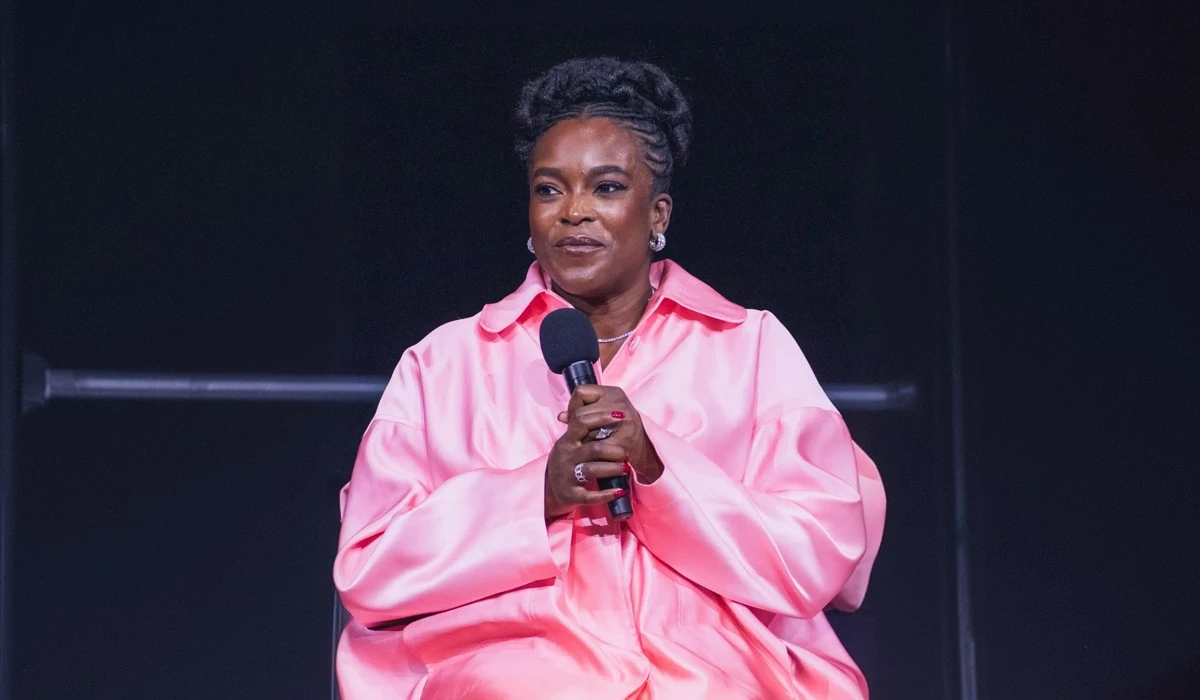
Image Credit - By Kevin Paul, CC BY 4.0, via Wikimedia Commons
A £30 Google Search Launched Wunmi Mosaku
Most people believe acting careers start with a bolt of lightning or a stroke of destiny. The reality is usually a boring afternoon and a reliable internet connection. For Wunmi Mosaku, the path to Hollywood didn't begin on a grand stage. It started with a simple Google search in a bedroom in Manchester. She loved the musical Annie, found out Albert Finney was from near her home in Salford, and clicked a link for RADA. That one click dismantled a future in economics and replaced it with red carpets. Now, as an Oscar nominee, she navigates a new conflict: how to stay famous while keeping her secrets.
The Google Search That Changed Everything
Genius often looks like a teenager trying to avoid math class. Wunmi Mosaku sat at a crossroads between a stable life and a wild gamble. According to The Guardian, she had a university spot waiting for her at Durham to study Maths and Economics. Her parents, both academics who struggled to find equivalent work after moving from Nigeria to the UK, valued security. A career in numbers offered a clear, safe path.
The internet offered a different option. Mosaku obsessed over the musical Annie daily. She wondered how a person actually became an actor. She typed "Annie cast" into the search bar. She discovered Albert Finney, a local hero from Salford, had trained at RADA. The connection sparked a realization. Acting belonged to people from her neighborhood too. She auditioned.
Her mother provided the £30 audition fee. That small sum covered the Megabus ticket and food. It was a massive gamble for a family that prioritized academic stability. Mosaku made a pact with her father. If RADA said no, she would return to the safety of economics. RADA said yes. The math degree vanished, replaced by Shakespeare and voice lessons.
Surviving the Typecasting Trap
Institutions promise to refine your talent, but they frequently try to erase your identity first. Drama school was a shock to the system. Mosaku found herself as the only black female in her year. The casting choices made by the school revealed a harsh truth about the industry. Teachers rarely saw her as the lead or the romantic interest.
She spent her training playing 50-year-old sea captains and older women. They pushed her toward "character" roles rather than "ingénue" parts. This casting strategy went beyond poor choices and became a form of psychological conditioning. It taught her to see herself on the periphery of the story.
Mosaku had to fight to keep her own spirit intact. She later realized that trying to fit in taxes the soul. She described the pressure to assimilate as a kind of cultural erasure, a genocide of the self driven by the desire to be accepted. She needed to unlearn the limitations her teachers placed on her.
Wunmi Mosaku and the Pregnancy Conflict
Success punishes you by auctioning off your private moments to the highest bidder. In January 2026, Mosaku found herself in the middle of a cultural collision. She was pregnant. According to Nigerian tradition, an expectant mother protects her news. You keep the pregnancy secret to safeguard the baby and the mother until the birth.
Hollywood operates on the opposite rule. Visibility is the currency of awards season. With an Oscar nomination for Sinners on the table, she had to be seen. She could not hide a growing bump on the red carpet. The demand for public consumption forced her hand.
How does Wunmi Mosaku handle her private life? She balances strict Nigerian traditions of privacy against the publicity requirements of her acting career.
She regained control by writing an open letter in British Vogue. In the essay, she explained that while Nigerian culture dictates protecting such news, she announced it on her own terms before the tabloids could gossip. She preempted the body shaming and the commentary. It was a strategic move. She honored the gratitude of the moment while acknowledging the reluctance to share it. She stood in the spotlight, but she set the lighting herself.
The Shadow of Damilola Taylor
Safety often depends heavily on your zip code rather than your behavior. Mosaku carries a haunting parallel in her personal history. She shares a specific narrative with Damilola Taylor. Both were born in Nigeria. Both moved to the UK at a young age. They were the same age.
The difference lay in the landing spot. Mosaku grew up in Manchester. Taylor lived in Peckham, London, where he was killed at age ten. Mosaku realized her safety had nothing to do with her actions. It was simply a matter of geography. She felt a deep survivor's guilt. She bloomed because she landed on safer soil.
This connection fueled her performance in Damilola, Our Loved Boy. As reported by Radio Times, she won a BAFTA for Best Supporting Actress in 2016 for the role. The performance served as an acknowledgment of a ghost that walked beside her. She used her art to honor the life that mirrored her own but ended too soon.

Image Credit - By IMP Awards, Fair use.Wikipedia
Reclaiming the Past Through Sinners
You cannot outrun your heritage when your job requires you to study it. For years, Mosaku's parents discouraged her from speaking Yoruba. They wanted her to have a British accent. They believed assimilation would protect her from prejudice. It was a survival strategy that worked, but it cost her a connection to her roots.
Her role in Sinners, set in 1930s Mississippi, demanded a reversal of that assimilation. She played a character named Annie—a different Annie this time. This character became a source of strength. To prepare, she told W Magazine she hired a Hoodoo consultant named Miss Yvonne to talk her through spiritual practices that linked back to West Africa.
Is Wunmi Mosaku British or Nigerian? She was born in Zaria, Nigeria, but moved to Manchester, England, when she was one year old.
The role forced her to dig up the ancestry her parents had buried. She found a new power in the Yoruba language and traditions. The "Annie" of her childhood was a movie character who got a happy ending. The "Annie" of Sinners was a woman who survived through spiritual grit. Mosaku internalized this wisdom. When fear strikes now, she asks herself what this character would do.
The Physical Cost of Great Art
The body keeps the score even when the mind tries to push through. Filming Sinners took a heavy physical toll. Mosaku started the project only seven months after giving birth to her first child. The shift was brutal.
She stopped breastfeeding to focus on the role. Her body went into oxytocin withdrawal. The sudden drop in bonding hormones left her chemically depleted. She felt raw and vulnerable. On set, the pressure to perform led to a physical injury. She sliced her thumb because she was rushing.
That moment of pain brought clarity. The character Annie would never rush. Annie moved with intention. Mosaku realized she was trying to sprint through a marathon. She slowed down. She learned that professional ambition cannot override biological reality without consequences.
Drawing the Line on Cop Roles
An actor's power lies in the word "no." For years, British casting directors saw Wunmi Mosaku as the perfect police officer. She wore the uniform in multiple shows. It was steady work, but it was a creative cage.
She decided to revolt. She told her agents she was done enforcing the law on screen. She wanted variety. She looked across the ocean to the US for better opportunities. The American industry seemed more willing to see the human rather than the badge.
What is Wunmi Mosaku best known for? Records from the Radio Times and Academy listings show she gained major recognition winning a BAFTA for Damilola, Our Loved Boy and later an Oscar nomination for Sinners.
This refusal to be typecast opened doors. It led to roles in Lovecraft Country and eventually Sinners. She is now attached to projects with heavy hitters like Aaron Sorkin and Idris Elba. By saying no to the safe, repetitive roles, she created space for the dangerous, exciting ones.
Cakes, Heels, and Real Life
High fashion rarely survives the comfort test of the real world. Despite the Oscar nomination and the Vogue spreads, Mosaku rejects the uncomfortable standards of celebrity. She detests high heels. She actively campaigns to remove them from red carpet norms. She prefers to keep her feet on the ground, literally.
Her tastes remain stubbornly regional. You can take the girl out of the North, but you can't take the bakery out of the girl. She is a Greggs enthusiast. She speaks passionately about Tottenham cake, Eccles cake, and Scouse pie. She knows where to get the best bread in Newcastle.
These details matter. They prove that the fame hasn't consumed her. She wears the couture gowns, but she misses the £2 pastries. She navigates the elite world of Hollywood without losing her appetite for the real world.
Wunmi Mosaku's Quiet Revolution
The path from Zaria to Manchester to the Academy Awards follows a specific logic. Wunmi Mosaku did not arrive here by accident. She arrived by constantly negotiating the terms of her existence. She traded a math degree for a drama school that didn't understand her. She traded the safety of silence for the visibility of an open letter.
She stands at the peak of her career, yet she refuses to let the industry own her. She keeps her heels low and her standards high. She honors the Nigerian traditions she was raised with while breaking the British casting molds that tried to contain her. The Google search gave her the map, but she walked the path on her own terms.
Recently Added
Categories
- Arts And Humanities
- Blog
- Business And Management
- Criminology
- Education
- Environment And Conservation
- Farming And Animal Care
- Geopolitics
- Lifestyle And Beauty
- Medicine And Science
- Mental Health
- Nutrition And Diet
- Religion And Spirituality
- Social Care And Health
- Sport And Fitness
- Technology
- Uncategorized
- Videos

