

Dallas Hub: “Y’all Street” Consumes Wall Street
Aasem Khalil spent his career in New York finance. So, when Goldman Sachs asked him to consider relocating to Dallas in 2016, he was baffled. To him, Dallas was a layover city, not a destination. He was wrong.
Currently, Dallas is the fastest-growing metro among 385 U.S. cities tracked from 2010 to the present. Dallas Mayor Eric Johnson recently announced he would personally lead a business delegation to New York City to promote the rise of "Y'all Street." That trip is not a publicity stunt. It is a declaration that the Dallas financial hub is a serious rival to Manhattan, and Wall Street is starting to agree.
Over the previous decade, a 40% increase in the Dallas-Fort Worth finance workforce brought the total to 386,000 workers. The dollars are moving south fast, and so are the people who manage them.
The Gravity Pulling Capital to the Dallas Financial Hub
Big institutions are not sentimental. They go where the math makes sense. Goldman Sachs is building an 800,000-square-foot campus in Dallas with a price tag between $500 million and $700 million. Upon completion, it will support more than 5,000 employees. That is not an auxiliary office. That is a commitment.
Scotiabank moved 1,000 jobs from North Carolina to Texas within the past year. The Dallas City Council endorsed the move with $2.7 million in incentives and a decade-long property tax exemption, according to NBC DFW. Exxon Mobil relocated from New Jersey to Texas within the past month. Oracle shifted its headquarters from Silicon Valley to Austin back in 2020.
This is not coincidence. Financial service firms follow their biggest clients. With major tech companies and energy giants already planted in Texas, banks and investment firms are moving south to stay close to that business.
Mike Rosa, Senior Vice President at the Dallas Regional Chamber, leads global corporate outreach for the region. He sees a full international bank headquarters landing in DFW as a realistic outcome, not a long shot. The infrastructure and talent base for that kind of footprint already exist in the middle of Texas.
Why "Y'all Street" Beats Midtown Manhattan
Texas does not ask corporations to justify their profits. New York does. Mayor Eric Johnson frames New York City's governance as a direct threat to corporate health. He points to social subsidies and tax hikes as the specific policies pushing firms out. His pitch for Dallas is simple: Texas is the opposite of that.
Why are Wall Street banks moving to Dallas? The reasons are concrete: zero corporate income tax, light regulation, fast-track business courts, and office space that costs a fraction of Manhattan prices. In the first quarter of 2025, midtown Manhattan office space averaged $83.04 per square foot. Dallas-Fort Worth averaged $22.15 per square foot. New York City has also proposed a $2.7 million property tax hike, which compounds the cost pressure on firms already squeezed by high Manhattan rents.
Dallas made its regulatory environment even more business-friendly in 2023, updating its municipal code to cut parking requirements and ease multi-family zoning rules. That kind of policy alignment matters when a company is weighing a billion-dollar real estate decision.
For executives like Aasem Khalil, the lifestyle math matters too. High incomes in New York City do not provide the same value as in Texas. The Dallas financial hub offers those same earners more space, lower taxes, and less friction day to day.
Engineering the Texas Stock Exchange
Finance is not just being hosted by Dallas; the infrastructure to run it is being built there. Texas plans to launch its own stock exchange later in the year, though trading may not begin until 2026. The Texas Stock Exchange (TXSE) has raised $161 million in capitalization, a record for any U.S. exchange applicant. According to Reuters, BlackRock, Citadel Securities, and Charles Schwab are among the major financial backers.
How is the Texas Stock Exchange different from the NYSE? The TXSE operates fully electronically and does not impose diversity mandates. It also offers relaxed listing criteria compared to existing major exchanges. Some coverage focuses on those specific regulatory differences as the draw for conservative corporate leadership. Other coverage emphasizes institutional-grade governance, Nasdaq-level compliance standards, and a strict policy of excluding shell companies.
Both descriptions point to the same thing: a new exchange built around fewer restrictions and broader access for companies that feel boxed in by current listing rules.
The region is already hosting major exchange operations. Nasdaq runs a Dallas outpost to handle Southeast corporate operations. The NYSE recently converted a former Chicago-based electronic exchange into a regional operations center in Texas.
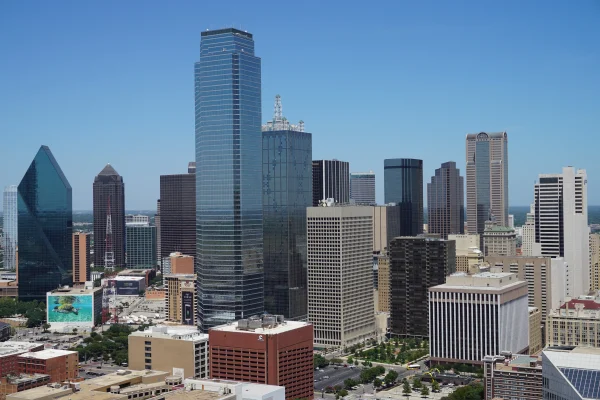
Image Credit - by Michael Barera, CC BY-SA 4.0, via Wikimedia Commons
Defending the Dallas Financial Hub Against Rivals
Dallas is not the only city pitching itself to finance executives. Charlotte, North Carolina, holds the title of the second-largest U.S. banking center. Miami has attracted major hedge funds, including Blackstone Group, Icahn Capital Management, and Citadel. Citadel cited Chicago's crime rates as a crucial factor in its decision to leave.
Dallas holds an advantage over those rivals because it operates as a full-scale command center rather than a niche destination. Texas has a labor pool of more than 15 million people. The Texas Higher Education Coordinating Board reports that the state supports 148 public and independent colleges. Texas ranks first nationally in export value by state. DFW Airport, open since 1974, gives companies direct global logistics access.
Over the past 20 years, a 111% increase has been recorded in Texas investment banking employment. That trajectory reflects a depth of financial infrastructure, not just favorable tax policy.
Bank of America is completing its Parkside Tower by the latter part of 2027. Nine floors will accommodate roughly 1,000 workers. The bank already employs 14,480 individuals in the DFW area, out of 19,000 total Texas employees.
The Brutal Squeeze on DFW Real Estate
When high earners flood a market, working-class residents pay the price. Between 2022 and 2023, the Dallas-Fort Worth Metroplex added more than 152,000 residents, pushing the total population past 8.1 million, according to NBC DFW. Between 2013 and 2023, households earning over $100,000 in the city of Dallas increased by 87,000. At the same time, households earning under $35,000 dropped by 61,000.
SMU Economist Cullum Clark identifies domestic interstate migration as the primary demographic engine. Buyers from California and New York arrive with equity built from higher-priced markets and use that advantage to outbid local buyers on premium properties. Linda McMahon, head of the Dallas Economic Development Corporation, confirms that those out-of-state buyers carry a significant market advantage over longtime residents.
The consequence is visible neighborhood by neighborhood. Custom construction through full property demolition is routine across Dallas. Starter homes come down. Premium builds go up. Local working-class families get pushed further out.
The Debt Crisis Trailing the Boom
Corporate growth at the top does not lift everyone below it. Is the cost of living increasing in Dallas? Yes, sharply. The influx of highly paid executives has driven housing prices well beyond what local workers can afford. Low-income renters in Dallas currently spend more than 50% of their income on rent.
Texas Appleseed Director Ann Baddour warns that salary purchasing power has deteriorated significantly for lower-income groups across the state. Debt accumulation has become a survival strategy for families trying to keep up. Research from Texas Appleseed reveals an 82% surge in debt collection filings in Texas between 2022 and 2025. Baddour describes those lawsuits as a leading distress indicator for the region.
A two-tier economy is forming. One tier includes the finance professionals and executives arriving from higher-cost cities. The other includes the workers who were already here, now carrying mounting debt to afford the same city they lived in before the boom.
Municipal Collisions and the Housing Crisis
Dallas is growing faster than its civic infrastructure can keep pace. Severe cost burden extends well beyond absolute poverty in the city. Since 2021, Dallas has placed 22,939 homeless individuals into housing. The larger affordability crisis is still accelerating.
Cullum Clark sees corporate expansion as a problem that carries real benefits and real costs simultaneously. High-growth cities need a structured housing strategy to avoid widespread displacement. Clark says Dallas is not ready for the volume of residents it is absorbing. The city is under-prepared.
Ann Baddour emphasizes the need for deliberate action to bridge the gap between incoming wealth and the existing workforce. The Dallas financial hub generates significant revenue. The working class absorbs the operational strain. Without intentional intervention on housing supply, low-income displacement, and transit infrastructure, that imbalance will deepen.
The Future of the Dallas Financial Hub
Zero income tax, fast-track courts, and commercial rents a quarter of Manhattan's price point have made the Dallas financial hub one of the most important financial centers in the United States. The formation of the Texas Stock Exchange, the arrival of Goldman Sachs, Bank of America, and Scotiabank, and the steady growth of "Y'all Street" have confirmed what Mayor Eric Johnson has been arguing for years.
Dallas won the competition for corporate investment. Now it faces a harder problem: managing what that victory costs the people who were already living here. Demolished starter homes, an 82% sharp increase in debt-collection lawsuits, and rent burdens above 50% of income are not side effects. They are direct consequences. The Dallas financial hub has the capital. The question now is whether the city builds the infrastructure and policy to keep the working class in the same city where that capital lands.
Recently Added
Categories
- Arts And Humanities
- Blog
- Business And Management
- Criminology
- Education
- Environment And Conservation
- Farming And Animal Care
- Geopolitics
- Lifestyle And Beauty
- Medicine And Science
- Mental Health
- Nutrition And Diet
- Religion And Spirituality
- Social Care And Health
- Sport And Fitness
- Technology
- Uncategorized
- Videos

