
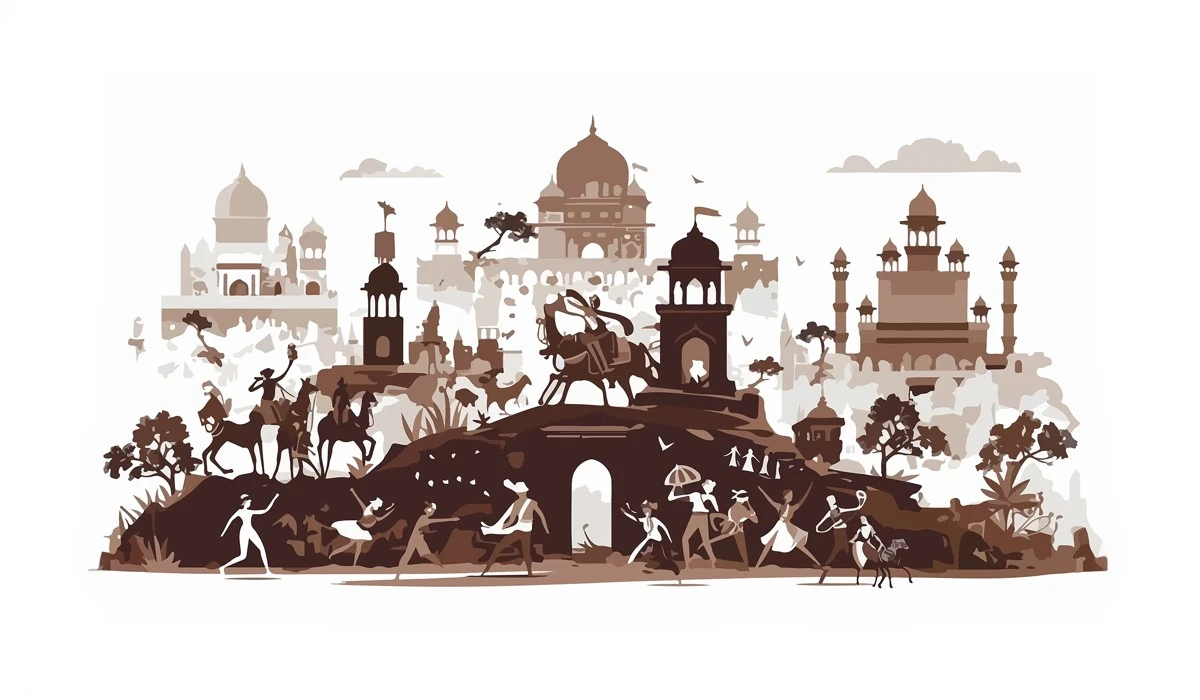
Mapping History of Modern India After 1947
On August 15, 1947, the British did not leave behind a polished, ready-to-run nation. They left a massive, fractured puzzle with hundreds of missing pieces and conflicting instructions. Leaders who spent decades in prison during the indian independence movements suddenly had to keep the lights on and the borders safe. This shift defines the History of Modern India. It represents a complete overhaul of how a billion people relate to power.
This period of postcolonial nation-building forced a diverse population to find common ground while the world watched for a collapse. The new government inherited a system designed for extraction instead of service. They had to flip the script entirely. Every decision made in those first years set the stage for the global power India eventually became.
From Resistance to Governance: The Legacy of Indian Independence Movements
The shift from protest to policy happened almost overnight. According to a report by the Constitution of India, revolutionary leaders used the Government of India Act of 1935 as a temporary legal framework because it served as the basis for governing until the new constitution was enacted. This allowed the new state to keep the lights on while they drafted a sovereign plan. They needed stability during a time of extreme chaos.
Translating Revolutionary Ideals into Policy
The values of the freedom struggle needed a permanent home in the law. Leaders moved from the streets into the offices of the new administration. They turned the principle of non-violence into the "Directive Principles of State Policy." These rules tell the government to promote social justice and local village councils.
Who was the first Prime Minister of India? As noted in a Britannica biography, Jawaharlal Nehru took office in 1947, leading the country through its initial years of transition and establishing the main institutions of the state. He focused on building a secular nation that could hold its own on the world stage.
Maintaining Unity in a Fragmented Environment
Integrating the country presented a massive hurdle. A biography in Britannica highlights that Sardar Vallabhbhai Patel worked to bring more than 560 princely states into the union. He used a legal tool called the "Instrument of Accession." This document transferred power over defense and foreign affairs to the central government.
For states like Hyderabad and Kashmir, the government used "Standstill Agreements." These kept existing services running while long-term deals were reached. This careful balancing act prevented the new nation from shattering into dozens of tiny countries.
The Constitutional Framework as a Pillar of the History of Modern India
The Constitution acted as the anchor for the new republic. It moved the people from the status of "subjects" to the status of "citizens." This change gave every individual a stake in the success of the country.
Drafting the World’s Longest Constitution
Dr. B.R. Ambedkar led the intellectual labor of the Constituent Assembly. He pushed for "Constitutional Morality," which means the government must follow the spirit of the law, not just the text. This protects the rights of small groups against the power of the majority.
The assembly chose Universal Adult Franchise under Article 326. Every person over 21 gained the right to vote immediately. Most Western countries waited decades or centuries to grant this right to everyone. This bold move made India the world’s largest democracy from day one.
Secularism and Federalism in a Diverse State
Pluralism became a structural requirement for survival. The History of Modern India relies on a federal system that shares power between the center and the states. This prevents any single group from dominating the entire country.
The "Basic Structure Doctrine" ensures that certain parts of the Constitution can never change. This includes secularism and the independence of the courts. This methodology protects the core values of the indian independence movements from erasure by future politicians.
Navigating the Early Hurdles of Postcolonial Nation Building
The 1950s tested the limits of the new union. The government had to manage millions of refugees and rebuild a damaged economy. This period of postcolonial nation-building required both physical and social engineering.
The Linguistic Reorganization of States
People wanted states that shared their language. According to Britannica, the 1956 State Reorganisation Act redrew the map of India based on these linguistic lines. Many feared this would lead to the country breaking apart.
How did India become a republic after independence? The same source explains that India officially became a republic on January 26, 1950, when its constitution came into force, finalizing the country's sovereign status. The linguistic shift actually strengthened the union because it made the government more accessible to people in their own languages.
Building the "Temples of Modern India"

The government focused on massive infrastructure projects to achieve self-reliance. They called these projects the "Temples of Modern India." This included large-scale dams like Bhakra-Nangal and the creation of the Indian Institutes of Technology (IITs).
The Nehru-Mahalanobis model guided this growth. This methodology prioritized heavy industry and "capital goods" like steel and power. The goal was to build a country that no longer needed to import basic necessities from its former colonizers.
Economic Transformations from Socialism to Liberalization
The economic story of the History of Modern India follows two distinct paths. First came decades of state control, followed by a sudden opening to the world market. Both phases shaped the current situation.
The License Raj Period
From 1951 to 1991, the state controlled almost every part of the economy. This "License-Permit-Quota Raj" required businesses to get government permission for everything. While this protected local industries, it also slowed down growth.
The government used Five-Year Plans to decide where money should go. This system helped build a strong industrial base. However, it eventually led to a lack of competition and a slow-moving bureaucracy.
The 1991 Reforms and the Globalized Economy
A major cash crisis in 1991 forced a complete change in direction. The government introduced Liberalization, Privatization, and Globalization (LPG). This ended the state's monopoly and invited foreign investment.
When did India start its economic reforms? As documented by Britannica, major economic liberalization began in 1991 under the leadership of Prime Minister P.V. Narasimha Rao and Finance Minister Manmohan Singh, moving the country toward a more market-oriented system. These reforms significantly accelerated India's GDP growth over the following decades. This shift allowed Indian companies to compete on a global scale for the first time.
Scientific Frontiers and the Green Revolution
Science became a tool for national survival. The government invested in research to solve the most pressing problems, from hunger to communication. These breakthroughs changed the daily lives of millions.
Achieving Food Security
Research published in Britannica mentions that in the 1960s, India faced the threat of widespread famine due to severe food shortages. M.S. Swaminathan led the Green Revolution to solve this. He introduced High-Yielding Variety (HYV) seeds, specifically for wheat and rice.
This methodology turned India from a food-importer to a food-exporter. The country no longer relied on foreign aid to feed its people. Shortly after, "Operation Flood" used a cooperative model to make India the world’s largest milk producer.
From Space Research to Digital Dominance
The space program began with humble roots. The Indian Space Research Organisation (ISRO) started with the launch of small rockets from a fishing village. Today, it sends missions to the Moon and Mars at a fraction of the cost of other nations.
The IT boom followed a similar path of rapid growth. High-speed internet and mobile connectivity now drive the "Digital India" period. This technological shift supports the ongoing process of postcolonial nation-building as it connects rural villages to global markets.
The Evolving Environment of the History of Modern India
India’s role in the world changed as its internal strength grew. The country moved from a position of "non-alignment" to being a key player in global decision-making.
Foreign Policy and the Non-Alignment Movement
During the Cold War, India refused to take sides between the US and the USSR. This was the Non-Aligned Movement (NAM). It allowed India to maintain its autonomy while receiving help from both sides.
The Panchsheel Agreement established five principles of peaceful coexistence, including mutual respect for borders. Today, India uses this same independence to navigate relations in the Quad and the G20. The History of Modern India shows a consistent preference for strategic autonomy.
Social Movements and the Rights-Based Approach
In the 21st century, the focus shifted toward empowering individual citizens through the law. The Right to Information (RTI) Act of 2005 gave people the power to demand transparency from the government. This moved the state away from a culture of secrecy.
Other laws, like MGNREGA, guaranteed work for rural households. These movements ensure that the benefits of growth reach the poorest people. They represent the modern evolution of the ideals found in the indian independence movements.
Strengthening Democracy through Decentralization
The government realized that a country this large cannot be run only from the capital. Real power had to move closer to the people. This led to a major change in how local towns and villages operate.
The 73rd and 74th Amendments in 1992 created a third level of government. These laws mandated regular elections for village councils (Panchayats) and city boards. They also reserved 33% of seats for women, bringing millions of new voices into leadership roles.
This decentralization helps fix local problems like water access and primary schooling. It makes the government more accountable to the people it serves. This local focus remains a vital part of postcolonial nation-building.
The Enduring Legacy of the History of Modern India
The path from 1947 to today proves that democracy can survive against the odds. The History of Modern India remains an ongoing process of refinement rather than a finished story. The country successfully integrated hundreds of regions, languages, and religions into a single working unit.
While the nation faces new challenges in the digital age, it relies on the same foundations laid during the indian independence movements. The commitment to a constitutional path and a diverse society provides the strength needed for the future. India now stands as a rising global power, proving that the gamble taken in 1947 paid off. The work of building a nation continues with every new generation.
Recently Added
Categories
- Arts And Humanities
- Blog
- Business And Management
- Criminology
- Education
- Environment And Conservation
- Farming And Animal Care
- Geopolitics
- Lifestyle And Beauty
- Medicine And Science
- Mental Health
- Nutrition And Diet
- Religion And Spirituality
- Social Care And Health
- Sport And Fitness
- Technology
- Uncategorized
- Videos

