
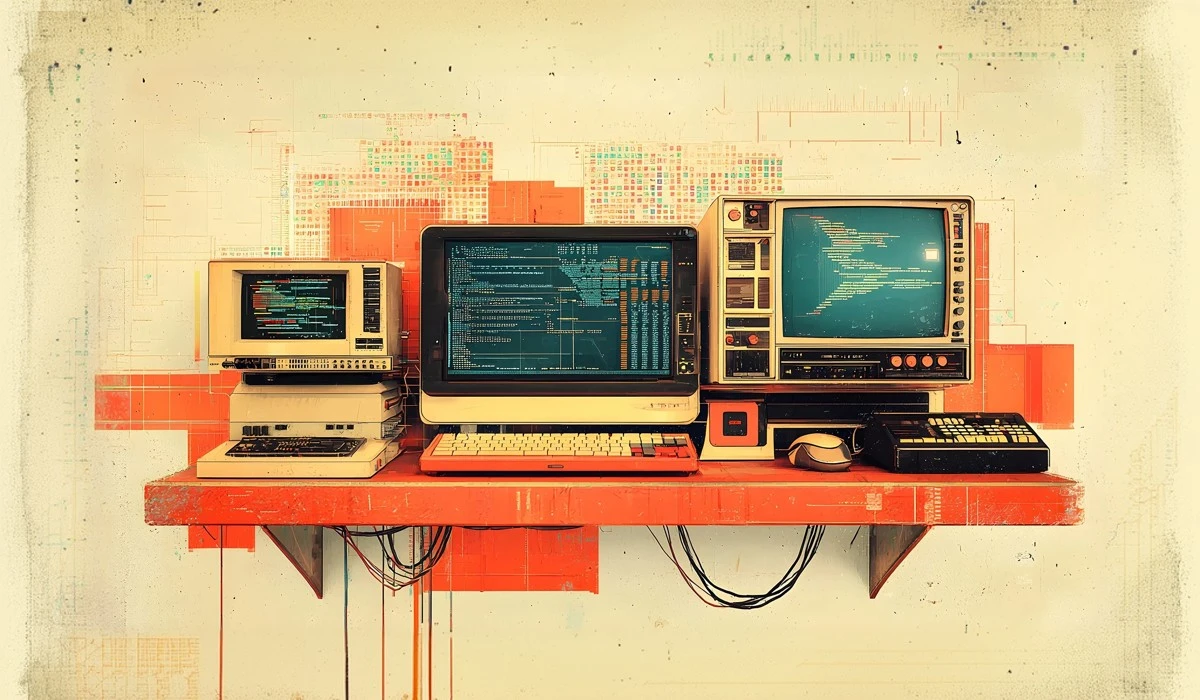
History of Modern Computing: Mainframe Foundations
You carry more processing power in your pocket than NASA used to land on the moon. Today, we touch a screen and expect an instant response. Decades ago, computing required thousands of glass tubes and massive cooling units. If one tube burned out, the whole system stopped working. Engineers spent hours hunting for the single failed component in a room full of heat. This constant battle against hardware failure shaped the History Of Modern Computing.
We often think of tech as getting smaller and faster, but it started with the challenge of keeping giant machines alive. These room-sized giants required dedicated power grids and teams of technicians just to stay operational. Understanding these massive early architectures is essential for modern developers and tech enthusiasts because it shows how we solved the biggest problems of the past. The progression from vacuum tubes to integrated circuits demonstrated how we learned to handle data at scale alongside shrinking parts.
The Genesis of Early Mainframe Systems
After World War II, the race for data began in earnest. According to Penn Today, the ENIAC weighed 30 tons, contained nearly 17,500 vacuum tubes, and required 1,800 square feet of physical space. To change its task, engineers had to rewire the entire machine by hand. It was as much physical labor as a mental one. By 1951, the UNIVAC I changed the game by introducing magnetic tape drives. These drives could read 12,800 characters per second.
What was the first mainframe computer? As noted by the U.S. Census Bureau, the UNIVAC I, which they accepted in March 1951, is widely considered the first commercial mainframe. It set the standard for handling large-scale data processing long before the History Of Modern Computing became a standard academic subject. These early mainframe systems proved that machines could handle both business tasks and ballistics calculations. This period proved that data could be stored and retrieved without using millions of paper cards.
Core Architectures in the History Of Modern Computing
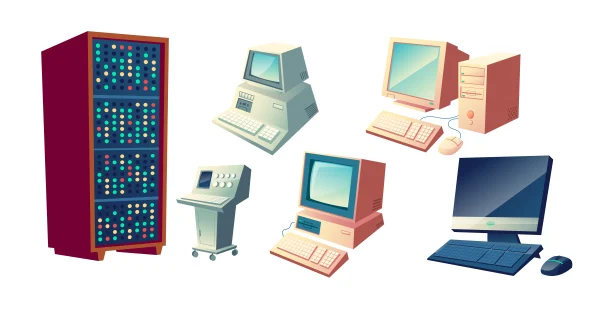
The shift from tubes to transistors changed the History Of Modern Computing. The IBM 7090 replaced glass tubes with tiny transistors in 1959. This change slashed power consumption by 90% and increased speed by six times. Transistors were much more reliable than vacuum tubes, meaning the machines could run for days without a crash.
Meanwhile, memory tech moved to magnetic cores. These were tiny ferrite rings woven with wires. Unlike modern RAM, these cores kept their data even when the power went out. Because hardware was so expensive, software had to be incredibly optimized. According to Britannica, this period established a culture of "batch processing," where it was standard practice for individuals to hand a deck of punched cards to an operator and wait hours for the machine to finish. The computer functioned as the center of the world, and everyone else worked around its schedule. This centralized model defined how businesses operated for decades.
The IBM System/360: A Major Change
According to IBM's historical archives, the company launched the System/360 in April 1964 with the goal of serving all possible types of users through one unified software-compatible architecture. Before this, every computer model had its own unique language. If a company bought a bigger machine, it had to rewrite all its software from scratch. The records indicate that IBM resolved this by introducing the instruction set architecture, replacing five existing product lines with one strictly compatible family so that the exact same code could run on a small machine or a giant one. It is a primary part of the History Of Modern Computing that mirrors how we use cloud servers today.
The source also notes that this new architecture pioneered the 8-bit byte standard that remains in use today. Earlier machines used 6-bit or 36-bit formats, which made sharing data difficult. Choosing an 8-bit standard allowed IBM to help different machines talk to each other. They also used EBCDIC encoding for characters, which stayed the mainframe standard for decades. This compatibility meant that a business could grow its hardware without losing its investment in software. It changed the industry from selling one-off machines to building long-term platforms.
Witnessing the microprocessor evolution
While mainframes ruled the office, a new shift happened on silicon chips. In 1971, the Intel 4004 squeezed the logic of a CPU onto one chip. It only had 2,300 transistors, but it proved that computers didn't need to be room-sized. How did microprocessors change computing? The microprocessor evolution allowed for the decentralization of power, moving logic from a single massive CPU to individual workstations and PCs. This shift significantly lowered the cost of entry for businesses and individual users, effectively democratizing the History Of Modern Computing.
As detailed by Electronics360, the Intel 8080 arrived in 1974, featuring an 8-bit architecture paired with a 16-bit address bus, enabling access to 64KB of memory. It was enough memory to run the first real disk operating systems, bringing advanced power to a desk. This time frame proved that smaller could be better for many tasks. Engineers focused on fitting more transistors onto every square inch of silicon. This led to a massive drop in the cost of a single calculation.
The Intersection of RISC and CISC
As chips got smaller, designers argued about how they should work. Some favored Complex Instruction Set Computing (CISC). This method tried to make each instruction do as much as possible to save expensive memory. Ironically, this made the hardware very difficult to build. According to IBM's historical records, a team of researchers led by John Cocke initiated Project 801 in 1974 to search for ways to automate processes through a different idea: Reduced Instruction Set Computing (RISC).
RISC processors use simple commands that finish in one clock cycle. This approach eventually led to the MIPS architecture. Research materials from Columbia University explain that the MIPS architecture utilized a pipeline system with five distinct stages—processing one step per stage—allowing it to work on five instructions at once, much like an assembly line in a factory. Today, most phone chips use RISC principles. This battle between highly detailed and simple designs influenced every chip in our current devices. Mainframes eventually adopted these optimized designs to keep up with the speed of smaller processors.
Input, Output, and Storage in the History Of Modern Computing
Early computers were useless without a way to feed them data. Early mainframe systems relied on stacks of punched cards and massive tape drives. In 1956, the IBM 350 introduced the first hard drive. It had 50 platters that were two feet wide, yet it only held 5MB of data. Even with its massive size, it allowed for random access to information for the first time.
Managing this data required specialized hardware. Mainframes used "channels," which were smaller processors that handled data movement while the main CPU focused on math. Documentation from IBM indicates that the company introduced virtual storage to the System/370 in 1972. Further historical records from the same company explain that fully utilizing this virtual storage enabled programmers to use more memory than might be physically available by swapping data to the disk. These storage methods are the reason the History of Modern Computing records focus so much on the "input-output" bottleneck. We still use these paging techniques in modern operating systems like Windows and Linux.
Comparing early mainframe systems to Today’s Infrastructure
People often think mainframes are museum pieces, but they still run the world's economy. A report by IBM notes that mainframes handle 87 percent of all credit card transactions and process close to $8 trillion in payments per year. Are mainframes still used today? Yes, most global financial transactions and airline reservations still run on modern versions of these systems due to their unmatched uptime and I/O capacity. Their persistence is a testament to the resilient engineering found in the History of Modern Computing.
According to an IBM press release, modern systems such as the IBM z16 use built-in artificial intelligence to process 300 billion inference requests a day with just one millisecond of latency, rapidly stopping credit card fraud. We still use early mainframe systems' logic because it handles massive data streams better than many modern web servers. These machines excel at "high-volume transaction processing." As highlighted by IBM, a single mainframe operates as a data server designed to process up to 1 trillion web transactions daily, managing thousands of concurrent users without slowing down. This capability remains a primary requirement for global banks and insurance companies.
Why Hardware Reliability Defined the Industry
Reliability was the primary goal in the History of Modern Computing. Engineers aimed for "five nines" of uptime, meaning less than five minutes of failure per year. To reach this, they created Error Correction Code (ECC) memory. ECC detects and fixes electrical errors before they crash the system. This level of protection was necessary because a single error could ruin a bank's entire database.
They also invented "hot-swapping," which lets a technician replace a CPU or memory card while the computer stays running. If a part fails, the machine simply shifts the workload to a backup component. This focus on reliability changed how we build data centers today. We even use microcode to trick modern chips into acting like 1970s hardware, ensuring old business programs never stop working. This dedication to serviceability ensures that critical systems remain online for decades.
Reflecting on the History Of Modern Computing
The progression from room-sized cabinets to tiny silicon wafers demonstrated how we learned to manage vast systems and keep them running under pressure, rather than merely representing a change in size. Those early mainframe systems established the rules for how data moves and how software stays compatible over many years. The microprocessor evolution then took those rules and put them into everyone's hands.
We often ignore the foundation beneath our modern apps, but every click depends on the engineering choices made decades ago. The History of Modern Computing continues to shape our future by reminding us that reliability and effectiveness are the true drivers of progress. As we look toward quantum computing and AI, we still rely on the lessons learned from the giants of the past. These early designs proved that with enough engineering ingenuity, we can turn a room full of glass tubes into a tool that changes the world.
Recently Added
Categories
- Arts And Humanities
- Blog
- Business And Management
- Criminology
- Education
- Environment And Conservation
- Farming And Animal Care
- Geopolitics
- Lifestyle And Beauty
- Medicine And Science
- Mental Health
- Nutrition And Diet
- Religion And Spirituality
- Social Care And Health
- Sport And Fitness
- Technology
- Uncategorized
- Videos

