
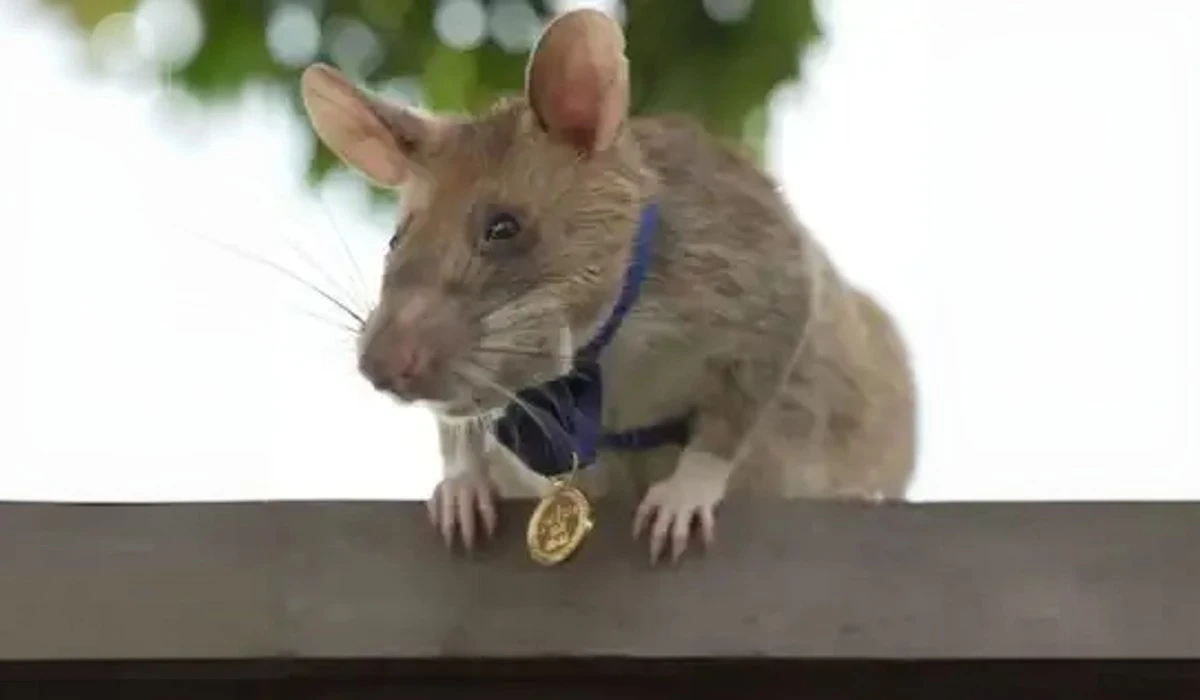
Image Credit - By APOPO, In Loving Memory of Magawa, via Wikipedia (Fair use).
Magawa the Hero Rat and His Explosive-Sniffing Legacy
Cambodia has around six million landmines planted since the 1970s. Roughly three million remain buried and undetected today. Human engineers with metal detectors can spend four days clearing a single tennis-court-sized patch of ground, flagging rusty nails and bottle caps along the way. Magawa the Hero Rat did the same job in 20 minutes, and he never dug up a single piece of scrap. He weighed just over a kilogram, walked over live explosives without setting them off, and cleared 141,000 square meters of contaminated Cambodian land over five years. When he died in 2022, he held a military medal, a stone monument, and a successor already breaking his records.
The Chemistry Over Metal Strategy
Standard metal detectors flag every rusty nail, treating harmless junk with the exact same caution as a lethal device. Mine-sniffing rats skip the scrap and go straight for the bomb. The Southern giant pouched rat has an extremely sharp olfactory system focused strictly on TNT. These animals zero in on the explosive compound itself to bypass the clutter that stalls human technicians.
How long does it take a rat to clear a landmine field? A trained rat searches an area the size of a tennis court in just 20 minutes, a task that takes a human with a metal detector up to four days. According to a report by AP News, these rats detect the TNT commonly found in landmines rather than reacting to surrounding metal. They pinpoint the exact location and alert their handlers, removing all guesswork from the process. Magawa the Hero Rat perfected this skill, allowing his team to clear massive stretches of terrain with zero false alarms. That speed completely changed the pace of post-war recovery in Cambodia.
Why He Survived Every Mission
Size creates vulnerability in most dangerous scenarios, but in a minefield, low body weight works as the ultimate shield. According to Guinness World Records, landmines require a specific amount of downward pressure to activate the firing pin. Magawa the Hero Rat weighed a fraction of that threshold. The record publication also notes that due to their small size and weight, rats scurry directly over live explosives without ever activating them.
This biological reality removed the detonation risk that constantly threatens human demining teams. During his five-year career, he found over 100 explosives. Records show his career totals included 71 landmines and 38 unexploded ordnance, though early tallies vary slightly. His lightweight frame meant he worked faster and more confidently than any human engineer. As reported by Xinhua News, these undetected explosives pose a risk to more than one million Cambodian people living on contaminated land. Sending a light animal into the brush first kept human crews out of the blast radius until it was time to safely disarm the weapon.
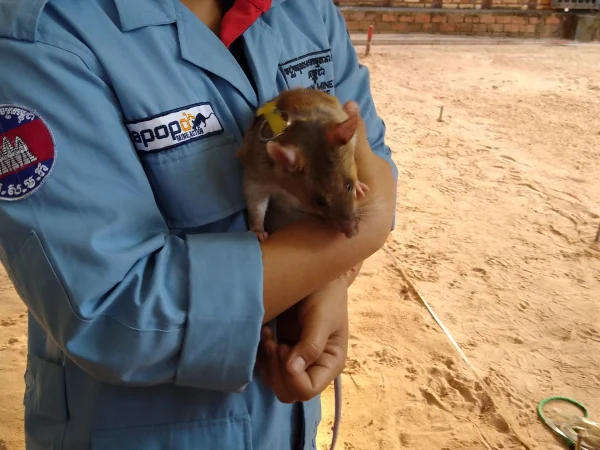
Image Credit - by Mx. Granger, CC0, via Wikimedia Commons
The Nine-Month Conditioning Process
You cannot teach an animal the concept of war, so trainers translate saving lives into a simple transaction of bananas and peanuts. The APOPO training program, started in the 1990s at Sokoine University of Agriculture in Tanzania, turns base instincts into precision tools.
What is the training process for mine-sniffing rats? Handlers use a nine-month clicker and food reward system to teach the rats to scratch at the ground when they smell TNT. When Magawa hit the mark, he heard a click and received a snack. This conditioning turns a wild animal into a reliable biological sensor. According to VNExpress, APOPO uses African giant pouched rats to detect landmines and tuberculosis, applying this same conditioning structure to identify the disease faster than lab microscopy. A study published by APOPO also shows that these animals are trained to detect illegally trafficked wildlife, disrupting smuggling operations in Tanzania even when contraband is concealed among other substances. The rigorous preparation ensures only the most accurate rodents ever step foot in an active minefield.
Reclaiming Cambodia's Lethal Soil
Decades-old wars leave a frozen threat underground, holding millions of citizens hostage on their own property. As highlighted by People magazine, Cambodia harbors around six million landmines planted since the 1970s, leaving roughly three million still undetected today. A report from Time indicates this underground crisis has killed and injured some 65,000 people, creating over 40,000 amputees and giving the country the highest per-capita casualty rate globally.
Magawa the Hero Rat entered this volatile environment in 2016. He cleared roughly 141,000 square meters of contaminated land, the equivalent of 20 football pitches, though some records cite totals up to 225,000 square meters. His careful movements exposed concealed threats and restored community confidence. Local farmers finally returned to their fields without the constant fear of stepping on a forgotten weapon.
The Medal That Changed Animal History
Military honors usually reward human courage, completely ignoring the biological assets that actually secure the terrain. In 2020, Magawa the Hero Rat broke a 77-year tradition. He became the first rat in history to receive the PDSA Gold Medal, an award previously reserved for dogs, horses, and pigeons. This recognition highlighted a major shift in how global organizations value alternative clearance methods.
The award proved that a small animal delivers a massive effect on local terrain. Before his death in 2022 at age eight, Magawa spent a short retirement mentoring 20 new recruits on a strict diet of bananas and peanuts. He set a permanent benchmark for careful progress in mine action, proving that rodents rival advanced technology in the field.
Ronin and the Next Generation of Clearance
A successful system never relies on a single exceptional performer. It requires replicable results from the next recruit in line. After Magawa stepped away from active duty in 2021, another rat named Ronin immediately took over his daily operations. By 2025, Ronin shattered previous records by finding 109 landmines and 15 unexploded items in the Preah Vihear province. This steady pipeline of trained rodents keeps Cambodia moving toward its national safety goals.
What is Cambodia's deadline to become mine-free? The country aims to clear all known minefields by the year 2030. The APOPO program ensures forward momentum never stops when an older rat ages out of the field. Each new animal picks up the scent exactly where the last one left off.
Carved in Stone: The Monument in Siem Reap
Public statues often mark the end of a conflict, missing the dangerous cleanup still happening in surrounding fields. A new stone monument in Siem Reap ensures the legacy of Magawa the Hero Rat stays visible. Unveiled on a Friday ceremonial event in time for April 4, the International Day for Mine Awareness, the statue serves a specific dual purpose. CMAA First Vice-President Ly Thuch noted the sculpture acts as a symbol of massive effect from small participants. He emphasized that their dedication and teamwork drive a national geographic change. APOPO Cambodia Programme Manager Michael Raine stated the monument stands as a global reminder about unfinished local clearance tasks. The event's primary theme, "Invest in Peace; Invest in Mine Action," pushes focus directly toward the ongoing cleanup effort.
The Path to Safe Ground
With over 80 million active undetected mines worldwide, traditional clearance methods cannot keep up with the threat. The reliance on heavy metal detectors and human engineers leaves too many communities waiting in danger. Magawa the Hero Rat proved that a biological approach cuts through the wastefulness of standard metal detection. Deploying lightweight, trained animals helps organizations reclaim land faster and more safely. Cambodia still faces millions of buried threats, but the success of Magawa and his successor Ronin offers a practical solution to a lethal problem. The path to a mine-free world depends on smelling the chemistry instead of digging for the metal.
Recently Added
Categories
- Arts And Humanities
- Blog
- Business And Management
- Criminology
- Education
- Environment And Conservation
- Farming And Animal Care
- Geopolitics
- Lifestyle And Beauty
- Medicine And Science
- Mental Health
- Nutrition And Diet
- Religion And Spirituality
- Social Care And Health
- Sport And Fitness
- Technology
- Uncategorized
- Videos

