
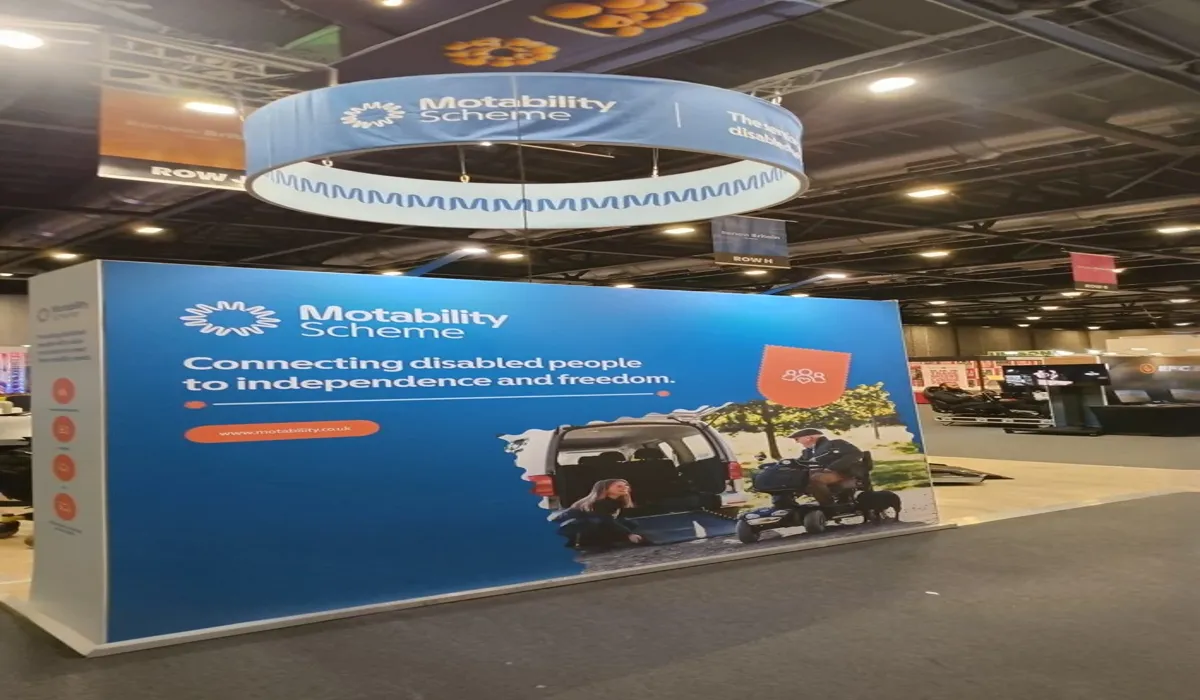
Image Credit - by Rathfelder, CC0, via Wikimedia Commons
Motability Black Box Rules: Driver Tracking
On April 13, Motability Operations rolled out a policy that turned smartphones into mandatory surveillance tools for thousands of disabled drivers under 30. New leases came with a condition: install the Drive Smart tracking app within ten days or lose the car. No exceptions.
That's the core of the Motability black box rules. A charitable scheme built around giving disabled people independence now scores their every brake, turn, and acceleration. For many users, this feels less like support and more like a leash.
The Math Driving the Motability Black Box Rules
The money problem came first. In July, a VAT requirement on vehicle leases took effect, wiping out a major tax exemption the scheme had relied on. Overnight, the program absorbed a £300 million budget shortfall. That works out to roughly £1,100 per user, on top of an average insurance premium increase of £230 heading into 2025.
Motability Foundation CEO Nigel Fletcher pointed to those numbers directly when defending the policy. The organization could not keep leases affordable while absorbing those costs without changing something structural. So, they changed who bears the monitoring burden, and they chose young drivers.
Targeting the High-Risk Group
Rather than raising prices across all 930,000 users (or 700,000, depending on the source), Motability zeroed in on the group most likely to file insurance claims. Fletcher identified drivers under 30 as statistically high-risk. By requiring telemetry for that group, the charity aimed to reduce expensive claims without penalizing older members.
The logic is straightforward from a financial standpoint. The ethical tension is just as straightforward. Young disabled drivers now carry the cost of the scheme's solvency in the form of permanent behavioral monitoring, while older members drive without any such condition.
How the Tracking Software Targets Young Drivers
As detailed on the official Motability support page, any contract involving a driver aged 30 or under now requires the Drive Smart app. After collecting the vehicle, the driver has ten days to sync the app to their smartphone. Refusing to download it triggers immediate cancellation of the lease.
The initial rollout only covered new contracts. But Motability has confirmed an April 2026 expansion: at that point, the mandatory tracking requirement will apply to all first-time enrollees, regardless of age.
The Double Standard of Surveillance
Keron Day, a scheme participant, put the frustration plainly. Non-disabled drivers who pass the same licensing exams face zero mandatory tracking. The test is identical. The standard should be the same. Day argues that requiring additional surveillance of disabled drivers implies they are less trustworthy by default, which contradicts the equal standing the program claims to offer.
Some confusion also surrounds the exact rollout timeline. The BBC reported a September pilot phase, while the Disability News Service cited an August nationwide rollout. The discrepancy hasn't been formally clarified.
The Threat of Eviction Under Motability Black Box Rules
According to Motability Scheme News, the Drive Smart app scores every trip using a green, amber, or red rating based on speed, braking, cornering, and acceleration. Drivers who earn more than four red ratings within a 12-month period lose their lease entirely.
Safe drivers, on the other hand, can earn up to £160 a year in reward vouchers. During the Northern Ireland pilot, Motability removed 300 users for poor driving scores. One case involved a driver clocked at 117mph in a 30mph zone. That's an extreme example. Most evictions are the result of accumulated lower-level infractions, not single dramatic violations.
Erasing Postcode Stereotypes
Motability has argued that individual scoring removes one longstanding injustice in insurance pricing: postcode discrimination. Instead of charging higher premiums to drivers in lower-income areas, the scheme now evaluates each person's actual driving behavior.
Spokespeople say the goal is broader program inclusion through fairer pricing. Whether that framing holds up depends on how the algorithm actually performs in practice, particularly for drivers whose equipment or geography puts them at a structural disadvantage from the start.
The Hardware Flaw Punishing Disabled Drivers
Standard software algorithms misread the physical realities of specialized disability driving equipment.
Many disabled drivers use hand levers instead of foot pedals. Those controls require faster, more responsive movements to operate safely. Scheme participant Eva Hanna has noted directly that hand levers produce quicker stops than traditional braking, simply by design.
The Drive Smart app does not account for that. It reads a quick stop as harsh braking and issues a penalty score. A driver stopping safely at a red light using hand controls gets flagged the same way a reckless driver slamming the brakes would. The Motability black box rules treat both identically.
Penalizing Necessary Modifications
The result is a system that punishes the very equipment that makes driving possible for some users. Drivers who rely on adaptive controls now face a choice: brake the way their body and equipment require, or artificially smooth out their movements to satisfy the algorithm.
Prioritizing software metrics over physical hardware realities creates unnecessary risk on public roads. A disabled driver contorting their technique to avoid a red score is not driving more safely. They're performing for an app that wasn't built with them in mind.
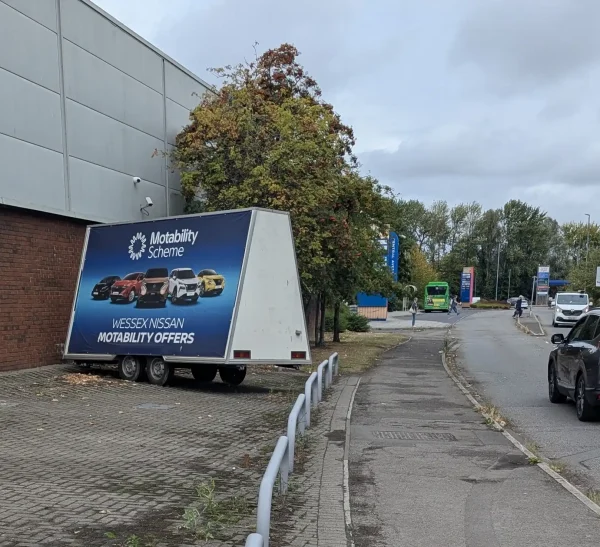
Image Credit - by Motability Scheme advert, Central Avenue, Newport by Jaggery, CC BY-SA 2.0, via Wikimedia Commons
Why Rural Commuters Face Impossible Trip Limits
Enforcing rigid driving schedules from a corporate office creates severe logistical problems for people living outside city centers.
The Motability black box rules include a one-hour uninterrupted trip limit. Drivers who exceed that without stopping receive a red score for the trip. There's also a daily cap of six trips. Can I turn off my Motability tracker? No. Disabling the app means losing the lease. Users can, however, earn up to £160 annually in safe driving vouchers.
Exceeding the daily trip cap or the one-hour limit doesn't risk the lease itself. But it does cost drivers their voucher eligibility for that period.
Navigating Minor Infractions
According to Motability's Drive Smart FAQs, the app also monitors phone usage. It measures how long a driver holds their device while the car is moving. Phone handling reduces the annual bonus but does not affect the overall safety grade or lease status.
Still, these restrictions hit rural users hardest. A countryside resident making a single trip into town for medical appointments or grocery shopping can't easily break that journey into timed segments. Urban driving standards don't translate to rural geography. Country-based disabled drivers rarely qualify for the full £160 reward because the infrastructure around them makes compliance structurally difficult.
Navigating the Confusion Over Personal Assistants
An administrative rule designed to penalize bad drivers created widespread panic about whether Personal Assistants could cost disabled passengers their vehicles.
Many severely disabled users don't drive at all. Their leased vehicles are operated entirely by Personal Assistants. Early interpretations of the policy suggested that a PA accumulating red scores could result in the disabled leaseholder losing the car.
As reported by the Disability News Service, Motability later clarified the distinction. If a Personal Assistant accumulates too many red scores under the Motability black box rules, administrators remove the assistant from the insurance policy, not the leaseholder. The disabled user keeps the vehicle and must find a new driver. Total lease termination only applies when the disabled customer personally commits the driving errors.
Securing Private Information
Users also raised concerns about government access to their location and behavior data. Motability confirmed that tracking data comes exclusively through the smartphone app. The vehicle itself carries no embedded tracker.
Motability does not share data proactively with the Department for Work and Pensions or with police. External authorities can only access historical telemetry records during active criminal investigations. Once a driver steps out of the car, the tracking stops.
The True Cost of the New Mileage Threshold
A quiet adjustment to annual mileage limits significantly increased the financial risk of regular travel.
According to the official Motability mileage changes page, the previous policy allowed 60,000 miles over a standard three-year contract, or 20,000 miles per year. The excess charge was 5p per mile. The updated policy cuts the annual allowance to 10,000 miles. What happens if I go over my Motability mileage? The new guidelines charge 25p per excess mile, five times the previous rate.
That's a significant change for active drivers. A single long-distance journey can now cost hundreds of pounds in overage fees.
The Political Pushback
Most scheme users average around 7,500 miles annually, so the standard allowance covers them. But active drivers, people who rely heavily on their vehicles for work, caregiving, or rural access, now face a much steeper financial ceiling.
Liberal Democrat MP Steve Darling has criticized both the tracking policy and the mileage changes. He argues that combining age-based surveillance with punishing financial penalties marginalizes the exact population the scheme is meant to support. Darling has described the structure as authoritarian overreach, one that charges young disabled people a premium for a default assumption of bad behavior.
The Future of Accessible Driving
The Motability black box rules were introduced to solve a genuine financial crisis. A £300 million shortfall is not a small problem, and the logic of targeting high-risk groups to control insurance costs is standard actuarial practice.
But the implementation has exposed real gaps. The Drive Smart app penalizes hand control users for using their equipment correctly. It locks rural drivers out of financial rewards through no fault of their own. It initially confused thousands of Personal Assistant users about their lease security. And it applies ongoing digital surveillance to a group of people whose primary need from this program is reliable, unmonitored access to transport.
Motability leaders argue the system maintains affordable entry points and removes postcode bias from pricing. Participants feel the weight of that differently. For thousands of disabled drivers, mandatory tracking software now sets the terms of what independence looks like.
Recently Added
Categories
- Arts And Humanities
- Blog
- Business And Management
- Criminology
- Education
- Environment And Conservation
- Farming And Animal Care
- Geopolitics
- Lifestyle And Beauty
- Medicine And Science
- Mental Health
- Nutrition And Diet
- Religion And Spirituality
- Social Care And Health
- Sport And Fitness
- Technology
- Uncategorized
- Videos