
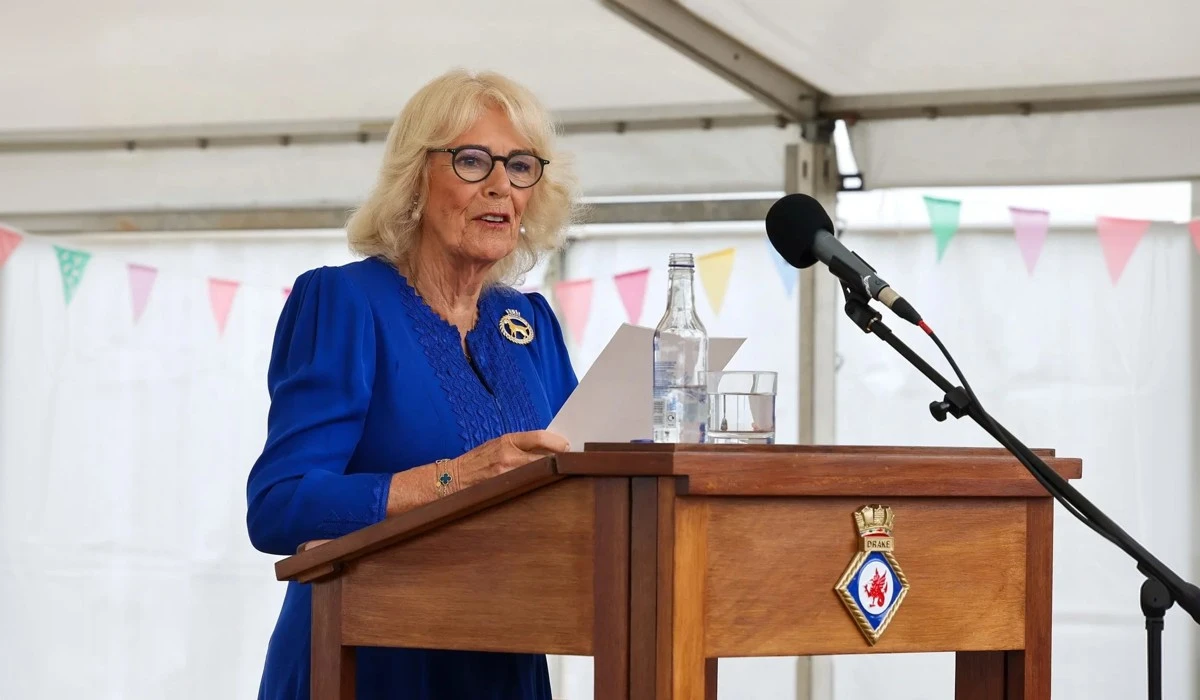
Image Credit - by Ministry of Defence (United Kingdom), OGL 3, via Wikimedia Commons
Camilla Reading Room Charity: Inside the Initiative
When a nation loses its reading habit, royal intervention functions as a public health salvage operation. According to The Queen's Reading Room official statistics, as it stands, only half of British adults read a book per year. That single statistic turns literature from a leisurely pastime into an endangered cognitive skill. The establishment responds by shifting its cultural weight. The Queen Camilla reading room initiative began as a simple charity. The project rapidly evolved into a coordinated effort to reverse a steep intellectual decline.
As noted in a letter from The Queen marking the anniversary of the book club she founded in lockdown, this project recently reached its fifth year with an aggressive expansion. The initiative pushes past polite book recommendations to tackle national mental well-being directly. A forthcoming television project investigates how text physically alters the brain. Leaders frame literary consumption as a strict medical necessity. The organizers use massive cultural influence to rebuild basic reading habits.
The Broadcast Strategy Targeting the Mind
Framing a royal hobby as a public health imperative gives cultural leaders a back door into shaping national mental health. According to Televisual, Blink Films produced a new documentary in partnership with The Open University and BBC Two, due to be screened in the autumn. Director Toby Trackman shifts focus from typical royal coverage to the literal life-altering power of literature. Trackman previously won a Royal Television Society award for his intense focus on wartime trauma in The Last Musician of Auschwitz.
What is the BBC documentary about Queen Camilla? The film investigates how reading structurally enhances mental wellbeing and traces the royal family's childhood literary roots. Suzy Klein, representing the BBC production team, points to clear scientific data linking book clubs and text engagement to clinical depression recovery. As reported by Radio Times, the documentary explores overcoming deep depression through the connection of a local book club, while showing how prison inmates find solace in pages. Literature gives individuals fresh worldly perspectives and potential life changes. Klein highlights the immense delight in having a royal figure champion this celebratory project.
Scientific Connections to Mental Health
Aspiration motivates all generations toward literature. The Queen Camilla reading room mission seeks to disseminate a lifelong belief in an enhanced existence through books. The initiative proves that text reshapes the human brain. Medical professionals increasingly prescribe reading as a direct intervention for psychological distress.
The documentary provides concrete evidence of this recovery process. Viewers see how isolated individuals rebuild their cognitive function through sustained reading habits. The charity forces the public to view reading as daily mental exercise. Skipping a book damages the mind as much as skipping physical exercise damages the body.
A Prisoner of War Survives Through Text
Historical extreme stress proves that literature acts as psychological armor long before it serves as entertainment. The upcoming broadcast explores the historical survival of Major Bruce Shand. According to The Independent, Major Bruce Shand served in the World War-II as a 12th Lancer, fought along with the Desert Rats, received the Military Cross twice, and was wounded and taken prisoner while fighting in North Africa. Inside a German prisoner of war camp, texts provided critical mental fortitude.
Reading offered a structural defense against psychological collapse. The Queen Camilla reading room charity uses this family history as foundational proof of literature's utility. Books build alternate realities when the physical world becomes unsurvivable. The Queen attributes her devouring of texts to her father. He served as her ultimate childhood storytime reader and material selector.
The Desert Rat in North Africa
Authors act as dangerous individuals. They expose raw truth while highlighting human abilities and limitations. Highlighting these historical narratives allows the charity to prove that reading guarantees survival under the harshest conditions. Literature trains the mind to endure suffering.
Major Shand’s experience in the North African desert required immense physical endurance. Surviving the isolation of an inmate of war camp demanded a completely different skill set. Books kept his mind sharp while his physical freedom vanished. The charity highlights this extreme scenario to shame modern audiences into picking up a book. If a prisoner finds time to read, a modern professional has zero excuses.
Expanding the Queen Camilla Reading Room Reach
Transforming a book club into an intervention network allows a cultural project to infiltrate domestic crises. The Queen Camilla reading room recently celebrated its fifth anniversary at a Clarence House literary reception. This project evolved rapidly from a basic literary charity into a sprawling festival. Massive book donation drives now partner directly with organizations mitigating domestic violence and supporting homelessness.
The charity acts as a barrier-free community builder. Authors function as guides on magical expeditions and facilitators of alternate perspectives. Kate Middleton also connects to this broad literacy push. She recently donated 50 copies of The Owl Who Was Afraid of the Dark to the Sebby’s Corner baby bank. The Princess previously appeared on CBeebies Bedtime Stories to reinforce early childhood reading habits.
The Clarence House Reception Attendees
The King mingled with high-profile attendees to secure maximum visibility for the charity. Richard Osman, Sigourney Weaver, Lee Child, and Stanley Tucci dominated the guest list. Authors like Jojo Moyes, Sir Ben Okri, and Jeffrey Archer shared space with actors like Sir Derek Jacobi and Celia Imrie. Vice Admiral Sir Tim Laurence also joined the gathering.
Yet the core focus remained on expanding access over securing celebrity endorsements. The star power simply acts as bait to draw public attention toward the basic literacy crisis. These celebrities use their massive audiences to push a pro-reading agenda. Their attendance guarantees press coverage for the charity's unglamorous daily efforts.
Recognizing Grassroots Literacy Builders
Elevating unfunded literacy champions creates an immediate pipeline for diverse literary voices to reach national prominence. The anniversary event featured the charity's inaugural medal presentations. The organization recognized two women for their specific literacy efforts. Selina Brown founded the Black British Book Festival in 2021 using her personal savings. She lacked prior industry experience but built a platform reaching over 100,000 people.
Her "Reading for Smiles" program aggressively advances Black British literature. She created a firm platform for authors to celebrate their talent. Who won the Queen's Reading Room medals? According to the charity's website, Her Majesty presented National and Local Reading Hero medals to Selina Brown and Liz Waterland, honoring their exceptional grassroots work in expanding book access. Both winners demonstrate how ground-level access transforms local reading habits.
Funding the Black British Book Festival
Liz Waterland received her medal for dedicated literature services in the Lincolnshire community. The Queen Camilla reading room deliberately honors people creating tangible results over those simply talking about books. Real change happens through aggressive community outreach.
Selina Brown’s massive reach proves that traditional publishing gatekeepers miss huge segments of the population. Honoring her lets the royal charity bypass traditional literary snobbery. The organization rewards direct action and personal financial risk. Brown funded her festival without safety nets. This level of dedication shames larger institutions failing to reach diverse audiences.

Conflicting Truths in Modern Reading Rates
A massive public celebration of literature masks the statistical reality of a population actively abandoning the written word. The Clarence House reception showcased extreme enthusiasm for books. Stark data reveals a harsh truth. Half of UK adults manage only one book annually. Actor Sigourney Weaver highlighted this tension during the event. She noted the US literacy crisis outpaces the UK decline.
Weaver stressed that an absence of adults in childhood reading routines drives this drop. She argued for the superiority of active imagination over passive digital video consumption. Weaver takes royal literature encouragement as a personal directive. She deeply enjoys reading The Far Pavilions on her Kindle following a royal recommendation.
America’s Steep Literacy Decline
The contrast between the glittering Clarence House reception and the grim public statistics creates immense friction. Cultural elites celebrate literature while the general public abandons it. Weaver’s commentary points to a transatlantic failure in parenting. Adults fail to model reading behaviors, leaving children reliant on screens.
The American data looks even worse than the British statistics. Weaver views the royal initiative as a necessary pushback against digital rot. Reading demands active mental participation. Video consumption requires zero cognitive effort. The charity fights a war against intellectual laziness.
The Unlikely Limits of the Queen Camilla Reading Room Founder
High literary enthusiasm completely fails to guarantee the performative skills required to capture a child’s attention. The royal grandmother selects Harry Potter as her top literary choice for her grandchildren. She reads to Tom Parker Bowles' children, Lola and Frederick, and Laura Lopes' children, Eliza, Gus, and Louis. She also reads to her royal step-grandchildren: George, Charlotte, Louis, Archie, and Lilibet.
Does Queen Camilla read to her grandchildren? Yes, she frequently reads to her grandchildren, though she openly admits she lacks the vocal mimicry skills to perform different character voices. King Charles possesses brilliant vocal mimicry skills, stepping in to perform the dialogue effectively. Queen Camilla attributes her poor performance to a lack of a school acting background.
The Podcast Audio Solution
She instead focuses on being a supreme consumer of texts. She devours material while leaving the theatrical voices to her husband. This division of labor keeps the children engaged while demonstrating different ways to appreciate a story. Reading aloud requires distinct theatrical abilities.
The Queen Camilla reading room podcast initiative bridges this performance gap for the general public. Podcast Republic listings indicate that podcast guests like Sir Ian Rankin, Dame Joanna Lumley, Peter James, and David Baddiel provide accessible entry points into deeper reading habits. Audio formats capture audiences who refuse to pick up physical books. The podcast demystifies the writing process and turns authors into conversational companions.
Translating Historical Trauma for New Minds
Archiving century-old wartime trauma into middle-grade fiction forces a new generation to process the physical cost of freedom. The literary focus extends beyond adult reading habits into youth comprehension of historical sacrifice. Victoria Panton Bacon recently authored Their Second World War, targeting children aged 8 to 14. The book features 100-year-old survivor Ivor Foster.
Foster details a 1945 RAF Lancaster raid over Essen involving 1,079 aircraft. The massive volume of planes completely obscured the ground. Crews relied entirely on radar during the grueling 5.5-hour operation. Queen Camilla views this type of resource as essential for generational remembrance. Young minds need direct access to these historical accounts.
The Brutal Reality of the Essen Raid
The Queen Camilla reading room emphasizes that literature serves as a vital bridge between past sacrifice and future understanding. Historical texts force young readers to confront uncomfortable realities. The sheer density of the aircraft during the Essen raid created extreme mid-air danger.
Bacon’s book distills this terror into language children understand. Foster’s firsthand account removes the romanticism from warfare. Literature locks these memories into the cultural record before the last survivors pass away. The charity demands that children understand the price paid for their current freedom. Reading prevents societal amnesia.
The True Cost of Losing Our Literacy
A society abandoning books quietly forfeits its ability to survive mental adversity. The statistics paint a grim picture of declining reading habits across the UK and the US. Aggressive interventions push back against this decline. Mapping the neurological advantages of reading and highlighting historical tales of survival allows cultural leaders to demand a return to the written word.
The Queen Camilla reading room strips away the elitism often associated with literature. Books provide armor against despair, tools for processing trauma, and avenues for understanding alternate realities. Promoting grassroots literacy builders ensures these tools reach the most vulnerable populations. A book functions as a survival toolkit for the modern mind. Society must protect the habit of reading to maintain its psychological resilience.
Recently Added
Categories
- Arts And Humanities
- Blog
- Business And Management
- Criminology
- Education
- Environment And Conservation
- Farming And Animal Care
- Geopolitics
- Lifestyle And Beauty
- Medicine And Science
- Mental Health
- Nutrition And Diet
- Religion And Spirituality
- Social Care And Health
- Sport And Fitness
- Technology
- Uncategorized
- Videos

