

Theraplay: Using Joy To Heal Childhood Trauma
According to the National Center for Biotechnology Information (NCBI), a child who pushes love away may act like a cornered animal. If you offer a warm meal or a soft blanket, they might respond with a scream or a cold stare because they have difficulty accepting physical or emotional closeness. The NCBI reports that this occurs because their nervous system labels closeness as a danger zone, often causing them to live in a "fight, flight, or freeze" state. Parents often try to explain love with logic, but the child’s emotional center stays closed.
The Theraplay Institute explains that this method changes the interaction pattern; it skips lectures and goes straight to physical connection. This playful child therapy uses simple, guided interactions to tell the brain that it is finally safe. The Institute further notes that through attachment-based play, an adult provides nurturing care that allows them to stop being a threat and start being a source of comfort. This process changes how the child views the world and their place in your family.
Understanding the Effects of Theraplay on Reactive Attachment
The NCBI reports that reactive attachment stems from a survival instinct that never turned off, often caused by early social neglect or maltreatment. Children who experienced such trauma learned that adults cannot be trusted, leading their brains to prioritize self-protection over bonding. Theraplay avoids the language centers of the brain to reach the deeper emotional layers where these fears live.
The Role of the Right Brain in Connection
Research published by the Parent Infant Foundation states that the right hemisphere of the brain, which handles emotions, non-verbal cues, and social bonding, is the first to develop in infants. When a child experiences trauma, this side of the brain becomes hyper-sensitive to perceived threats. Traditional talk therapy often fails because it targets the left brain, which handles logic and facts.
In contrast, a study in PubMed Central (PMC) notes that attachment-based play focuses on the "here and now," utilizing eye contact, rhythm, and touch to communicate safety through rapid right-brain-to-right-brain communication. This method allows the child to experience security without needing to find the right words.
Rebuilding the Internal Working Model
Every child carries an "internal working model," which acts as a mental map of relationships. For a child with attachment issues, this map says that adults are unreliable or dangerous. Consistent, joyful interactions slowly redraw this map.
How does Theraplay help with RAD? According to The Theraplay Institute, the method addresses the core sensory and emotional deficits of Reactive Attachment Disorder. When parents establish safety and joyful interaction, they help replace fear-based reactions with a sense of security. Repetition of these safe experiences allows the child to begin seeing themselves as someone worth caring for.
The Four Pillars of Attachment-Based Play in Theraplay
Dr. Ann Jernberg and Phyllis Booth developed this model in the 1960s based on how healthy parents naturally interact with their infants. As noted by The Theraplay Institute, they identified four specific dimensions that build a secure bond: Structure, Engagement, Nurture, and Challenge.
Establishing Safety through Structure
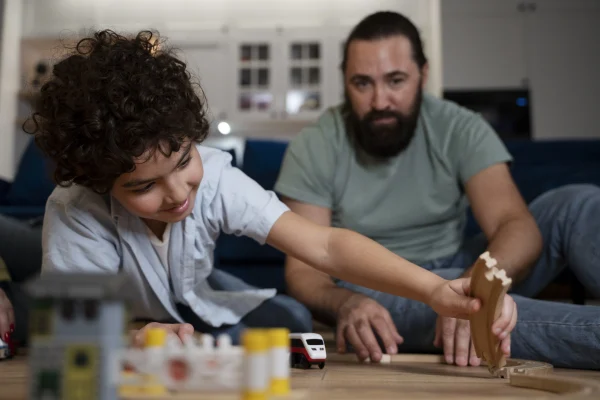
The NCBI notes that children with attachment trauma often have a strong desire to control every situation because they feel that losing control leads to being hurt. Structure in playful child therapy means the adult remains the leader of the session. The Theraplay Institute explains that when the parent sets the rules and directs the games, it creates predictability that lowers the child's anxiety.
When the adult provides clear boundaries, the child can finally relax. They no longer have to scan the room for danger or manage the environment. The Theraplay Institute highlights that this "felt safety" is the essential basis of all future progress.
Promoting Co-Regulation through Nurture
Nurture meets the child’s unmet developmental needs from their early years. Many children with reactive attachment missed out on basic soothing as infants. Nurturing activities involve gentle touch, like applying lotion or feeding the child a snack.
These actions stimulate the vagus nerve and reduce cortisol levels. You are teaching the child’s body how to move from a "fight or flight" state into a "social engagement" state. Over time, the child learns to use the parent's calm energy to regulate their own emotions.
Essential Theraplay Games to Break Through Resistance
Using the right games helps break through the defensive walls a child builds. These activities require no expensive toys or complicated setups. You only need yourself and a few household items.
Sensory-Rich Engagement Activities
Engagement games focus on being "in sync" with the child. "Cotton Ball Blow" is a classic example. You and the child sit across from each other and blow a cotton ball back and forth. This requires intense eye contact and shared focus.
Another effective game is simple hand-clapping. You mirror each other’s movements in a rhythmic pattern. These games build intersubjectivity, which is the state where both people feel the same positive emotion at once. This creates a strong bonding loop in the brain.
Nurturing Games for High-Stress Moments
"The Check-Up" is a game where you "examine" the child with great care. You might count their fingers, measure the height of their ears, or look for freckles. This reinforces that the child is unique and the center of your attention.
What age is Theraplay for? The Theraplay Institute states that while it was originally designed for young children, the principles have been successfully adapted for toddlers, school-aged children, and even teenagers with developmental trauma. Even a teenager can benefit from a "burrito" game, where you roll them snugly in a blanket to provide calming deep-pressure input.
Navigating the Challenges of Playful Child Therapy
Starting these games can feel awkward at first. You might feel "stuffy" or forced when you try to be silly. Ironically, the child often senses this hesitation and pushes back even harder.
Managing Overstimulation and Meltdowns
Children with sensory processing issues can become "flooded" by too much eye contact or touch. If a child starts to glaze over or becomes aggressive, you must scale back the intensity. Slow down the movements and lower your voice.
Watch for the child's "window of tolerance." If the game becomes too much, shift to a quieter, nurturing activity. The goal is to keep the child in a state of calm alert, not to overwhelm them with excitement.
Staying Consistent During the 'Testing' Phase
When a child starts to feel a real connection, they often sabotage the fun. Intimacy feels threatening to their survival instincts, so they increase the intensity of bad behavior. They are testing to see if you will stay in charge and remain loving even when they are difficult.
Consistency is your strongest tool. If you give up when they push back, you confirm their belief that adults are unreliable. Stay calm, maintain the structure, and return to the play as soon as the child is ready.
Creating a Home Environment for Successful Theraplay
You do not need a clinical office to see results. You can integrate Theraplay into your daily routine at home. Success depends more on your presence and focus than on your surroundings.
The 'Theraplay Bag' Essentials
Keep a small bag of supplies ready for spontaneous attachment-based play. Fill it with simple items like cotton balls, feathers, lotion, bubbles, and a soft blanket. These tools allow you to change into a game whenever you see the child becoming dysregulated.
Bubbles are excellent for "Challenge" games, where the child has to pop them with a specific finger. Feathers are perfect for "Engagement," as you can take turns blowing them at each other. Keeping these items ready prevents the stall that halts the momentum of play.
Routine and Timing for Maximum Influence
Timing matters more than duration. You do not need an hour of play to change a child’s brain. In reality, 10 to 15 minutes of "Special Time" each day is far more effective.
Short, frequent doses of playful child therapy build the neural pathways faster than long, infrequent sessions. Schedule this time when you are least likely to be interrupted. Turn off your phone and commit entirely to the child. This dedicated focus tells the child they are the most important person in the room.
Measuring Progress with Theraplay and Playful Child Therapy
Healing reactive attachment is a slow process. You might not see big changes overnight, but small shifts indicate that the attachment-based play is working.
Identifying Shifts in Eye Contact and Touch
Initially, a child might look away or pull their hand back when you touch them. Over time, you will notice "social referencing." This is when the child begins to look at you for guidance or emotional cues during a new situation.
Watch for relaxed eye contact. Instead of a quick glance, the child might hold your gaze for a few seconds longer. They may also start to lean into you during a nurturing game rather than pulling away. These are major milestones in neuroplasticity.
Observing Behavioral Changes Outside of Play
The benefits of Theraplay eventually spill over into daily life. How long does it take for Theraplay to work? While some families notice an immediate "softening" in their child, deep-seated attachment healing typically requires consistent practice over several months to truly change the child's sense of security.
You might notice fewer power struggles at the dinner table. Perhaps the child handles a change at school without a meltdown. These improvements happen because the child’s brain is no longer stuck in a permanent state of alarm. They are learning to trust the structure you provide.
Integrating Theraplay into Your Long-Term Parenting Strategy
Theraplay is a mindset, not simply a collection of games. You can use its principles to handle almost any parenting challenge.
Using Play to De-escalate Conflict
When you sense a tantrum coming, try to use an "Engagement" or "Nurture" technique. If a child is refusing to put on their shoes, turn it into a game of "The Check-Up" on their toes. This shifts the child from a defiant state to a playful one.
Choosing play instead of punishment prevents the child’s survival brain from taking over. You remain the calm leader they need. This doesn't mean you ignore the behavior, but you address the basic dysregulation first.
Sustaining the Bond as the Child Grows
As your child gets older, the games will change, but the pillars remain the same. The Theraplay Institute explains that a strong attachment between a child and the adults in their life is the essential basis for lifelong mental health and resilience. A teenager might not want to play "Slippery Slippery Soda," but they might enjoy a "Challenge" game like a thumb-wrestling tournament or a complex handshake.
The goal is to maintain the connection. Keep looking for ways to provide structure and nurture as they navigate the challenges of adolescence. Secure attachment helps them build healthy relationships of their own in the future.
Reclaiming the Joy of Parenting with Theraplay
Healing a child with reactive attachment feels like a marathon. There will be days when the progress seems to stall, and the old behaviors return. However, every minute of attachment-based play adds a new layer of trust to your relationship. You are not just playing games; you are physically changing the way your child’s brain functions.
The Theraplay Institute highlights that when parents provide structure, engagement, nurture, and challenge, they provide their child with the tools to feel safe in a world that often lacks predictability. You move from being a caregiver they tolerate to a parent they truly trust. The struggle is real, but so is the hope. With consistency and a little bit of play, you can cross the finish line together and build a bond that lasts a lifetime through Theraplay.
Recently Added
Categories
- Arts And Humanities
- Blog
- Business And Management
- Criminology
- Education
- Environment And Conservation
- Farming And Animal Care
- Geopolitics
- Lifestyle And Beauty
- Medicine And Science
- Mental Health
- Nutrition And Diet
- Religion And Spirituality
- Social Care And Health
- Sport And Fitness
- Technology
- Uncategorized
- Videos