
Artemis: The Massive Cost Of Returning Home
Sending humans to another world rarely fails because of grand cosmic forces. The real breaking point hides inside the mundane plumbing connecting fuel tanks to metal tubes. Every ambitious space project eventually crashes into basic fluid dynamics.
When engineers push massive volumes of super-chilled liquid through miles of piping, the extreme cold physically shrinks the metal. This thermal reaction opens tiny gaps that simply did not exist at room temperature. As reported by Reuters, during a wet dress rehearsal, liquid hydrogen began leaking through the tiny fittings of a large hose pumping fuel into the rocket, proving the Artemis II mission lives and dies by this basic physical reality.
A single seal cools, contracts, and lets the most volatile element in the universe slip through the cracks. This simple thermal reaction dictates whether astronauts leave the atmosphere or sit indefinitely grounded on the launchpad.
People treat space exploration as a triumph of high technology. The public ignores the reality that a rocket functions as a highly explosive pressure cooker demanding absolute perfection from everyday O-rings and valves. We look at the stars. We wait on the pipes.
The Financial Weight of the Artemis II Mission
The fastest way to drain a national budget comes from fixing things that worked perfectly on paper but fail unpredictably in reality.
Every time engineers pull a rocket back to the assembly building, the final receipt grows by millions. NASA accumulates astronomical bills precisely because gravity leaves no margin for trial and error. The space agency spent billions before anyone ever pressed an ignition switch.
Between 2006 and 2022, the broader program accumulated a massive $49.9 billion total cost. The Space Launch System rocket itself consumed $23.8 billion following its program inception in 2011. Meanwhile, the Orion capsule required another $20.4 billion over a ten-year span.
These numbers add up to a staggering reality. How much does the Artemis II mission cost? The total program development approaches fifty billion dollars, with each individual launch draining roughly four billion dollars from the agency budget. Financial critics constantly attack these massive figures.
Justifying the Astronomical Expense
Despite the price tag, mission directors like NASA Administrator Jared Isaacman—whose leadership role is noted in NASA policy updates and whose confirmation was reported by Reuters—refuse to let financial pressure rush the timeline. He explicitly shifted the launch targets to ensure maximum success probability preparation.
Isaacman demands absolute workforce security and public wellbeing. He views total readiness as a strict prerequisite for historic mission initiation. Space historian Jordan Bimm echoes this exact sentiment. He actively warns teams to avoid the sunk cost fallacy. Engineers must ignore the spent money and prioritize risk minimization. Running an experimental deep-space vehicle demands absolute perfection.
Liquid Hydrogen Dictates the Launch Window
Controlling the coldest fuel on earth forces engineers to fight an endless war against microscopic leaks that only appear right before ignition.
Liquid hydrogen sits at the core of the SLS rocket power system. It offers incredible thrust. It also creates a logistical nightmare. The molecules exist at such a tiny scale that they find escape routes through nearly solid seals.
Ground crews must load two million liters of super-cooled hydrogen and 750,000 liters of oxygen into the rocket stages. The team freezes these gases into a liquid state to pack maximum energy into the tanks. Technicians regularly manage a 700,000-gallon practice loading and removal volume to verify the plumbing integrity. The loading process itself serves as a critical test.
The Wet Dress Rehearsal Flaws
During a recent wet dress rehearsal initiation, sensors detected an alarming issue. The cold fluid warped the metal connections. This warping caused a severe liquid hydrogen leak near the tail service mast umbilical interface. NASA immediately ordered a curtailment of the practice run.
This single leak forced a massive schedule shift. Launch controllers initially targeted a February 6 original target date. A sudden Florida cold spell caused a two-day pushback. The leak issue then forced a secondary target launch date postponement on February 8.
Project managers present conflicting recovery timelines. According to a NASA blog post reassessing the rollout, official statements target an April 1 through 6 launch window, holding an alternative April 30 slot in reserve. Conversely, separate internal agency updates label March 6 as the earliest possible opportunity following a planned February 19 second rehearsal. Why does NASA use liquid hydrogen if it leaks so easily? Liquid hydrogen provides the highest specific impulse of any known chemical fuel, giving the rocket the necessary raw power to push heavy payloads out of Earth's orbit. The sheer energy density makes these agonizing schedule disputes totally worthwhile.
Defining the Deep Space Crew Protocol
Picking the right astronauts requires balancing intense media optics with the stark reality that human bodies break down rapidly outside Earth's magnetic shield.
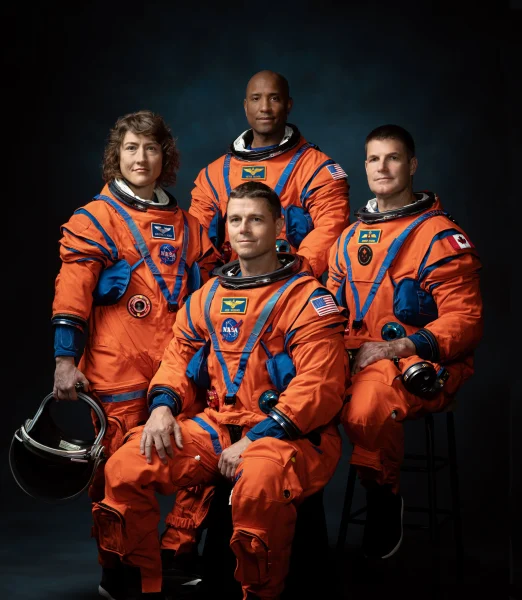
The space agency selected four specific individuals to test these biological limits. According to NASA's official crew roster, Commander Reid Wiseman leads the flight. The report notes Victor Glover pilots the capsule, stepping up as the first person of color to leave low Earth orbit. The same roster confirms Christina Koch joins as a mission specialist and the first woman assigned to a deep-space trajectory.
As detailed by the agency, Jeremy Hansen rounds out the primary roster. He flies as the first non-US citizen on a lunar voyage. The agency also assigned Jenni Gibbons and Andre Douglas as the official backup crew. No human has traveled this deep into space since the final Apollo program flight in December 1972.
The Fourteen-Day Medical Lockup
The agency demands extreme isolation before anyone boards the rocket. All members must enter a strict 14-day pre-launch health stabilization protocol. This quarantine duration guarantees no one carries a common cold into the confined Orion capsule.
Sickness in deep space creates an immediate, unsolvable emergency. Microbes mutate differently in zero gravity. The crew cannot risk introducing aggressive bacteria into the cabin environment. They complete their quarantine reentry procedures long before stepping foot near the launchpad.
Their entire flight lasts just 10 days. During that tight window, they must execute flawless manual piloting tests in high Earth orbit. Once they finish orbital maneuvers, they transfer control to Houston. The crew then braces for a rapid four-day moon circuit.
Navigating the Artemis II Mission Flight Path
Charting a path beyond the moon relies on slingshotting a heavy capsule using gravitational pulls that tolerate zero navigational errors.
The primary flight plan features a daring trajectory. According to the NASA Artemis II press kit, the capsule will fly roughly 4,600 miles past the moon's far side. Some orbital models suggest the distance stretches closer to 5,000 miles. The exact apogee depends entirely on the precise insertion angle the engines achieve as they approach lunar orbit.
This deep-space vantage point isolates the crew entirely from normal communication relays. They rely heavily on the new Orion Artemis II Optical Communications System. This laser-based setup beams data back to ground stations in California and New Mexico.
High-Speed Data and Biological Testing
The hardware achieves a staggering 260 megabytes per second downlink speed. High-speed communication completely transforms deep-space operations. Ground controllers receive high-definition video instantly, eliminating the historic lag times of previous lunar flights.
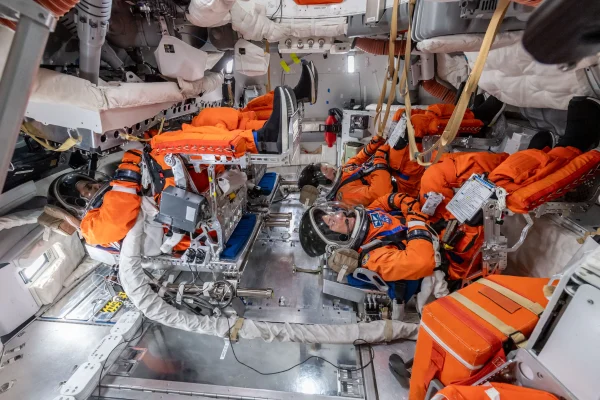
Along for the ride, several international payloads crowd the tight interior. The AVATAR organ analog and ARCHAR health monitors track radiation effects on biological tissue. Five different international CubeSats ride along inside the massive vehicle.
These mini-satellites include TACHELES, ATENEA, K-RadCube, Space Weather CubeSat-1, and the Avionics Unit. They conduct independent space weather research. Every inch of cargo space serves a dual scientific purpose.
Unleashing the Space Launch System
Lifting a fully loaded spacecraft off the ground requires directing consecutive, controlled explosions powerful enough to vaporize the launchpad itself.
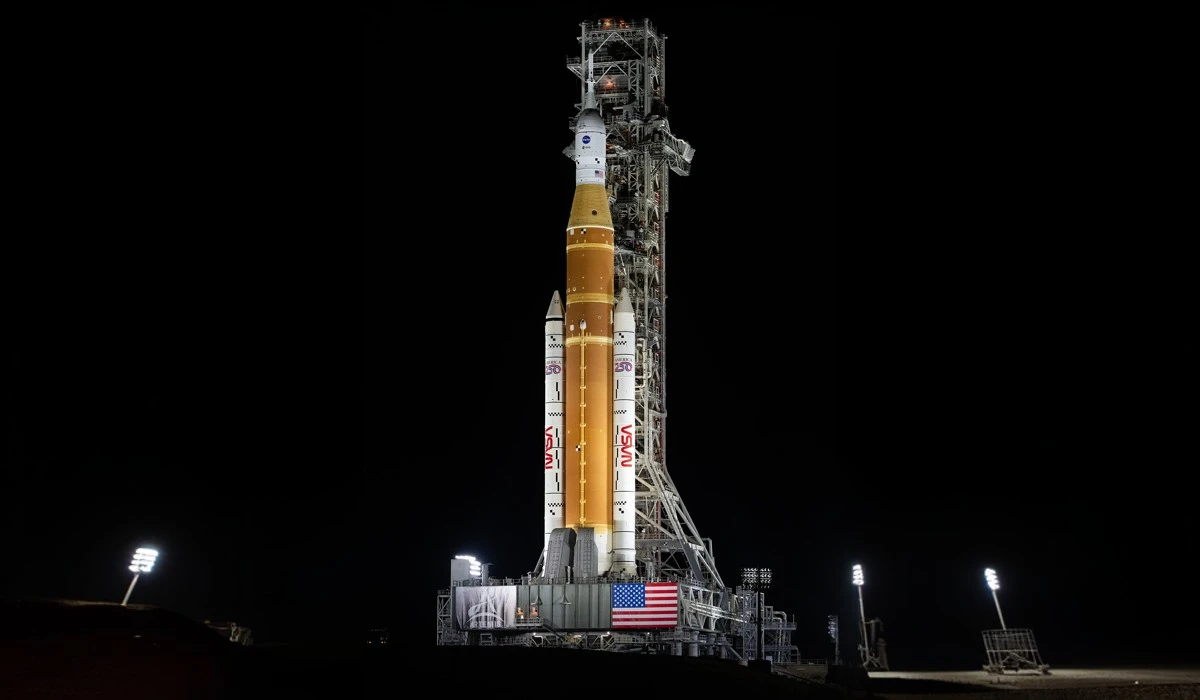
The Space Launch System stands 98 meters tall. This massive structure easily dwarfs iconic landmarks like Big Ben. You cannot simply drive a rocket this large to the launchpad. The Crawler-transporter 2 moves the 11-million-pound stack at exactly 1 mph.
During the initial January 17 rollout, the agonizing transit took 11.5 hours to cover just 4 miles. Technicians later pulled the rocket back to replace a faulty electrical harness on the core stage flight termination system. A subsequent March 19 rollout pushed the transit time to 12 hours.
The Violence of Ignition
Once the countdown hits zero, the real violence begins. A single solid rocket booster generates the equivalent thrust of 14 commercial jumbo jets. These twin boosters provide 75 percent of the total lifting power during the critical first two minutes of flight.
The core engines simultaneously unleash a terrifying storm of energy. The main engine exhaust exits the nozzles at 10,000 mph. This creates a massive steam reaction output that engulfs the entire launch facility. The sheer force shakes the ground miles away from the Florida coast.
Surviving Reentry and Heat Shield Flaws
Surviving the return trip depends entirely on a few inches of ablative material burning away at the exact right speed to prevent total incineration.
As detailed in the NASA Artemis I press kit, the Orion capsule slams into the Earth's atmosphere at nearly 25,000 mph. This velocity holds the record for the fastest crewed reentry in history. Hitting the air at that speed feels like crashing into a solid brick wall.
During the uncrewed November 2022 Artemis I launch, the vehicle suffered unexpected damage. The heat shield experienced significant spalling. Chunks of the protective coating broke away rather than melting smoothly. Technicians immediately redesigned the flight profile to mitigate this specific danger.
Changing the Descent Angle
Flight directors eliminated the planned skip reentry maneuver entirely. The original plan involved bouncing off the atmosphere to bleed off speed. Now, the crew will hit the atmosphere at a much steeper entry angle. How hot does the Orion capsule get during reentry? The same NASA press kit notes that the atmospheric friction generates temperatures up to 5,000 degrees Fahrenheit, which requires the heat shield to absorb and deflect the massive thermal load away from the crew cabin. The steeper descent helps the capsule punch through the maximum heating phase faster.
Following the fiery descent, the capsule aims directly for the Pacific Ocean near San Diego. A US Navy San Antonio-class amphibious transport dock waits in the recovery zone. Navy divers secure the capsule and extract the crew from the water.
Building the Interplanetary Bridge to Mars
Testing a lunar capsule directly decides the fate of future interplanetary missions because Mars requires technology we cannot build on Earth.
The space agency views the moon as a strict training ground. The NASA moon mission actively paves the way for the Lunar Gateway space station construction. Eventually, astronauts will use this orbiting platform to launch deep-space expeditions toward Mars.
NASA currently targets mid-2027 for the Artemis III timeframe. Internal documents present conflicting goals for this specific flight. The primary mission outline focuses on placing human boots back on the lunar dirt. However, secondary agency updates suggest Artemis III might serve strictly as an Earth orbit Orion docking test, pushing the actual lunar landing to the Artemis IV flight in 2028.
Global Rivalries and Weather Constraints
Global competition constantly drives these timelines forward. The US space program faces intense rivalry from China's rapidly advancing lunar ambitions. Geopolitics consistently fuels the funding for the next generation of exploration.
Yet, atmospheric conditions wield the final veto power. The massive rocket demands a zero rain tolerance. Launch controllers monitor strict wind, temperature, lightning, and cloud parameters. The smallest solar flare stops the countdown clock. Humans build the vehicles. The sky dictates the schedule.
The Reality of Leaving Earth
Sending humans into the dark void requires overcoming tiny, Earth-bound limitations. A failing valve or a leaking pipe carries enough consequence to ground the most advanced exploration vehicle ever constructed. The Artemis II mission perfectly illustrates this physical tension.
We spend billions of dollars designing vessels capable of outrunning gravity. We still struggle to keep super-cooled liquids safely inside their designated tanks. Every delay forces engineers to reconsider the raw violence of spaceflight. We demand absolute perfection from materials that naturally want to shrink, freeze, and shatter.
The true cost of lunar exploration involves resolving these mundane, microscopic failures before they cause catastrophic damage in high orbit. The next stage of discovery hinges completely on the integrity of a few rubber seals and the patience of the technicians who install them. The stars wait quietly while we fix the plumbing.
Recently Added
Categories
- Arts And Humanities
- Blog
- Business And Management
- Criminology
- Education
- Environment And Conservation
- Farming And Animal Care
- Geopolitics
- Lifestyle And Beauty
- Medicine And Science
- Mental Health
- Nutrition And Diet
- Religion And Spirituality
- Social Care And Health
- Sport And Fitness
- Technology
- Uncategorized
- Videos

