
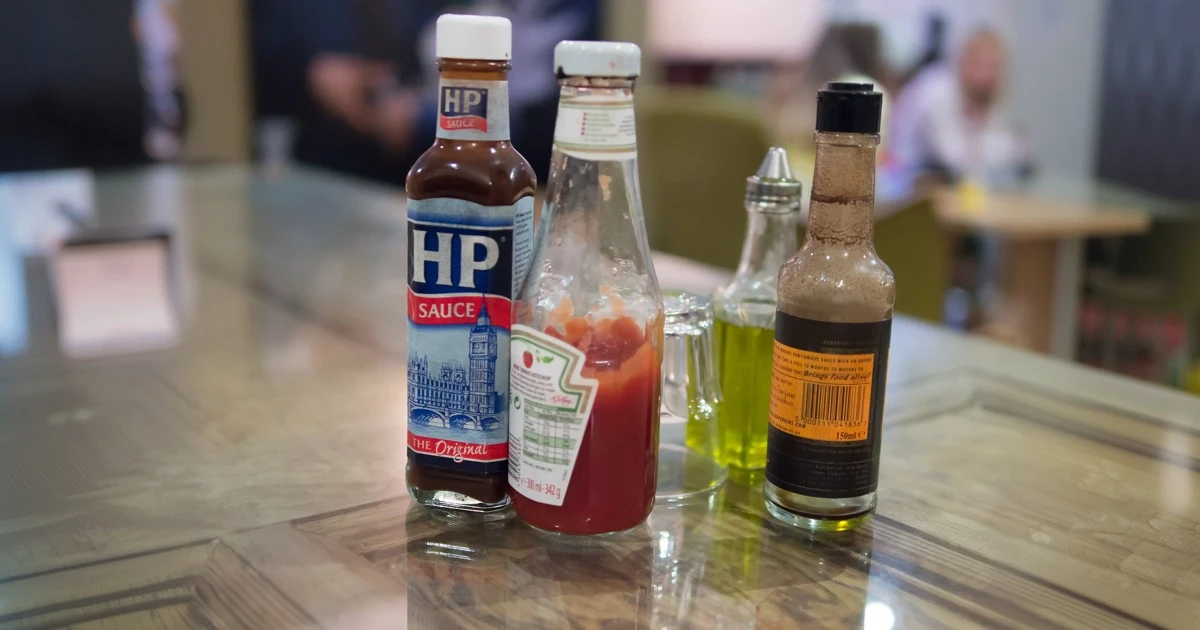
Image Credit - By James Petts from London, England, Wikimedia Commons
HP Sauce History: Debt, Power and Politics
A mass-market product often gains dominance through the theft of the symbols of the ruling elite. You take a cheap blend of vinegar and dates, slap an engraving of the British parliament on the glass, and suddenly you manufacture a pillar of national identity. This strange branding trick birthed a global monopoly. The philosopher Voltaire once mocked the English for having 42 religions but merely two sauces. He missed the brewing culinary shift that would soon sweep the nation. The true HP Sauce history involves heavy debts, political posturing, and corporate maneuvering masquerading as a humble dining table tradition. Today, millions pour this thick brown liquid over their breakfasts without realizing they consume a highly engineered cultural artifact. We will dig into the commercial origins, the hostile corporate takeovers, and the working-class signaling that built an international condiment empire.
The First Recipe Wars and HP Sauce History
The geographic center of a famous invention usually conceals a messy trail of stolen ideas and forgotten creators. The English East Midlands holds the strongest claim as the true origin point for thick, savory condiments. The 1840s experienced a massive deluge of piquant condiments hitting grocery shelves.
Brands like Crosse & Blackwell introduced products like Sir Robert Peel’s Sauce, setting the stage for aggressive market competition. Long before anyone registered a modern trademark, an obscure 1843 'English Cookery' book documented early formulas for steak accompaniments. Examining HP Sauce history requires looking at these early regional experiments.
A historical overview by Country Life suggests that during the mid-19th century, a man named David Hoe potentially mixed the inaugural commercial batch of brown liquid in Bottesford, Leicestershire, though competing regions dispute this claim. Hoe based his creation on an older concoction called Pontack Sauce. He leaned heavily on an elderberry base tied to the 17th-century aristocrat Sir Charles Sedley. People often wonder about the first brown sauce. What is the oldest brown sauce in the UK? Brand’s A.1. Sauce actually hit the market earlier in 1831 down in Vauxhall, London. Yorkshire Relish followed closely behind in 1837.
Yet, the distinct, thick, fruity variant that would eventually conquer British dining rooms sprouted directly from those early East Midlands experiments. The region became an incubation zone for intense savory liquids. Local grocers and chemists constantly tweaked their formulas to secure a competitive edge. David Hoe's early commercial attempts established the base for a massive industry shift. His obscure local mixture eventually caught the attention of ambitious entrepreneurs looking to mass-produce a national staple.
The Imperial Ingredients Behind the Recipe
Everyday household items often serve as liquid maps of historical trade routes and colonial expansion. During the late 19th century, Great Britain commanded a massive global trading network. Frederick Garton used this international access to formulate his original recipe in the 1880s. He built the formula on a base of exotic imports spanning the British Empire.
Garton mixed tomatoes, tamarind, molasses, dates, soy, spices, and malt vinegar into a highly pungent liquid. Each ingredient arrived at British ports from a different corner of the globe. The tamarind provided a sharp, sour tang imported from tropical climates. The dates added a dense, heavy sweetness from the Middle East. The soy introduced deep, fermented savory notes from Asia.
Garton combined these distant flavors with highly familiar domestic malt vinegar. He created a hybrid liquid perfectly suited to the British palate. The resulting product masked the poor quality of cheap domestic meat with aggressive, over-the-top flavoring. Ordinary citizens could suddenly transform bland, low-quality mutton into a highly seasoned meal using a single spoonful of dark liquid.
Frederick Garton and the Debt That Built an Empire
Financial desperation forces creators to hand over century-defining assets for literal pennies. Frederick Garton lived and worked in New Basford, Nottinghamshire, during the 1880s. He proudly developed the strong product he enthusiastically called Banquet Sauce. He officially registered his commercial trademark in 1895, hoping to secure his financial future through regional sales.
Garton soon ran into severe financial trouble. By 1899, he owed a significant sum of money to Edwin Samson Moore. Moore operated as the wealthy owner of the Midland Vinegar Company. Garton settled a mere £150 debt when he signed over his entire recipe and trademark to Moore. The businessman acquired the foundation of a massive commercial enterprise for the price of a modest horse carriage.
Soon after the acquisition, the Midland Vinegar Company transformed the regional Banquet Sauce into a national juggernaut. They utilized their massive existing distribution networks to push the bottles into grocery stores across the entire country. Garton walked away empty-handed from an invention that would soon generate hundreds of millions of pounds. His desperate financial compromise established the base of a modern commercial monopoly.
The Parliament Rebranding in HP Sauce History
Corporate renaming succeeds best when it borrows unearned prestige from highly restricted spaces. The name change from Banquet Sauce happened after rumors circulated that a restaurant inside the Palace of Westminster had started serving the liquid. Garton, or perhaps Moore, seized this elite association and renamed the product entirely.
HP officially stands for Houses of Parliament. According to a retrospective by Mashed, Moore began bottling the liquid in 1903 and updated the packaging to feature a new lithograph image of the government building. The packaging evolved carefully over the decades. The original label proudly displayed the full building. By the late 20th century, the design focused tightly on Big Ben. In 2019, the brand updated the artwork to show the famous clock tower surrounded by real-world scaffolding.
Readers might ask about these label changes. Why did HP Sauce remove the French text from its label? The company deleted the French translations in 1984 to streamline the design and double down on its strictly British identity. This packaging choice cemented the brand's total market dominance.
The parliamentary imagery convinced consumers they purchased a product endorsed by the nation's leaders. The strategy worked flawlessly. The brand eventually captured an astonishing 75% of the UK retail market by 2005. A cheap bottle of spiced vinegar effectively became the official flavor of the British government.

Image Credit - By Kolforn, Wikimedia Commons
How Politicians Weaponized a Condiment
Political leaders adopt specific dietary habits to manufacture instant solidarity with the working class. Brown condiments operate as pragmatic culinary enhancements for ordinary households. This pragmatic usage contrasts sharply with bourgeois alternatives like fancy chutney. In the 1960s, Prime Minister Harold Wilson actively exploited this stark cultural divide.
He intentionally positioned himself as a modest boy from a modest northern residence who achieved the attainment of highest office. His wife, Mary Wilson, once noted his singular vice involved the complete inundation of his meals in this specific condiment. The press excitedly nicknamed the thick liquid 'Wilson's gravy'. This clever signaling strategy spans across different nations and time periods.
Decades later, Donald Trump famously ordered well-done steaks smothered in cheap ketchup. The urban elite routinely mocked these dietary choices. The Guardian once highlighted this distinctly national characteristic as a total absence of gastronomic refinement. Critic Tom Sietsema derided the presidential palate, comparing the main course alongside a toddler drinking vessel.
The mockery misses the strategic political intent entirely. The deliberate absence of culinary sophistication builds immense trust with working-class voters. Ordinary citizens highly resent elite sensibilities. Politicians consume mass-market table liquids to vigorously prove they share the exact same simple tastes as the people electing them.
Conflicting Timelines in HP Sauce History
Historical records frequently clash because massive corporate success relies on streamlining chaotic origins into neat marketing myths. The accepted timeline heavily credits Frederick Garton with inventing the formulation in the 1880s. Persistent alternative narratives vigorously challenge this clean, corporate-approved story.
Some historical accounts claim Garton actually purchased his original formulation directly from David Hoe. This transaction would make Hoe the true creator of the iconic recipe. Another persuasive conspiracy points to a man named Harry 'HP' Palmer. Palmer supposedly created a highly famous Epsom Sauce recipe and used it to settle a personal debt with Garton. The initials of Palmer's name coincidentally match the famous brand name perfectly.
The official corporate timeline also contains glaring internal contradictions. Some company documents confidently suggest an 1884 introduction for the brand. Other historical records show Garton legally trademarked 'The Banquet Sauce' in 1890, while the parliamentary branding only registered in 1895.
These overlapping claims present a highly tangled web of early commercial history. Multiple men traded obscure recipes to settle minor debts, resulting in a single corporate entity claiming all the glory and financial reward. The truth likely involves a messy combination of stolen ideas and convenient rebranding.
Global Offshoots and Wartime Utility
Scarcity strips food of its flavor, forcing populations to rely entirely on intensely concentrated additives. During the mid-20th century, British citizens faced severe, ongoing food rationing. Promotional materials from rival brand Daddies explicitly advertised the elevation of general mood through the enhancement of basic scraps.
Thick, savory liquids provided a vital umami boost to otherwise bland, highly restricted diets. The poet John Betjeman even memorialized the brand in his 1940 'Lake District' poem. He captured its absolute cultural necessity during times of extreme national hardship. The intense demand for savory table liquids quickly crossed international borders.
OK Sauce found immense popularity across South-East Asia. Brand's A.1. migrated aggressively into Taiwan and the United States markets. In the 1940s, Japan experienced the genesis of its own thick, fruity tonkatsu sauce, heavily inspired by these British imports. Consumers frequently question the nature of this category. What flavor is brown sauce? It delivers a sharp, tangy, sweet, and heavily spiced profile dominated by tamarind and malt vinegar.
Regional preferences dictate its daily usage today. In Edinburgh, locals proudly mix the condiment with malt vinegar or water to create "chippy sauce" for their fried food. Canadians consume distinct regional variations like Chicken & Rib and Bold variants. The product molds itself to fit local dietary demands while maintaining its core imperial ingredients.
Corporate Acquisitions and the Dutch Migration
National heritage brands eventually outgrow their borders and become abstract assets traded by foreign conglomerates. The modern HP Sauce history features a dizzying string of high-value corporate takeovers. In 1998, the French giant Danone purchased the brand for £199 million. A few years later, in 2005 and 2006, Heinz acquired the asset for a staggering £440 million.
According to corporate history from Kraft Heinz, the brand maintains staggering annual sales of 28 million bottles. Total UK consumption exceeded 13 million kilograms annually. Despite these massive numbers, local production faced severe cuts. In 2006, Heinz formally announced the relocation of manufacturing from the historic Aston factory in Birmingham to a facility in the Netherlands.
The 2007 Aston closure resulted in around 125 immediate job losses and the subsequent demolition of the site. The move sparked massive public outcry and passionate national boycotts. Consumers felt deeply betrayed by the foreign ownership stripping away a piece of local industrial heritage.
The UK sales trajectory, long viewed as a permanent national success story, took a major hit following the factory closure. According to Mintel market research cited by The Guardian, the brand experienced a harsh 19% sales drop between 2013 and 2014. Corporate efficiency ultimately trumped geographical loyalty, permanently severing the condiment from its manufacturing roots.
The True Cost of a Condiment Monopoly
The true cost of a condiment monopoly becomes clear when you trace a bottle back to its messy roots. Financial desperation built the recipe, political posturing elevated its status, and international acquisitions ultimately stripped it of its geographic home. The ongoing HP Sauce history reveals exactly how a simple mix of tamarind and dates transforms into a high-stakes corporate asset.
A product designed to rescue cheap cuts of meat ended up generating hundreds of millions of pounds for massive foreign conglomerates. You pour the thick liquid over a plate of food, completely unaware of the stolen ideas, unpaid debts, and cynical political calculations swirling inside the glass.
The table condiment remains a powerful cultural signal. It survived severe wartime rationing, devastating factory demolitions, and constantly shifting consumer palates. The brand stands as a testament to the sheer power of aggressive marketing. A bottle of spiced vinegar conquered the world because it simply pretended to belong in the halls of power.
Recently Added
Categories
- Arts And Humanities
- Blog
- Business And Management
- Criminology
- Education
- Environment And Conservation
- Farming And Animal Care
- Geopolitics
- Lifestyle And Beauty
- Medicine And Science
- Mental Health
- Nutrition And Diet
- Religion And Spirituality
- Social Care And Health
- Sport And Fitness
- Technology
- Uncategorized
- Videos

