
Earth Science Decodes Our 4.6 Billion Year Era
Earth behaves like a 4.6-billion-year-old library where most of the books sit buried under your feet. These "books" consist of thick rock layers and crushed shells, but they do not use a normal alphabet. You need Earth Science to act as a primary tool to translate these dusty records.
This field helps us arrange every volcanic eruption, mass extinction, and mountain birth into the geological time scale. According to a report by Vajiram & Ravi, this framework organizes the planet’s history into clear, manageable chapters by expressing deep time in "million years ago" and providing a universal reference for Earth history studies. The Digital Atlas of Ancient Life further describes the scale as a global summary of countless small-scale temporal correlations of rock layers made at local and regional levels, meaning a canyon wall appears as a timeline of life rather than a pile of dirt. Learning to read the rocks provides the power to see exactly how the world changed over billions of years.
The Foundational Role of Earth Science in Deep Time
Humans usually measure time in minutes or years. However, the planet operates on a scale that dwarfs a single human life. Earth Science forces us to think in "deep time," a concept that stretches back billions of years.
James Hutton changed how we see the world by suggesting that the slow ripple of a stream today created the massive valleys of the past. He realized that the same natural forces we see now have always shaped the world. This idea, called uniformitarianism, means the present provides the key to the past.
Arthur Holmes eventually quantified this through the use of radioactive decay in 1913. His work proved that the geological time scale represents a physical reality etched directly into the planet’s crust. We now know the Earth is roughly 4.54 billion years old, thanks to lead-isotope analysis of ancient minerals called zircons. These tiny crystals act as time capsules from the birth of our world.
Breaking Down the Structure of the Geological Time Scale
The scale functions like a nesting doll. Larger units of time contain smaller units, allowing scientists to pinpoint specific events. These divisions track major changes in the environment and the types of life present at the time.
Eons and Ages: The Big Picture
Eons represent the largest slices of time, often spanning hundreds of millions of years. Within these eons, we find geological ages. What are the 4 main ages of the geological time scale? These are the Hadean, Archean, Proterozoic, and Phanerozoic, which represent the primary divisions of Earth’s history based on major physical and biological changes.
During the Hadean, the Earth existed as a molten ball of fire. By the Proterozoic, simple life forms began to fill the oceans with oxygen. Each age marks a massive shift in how the planet looks and functions.
Periods and Epochs: The Nuance of History
Periods and Epochs offer even more detail. Scientists use these smaller increments to track rapid changes, such as the rise of specific fossil groups. For example, the Jurassic Period specifically highlights the dominance of giant dinosaurs. Earth Science uses these divisions to map out exactly when certain species appeared and disappeared. This high-resolution view helps us understand how quickly the planet reacts to sudden shifts.
Tools for Decoding: Relative vs. Absolute Dating
To build the geological time scale, researchers use two main types of dating. One tells us the order of events, while the other gives us the exact number of years.
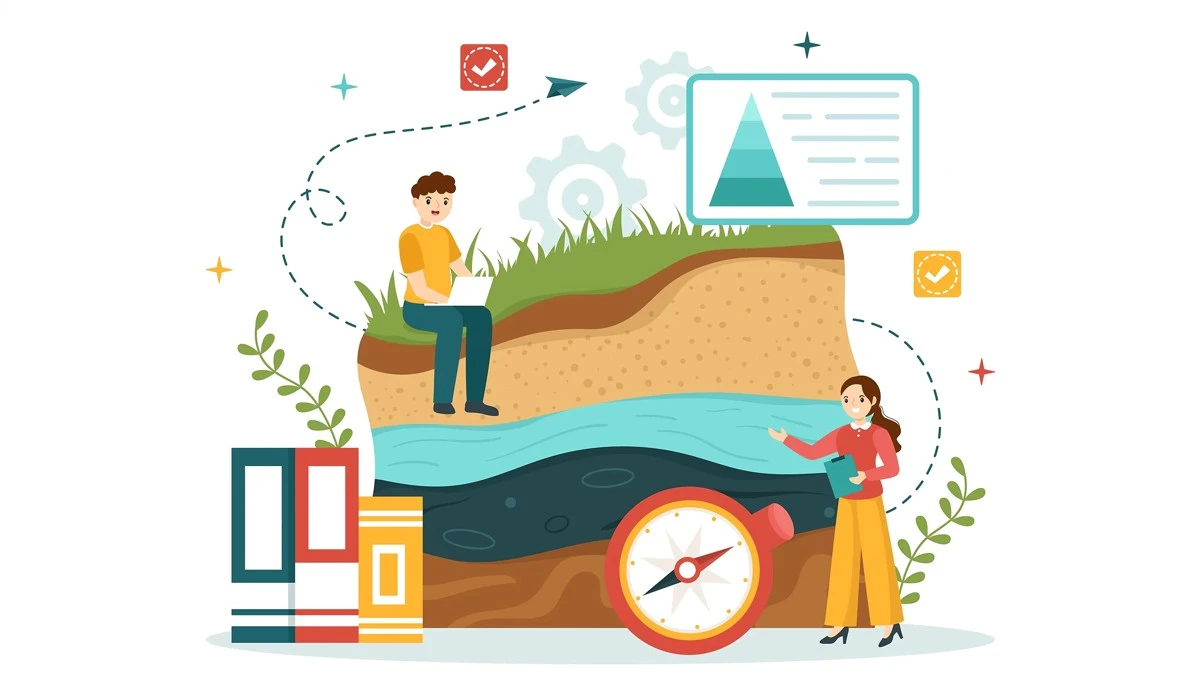
The Law of Superposition and Stratigraphy
The Law of Superposition states that in an undisturbed pile of rocks, the oldest layer sits at the bottom. Think of it like a laundry basket. The clothes you wore on Monday sit under the clothes you wore on Friday. Studying these layers, or strata, allows geologists to establish a relative timeline of events. This method allows us to see which volcanoes erupted first and which fossils came later.
Radiometric Dating: Setting the Absolute Clock
While layers show the order, radiometric dating provides the specific age. How do scientists determine the age of rocks? They primarily use radiometric dating to measure the decay of radioactive isotopes or apply stratigraphic principles to compare layers of sediment.
Certain elements, like Uranium, turn into Lead over millions of years at a steady rate. Measurements of these elements inside a rock allow scientists to calculate its age. Potassium-Argon dating helps us date volcanic ash layers older than 100,000 years. This allows us to sandwich fossil layers between known dates to find their exact age.
Major Biological Turning Points in Earth Science History
Life leaves a permanent mark on the geological time scale. Fossils act as timestamps that define the boundaries of different ages. When life changes drastically, a new chapter in history begins.
Looking for the first or last appearance of a specific species allows Earth Science to identify these boundaries. Research published by Inflibnet notes that the geological time scale framework uses fossils for correlation across regions, which helps geologists match rock layers from different continents. If you find the same trilobite in Nevada and Scotland, you know those rocks formed at the exact same time.
The Cambrian Explosion and the Rise of Elaborate Life
Around 538 million years ago, life suddenly became advanced. This event, known as the Cambrian Explosion, saw the rapid appearance of most major animal groups. It marks the start of the Paleozoic age. Before this, most life consisted of simple, soft-bodied organisms. Afterward, the oceans teemed with hard-shelled creatures and predators.
Extinction Events as Temporal Hard Stops
Mass extinctions serve as the "dividing lines" between major periods. Research published in ScienceDirect indicates that the Permian-Triassic extinction event was particularly severe, resulting in the loss of between 81% and 96% of all marine species. This event ended the Paleozoic age and cleared the way for the Mesozoic, the age of dinosaurs. Another famous boundary is the K-Pg layer, which contains a thin strip of iridium. This layer marks the asteroid impact that ended the dinosaurs 66 million years ago.
Tectonic Shifts and the Movement of Continents
The ground beneath us constantly moves. The shifting of tectonic plates influences how we record and understand the geological time scale. As continents collide and split, they leave distinct markers in the rock record.
These movements change ocean currents and mountain ranges. This, in turn, changes the global climate. Earth Science tracks these movements to explain why a desert today might have been a tropical forest 200 million years ago.
Supercontinent Cycles: Pangea and Beyond
Earth goes through cycles where all landmasses gather into one giant supercontinent, like Pangea. These cycles happen every 300 to 500 million years. When a supercontinent forms, sea levels change and life faces new challenges. When they break apart, they create new ocean basins. These massive physical shifts create unique rock formations that help geologists identify specific time periods.
Ocean Basin Formation and Climate Forcing
Tectonic activity creates the environmental shifts that are categorized within the geological time scale. For example, when the Isthmus of Panama closed, it changed ocean circulation. This event triggered the start of the recent ice ages. Studying these tectonic "gears" reveals how the physical movement of the Earth drives the biological history of life.
Practical Benefits: Why Decoding Deep Time Matters Today
Understanding the geological time scale is far more than a theoretical task; it carries massive implications for our modern economy and our survival. Earth Science provides the data we need to locate resources and protect our future.
Predicting Future Climate with Past Data
Studying the past allows us to see how the world handles high carbon levels. Why is the geological time scale important? It provides a vital framework for understanding how life and environments respond to change, which is essential for predicting future ecological shifts.
We look at events like the Paleocene-Eocene Thermal Maximum to see how fast the Earth warmed 55 million years ago. This helps us model what might happen to our current oceans and forests as temperatures rise.
Resource Location and Economic Geology
Knowing the age of a rock helps geologists find oil, minerals, and rare earth metals. Most of the world's coal formed during the Carboniferous Period. The Digital Atlas of Ancient Life also notes that temporal correlation has made many people very wealthy by allowing them to predict the locations of valuable geological resources like fossil fuels. Biostratigraphy uses microfossils to help oil companies identify the right depth to drill. This knowledge saves billions of dollars and powers our modern world.
Applying Earth Science to Future Global Challenges
As we look forward, the geological time scale continues to evolve. Humans now change the planet so fast that we might be creating our own geological chapter. Earth Science professionals currently debate whether to officially name a new epoch: the Anthropocene.
The Human Effect on the Rock Record
Human activity leaves a permanent signature in the soil. We have spread plastics, nuclear radiation, and concrete across the entire globe. Future geologists will find these "technofossils" in the rock layers. While an article in Nature reports that the International Union of Geological Sciences recently rejected the proposal to establish the current era as a formal epoch in Earth’s geological timetable, the debate continues. It forces us to realize that we are now a force of nature as powerful as a volcano or an asteroid.
Developing Resilience through Historical Literacy
Observation of how the planet recovered from past disasters helps us find ways to protect our biodiversity. Literacy in the planet’s history allows us to respect the limits of our environment. It teaches us that the Earth is a resilient but sensitive system that reacts to every change we make.
Becoming an Expert in the Earth Science Narrative
The geological time scale is a living document. It changes and improves as our technology gets better. Every time we find a new fossil or develop a more precise laser for dating rocks, we sharpen our view of the past.
Earth Science serves as a vital lens that allows you to see the world in four dimensions, reaching far beyond its role as a school subject. When you understand the history written in the stone, you realize that humans are part of a much larger story. This perspective provides the wisdom we need to ensure our future on this ancient, changing planet. Decoding the past provides the clarity to protect the world for the next billion years.
Recently Added
Categories
- Arts And Humanities
- Blog
- Business And Management
- Criminology
- Education
- Environment And Conservation
- Farming And Animal Care
- Geopolitics
- Lifestyle And Beauty
- Medicine And Science
- Mental Health
- Nutrition And Diet
- Religion And Spirituality
- Social Care And Health
- Sport And Fitness
- Technology
- Uncategorized
- Videos

