

Why Digital Users Need The Bates Method Today
Most people think better vision comes from trying harder. You lean into your monitor. You squint to read the fine print. You strain to catch a distant sign. According to research archived by EBSCO, Bates claimed that when you tighten the six muscles surrounding your eye, you pull the globe out of its natural round shape. This physical squeeze creates the blur you see.
Dr. William Bates noticed this over a century ago. He saw that patients with "perfect" eyes often had blurry vision when they felt stressed. He realized that sight depends on how much your mind and eyes relax together. The Bates Method teaches you how to let go of this habitual squeeze. Specific eye relaxation exercises help you return your visual system to its natural state of ease. You stop forcing clarity. You start allowing it to happen.
The Science of Visual Strain and the Bates Method Solution
Dr. Bates challenged the standard ideas of his time. Most doctors believed the lens inside the eye did all the work of focusing. A report from the National Center for Biotechnology Information explains that Bates utilized a technique called retinoscopy, which is a tool used to examine eyes and measure refractive error. He found that the shape of the eyeball changes based on effort. If you feel nervous or try too hard to see, your eye muscles clamp down. As noted in the Cochrane Library, while myopia is typically characterized by an elongation of the eyeball, Bates argued that this muscle clamp creates common issues like nearsightedness or farsightedness.
He proved that vision varies from minute to minute. Your sight improves when you feel calm and worsens when you feel tense. The Bates Method focuses on this relationship between the brain and the eye muscles. Does the Bates Method actually improve eyesight? This approach offers a way to retrain your brain to drop the habits that cause functional strain and often leads to much sharper clarity. Learning to release the extraocular muscles allows the eye to return to its proper focus.
Why We Stare: The Cost of Mental Strain
Bates found the power of the adrenal gland before he turned to vision. Research published in the journal Frontiers in Human Neuroscience notes that he understood the way physical stress affects the body and mind. The study explains that constant stress and high cortisol levels can negatively affect the eye and brain due to imbalances in the nervous system. Bates believed that most people "stare" because they feel a mental need to grasp information. This mental strain translates directly into physical tension.
Learning Palming for Immediate Relief
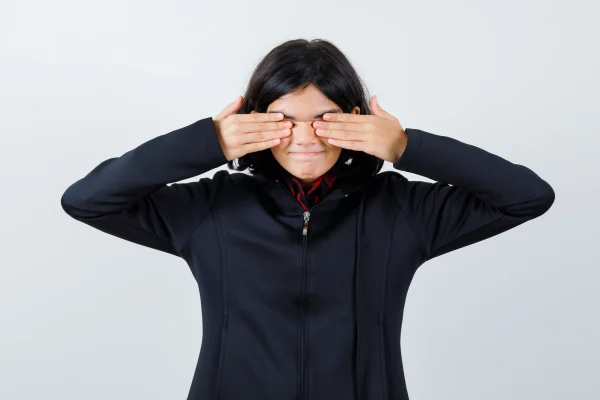
Palming provides the most direct way to rest the visual system. You sit at a table and place your elbows on a soft cushion. Cup your hands over your eyes without touching the lids. Ensure no light enters through the gaps in your fingers. Close your eyes and breathe deeply. You want to see total blackness. This state gives the optic nerve a rare chance to recover from constant stimulation.
The correct physical posture for palming
Sit with a straight spine to allow blood to flow freely to the head. Use pillows to support your elbows so your neck does not carry the weight of your arms. Cross your fingers at the forehead to form a perfect seal. This posture prevents physical fatigue from ruining the relaxation of your eyes. Relax your jaw and shoulders while you sit in this position.
Mental visualization during rest
If you see grey streaks or flashes of color, your mind remains active and tense. Dr. Bates suggested that seeing "perfect black" means your optic nerve has reached a state of deep rest. How long should you do eye relaxation exercises? You should aim for 5 to 10 minutes of palming to reach deep relaxation. A meta-analysis in Scientific Reports highlights that even a 30-second break, or micro-break, can help the nervous system reset and improve performance during a busy day. Use this time to imagine a calm scene or recall a memory of a deep black object like a piece of coal.
Applying Bates Method Principles to Digital Screens
As documented in the journal Cureus, modern life and the prolonged use of digital devices force us to look at flat screens for hours, which can lead to digital eye strain. This screen use leads to a state of "screen freeze." We stop moving our eyes. We stop blinking. The Bates Method offers tools to combat this specific type of fatigue. You must break the habit of locking your gaze on the monitor.
Overcoming the "stare" reflex
Staring is the enemy of clear vision. When you stare, you hold your breath and freeze your eye muscles. Practice letting your gaze wander across the screen instead of fixing it on one spot. Keep your eyes "soft" and receptive. Treat the information on the screen as something that comes to you. Avoid the urge to reach out and grab the words with your eyes.
The importance of frequent, soft blinking
Research published in the Journal of Ophthalmology suggests that blinking cleans the cornea and provides a tiny moment of rest for the retina; the study also notes that reduced blinking increases surface exposure and dryness. As indicated in the Chinese Journal of Ophthalmology, a healthy eye typically blinks every two to five seconds. However, a report in the journal Cureus shows that most people blink less while using a computer, dropping from a normal rate of 14–16 times a minute to just 4–6, which leads to dryness and irritation. Remind yourself to blink lightly and often. Think of your eyelids as the wings of a butterfly. This simple habit keeps the eyes moist and the mind relaxed.
Using Sunlight to Stimulate the Optic Nerve
Sunning uses natural light to strengthen the way your eyes handle brightness. Many people suffer from light sensitivity because they spend too much time indoors or behind sunglasses. The Bates Method encourages safe exposure to the sun to revitalize the retina.
Safe sunning techniques for light sensitivity
Find a sunny spot and close your eyes. Never look directly at the sun with open eyes. Gently rotate your head from side to side so the sunlight hits different parts of your closed lids. Although sun exposure carries risks such as solar retinopathy, as discussed in the Journal of Medical Case Reports, Bates claimed that this head rotation causes your pupils to contract and expand even through the eyelids. This movement feels like a warm massage for the interior of the eye. This practice reduces the "glare" pain many people feel when they step outside.
The change from light to dark
Always follow a sunning session with palming. The contrast between the bright warmth of the sun and the deep blackness of your palms deepens the relaxation. This change helps the eye muscles become more flexible. It trains the nerves to adapt quickly to different lighting environments. You will find that your eyes feel more active and less tired after alternating these two techniques.
Refining Focus through Central Fixation
Central fixation is the heart of the Bates Method. Information from the Macular Society states that the center of your retina, called the macula, is responsible for central vision and fine detail, allowing you to see things much more clearly than the edges. To see clearly, the eye must only look at one tiny point at a time. Trying to see a whole sentence with equal clarity creates instant strain.
Understanding the macula’s role
The eye is not a wide-angle camera. It is a precision instrument that focuses on a needle-point area. When you try to force your peripheral vision to be as sharp as the center, you create a "diffusion" of focus. This diffusion leads to headaches and blurred vision. Accept that you can only see one letter perfectly at any given moment.
Shifting for clarity
What is the most effective Bates Method technique? Many practitioners believe central fixation is the most significant habit. You should shift your gaze rapidly from one small detail to another. Moving your eyes constantly allows the macula to do its job without overworking. Contrast this with "diffuse vision," where you try to take in everything at once. Focusing on small parts actually makes the whole picture look clearer.
Restoring Natural Movement with Swinging and Shifting
Your eyes were meant to move constantly. Static vision is dead vision. Dr. Bates developed "swings" to help people rediscover the feeling of movement. These eye relaxation exercises break the physical "locks" that people develop after years of wearing glasses or staring at desks.
The "Long Swing" for total body relaxation
Stand with your feet shoulder-width apart. Rotating your body from left to right allows your arms to swing freely. As you turn, the world should appear to move in the opposite direction. This "apparent motion" is a sign that your visual system is letting go of its grip. Do not try to focus on anything as you swing. Just let the world slip past your eyes like water.
Shifting on a microscopic scale
You can practice shifting while reading or walking. Pick two small points, like the two dots on a colon. Look at the top dot, then the bottom dot. Do this quickly and easily. You will notice that when you look at the top, the bottom looks less clear. This is natural. Acknowledging this difference in clarity is a major step toward effortless vision.
Creating a Sustainable Daily Routine
You do not need to set aside hours for the Bates Method. The best results come from small, frequent sessions throughout the day. You are not "exercising" muscles as much as you are learning a new way of being. Change your habits, and your vision will follow.
Integrating micro-breaks into your workflow
Use every phone call or loading screen as a cue to palm your eyes for thirty seconds. Set a timer to remind yourself to blink and shift your gaze out the window every twenty minutes. These eye relaxation exercises fit into any schedule. Consistency matters more than intensity. If you spend all day straining, a single ten-minute session at night cannot undo the damage.
Tracking progress without the stress of testing
Avoid checking your vision against a chart every five minutes. Stress ruins the process. Instead, look for subtle signs of success. You might notice that colors look brighter. You might realize your eyes do not feel dry at the end of the day. Perhaps you can find that you can read the car's dashboard without leaning forward. These small wins show that your tension is melting away.
A New Way to See
The path to clear sight is a process of letting go. You cannot force your eyes to see better any more than you can force yourself to fall asleep. The Bates Method provides the map to return to your natural state. Through the practice of these eye relaxation exercises, you stop fighting your own physiology. You give your eyes the rest they deserve and the movement they crave.
This process is a form of neuromuscular re-education. It changes how your brain interprets light and how your muscles hold the eye. Start today with the simple act of closing your eyes and cupping your palms over them. Feel the warmth and the darkness. Give yourself permission to stop straining. Clarity is not created; instead, it occurs when the tension finally disappears. Embrace the ease of the Bates Method and look at the world with fresh eyes.
Recently Added
Categories
- Arts And Humanities
- Blog
- Business And Management
- Criminology
- Education
- Environment And Conservation
- Farming And Animal Care
- Geopolitics
- Lifestyle And Beauty
- Medicine And Science
- Mental Health
- Nutrition And Diet
- Religion And Spirituality
- Social Care And Health
- Sport And Fitness
- Technology
- Uncategorized
- Videos