
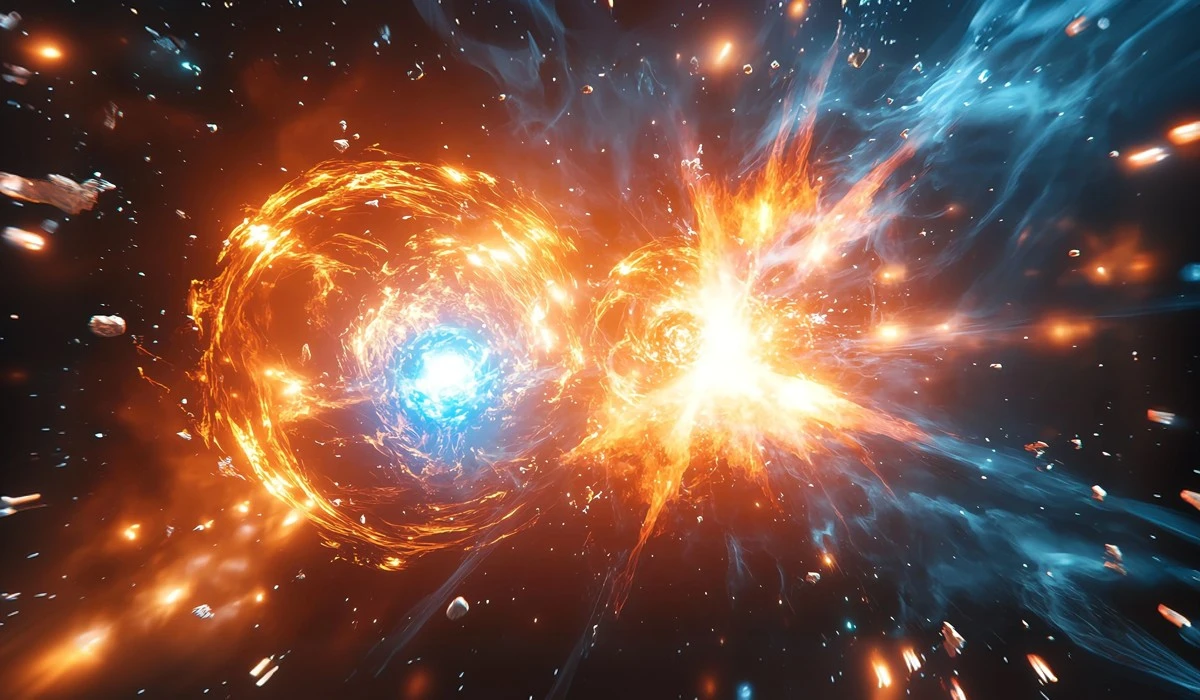
Redshift Confirms Every Big Bang Theory Model
Every star in the night sky acts like a glowing runner moving away from a starting line. We think the stars just hang there in the dark, but they actually race outward. This movement leaves a permanent trail in the light they send toward Earth. When we observe how the color of a star changes, we see exactly how fast it moves. This color change reveals the history of the entire world. It proves that the universe started from a single, tiny point.
Today, the Big Bang Theory explains how everything we see began as a massive burst of energy. Observations of light prove that the space between stars grows longer every second, rather than the stars simply drifting. Early astronomers struggled to understand why galaxies appeared to fly away from us. They eventually realized that the Big Bang Theory redshift and universe expansion held the answer to the age of the cosmos. This finding changed everything we know about space and time.
Light Wavelengths as a Record of Cosmic Evolution
Measurement of the "stretch" of light serves as the final proof for the birth and evolution of our universe. Research from NASA’s Hubble mission explains that as light travels across vast distances to reach telescope mirrors, the expansion of the universe stretches it into longer red wavelengths, a phenomenon known as cosmological redshift. Scientists use these measurements to look back through billions of years of history. They find evidence that the cosmos was once a hot, dense ball of energy. This article explains how simple light waves provide the evidence we need to confirm our origins.
Decoding the Light Spectrum within the Big Bang Theory
Light acts as a messenger from the distant past. When we look at a star, we see light that traveled for millions of years to reach our eyes. According to the Johns Hopkins University's FUSE project, a primary tool for studying this light is a spectrograph, which separates light into its component colors. This rainbow contains specific lines that act like a bar code for the star. These lines tell us what the star contains and how it moves through the deep reaches of space. This process is important to understanding the Big Bang Theory and its predictions about the cosmos.
The Anatomy of a Light Wave
Light travels through the vacuum of space in waves. These waves have peaks and valleys, just like ripples on a pond. Data from a NASA guide on the electromagnetic spectrum indicates that violet light has the shortest wavelength at about 380 nanometers, whereas red light reaches the longest wavelengths at approximately 700 nanometers. When space stretches, it physically pulls these light waves apart. This makes the peaks move further away from each other. As a result, the light looks redder than it did when it first left the star.
Absorption Lines as Cosmic Markers
Chemical elements in stars, like hydrogen and helium, absorb specific colors of light. Information from NASA regarding Hubble spectroscopy notes that an absorption spectrum contains dark lines where specific wavelengths have been absorbed. The European Space Agency adds that these atomic emission and absorption lines occur at specific, well-known wavelengths. These lines always appear in the exact same spot in a laboratory on Earth. However, when we look at distant galaxies, these lines shift toward the red side of the spectrum. These "Fraunhofer lines" provide a fixed reference point. Scientists use them to measure exactly how much the light has changed during its long path across the universe.
Mechanics of Big Bang Theory, redshift, and universe expansion
The relationship between distance and speed defines how we view the cosmos. A report in the Journal of the Royal Society of Medicine (via PMC) notes that Edwin Hubble’s 1929 publication established a correlation between distance and radial velocity, showing that more distant galaxies appear to move faster. This finding linked the Big Bang Theory redshift and universe expansion into a single, measurable law. It showed that the universe does not just exist in a static state. Instead, it grows larger every single day.
Hubble’s Law and the Constant of Change
Hubble’s Law uses a simple mathematical formula to explain galactic movement. It states that a galaxy's speed equals its distance multiplied by a specific number called the Hubble Constant. This constant tells us how fast a volume of space grows over time. As reported by Reuters, the standard model of cosmology suggests a Hubble constant of approximately 67 to 68, though recent data from the Hubble and Webb telescopes indicate a higher average value of about 73 kilometers per second per megaparsec. Observations of redshift in distant galaxies show they are moving away from us in all directions, which confirms that the fabric of space itself is stretching over time. This mathematical relationship proves that the universe follows a predictable growth plan.
The Balloon Analogy
Imagine drawing dots on a deflated balloon. These dots represent galaxies. As you blow air into the balloon, the rubber stretches. The dots move away from each other even though they aren't "walking" across the surface. The rubber between them simply grows. This is exactly how the Big Bang Theory describes the growth of our universe. Galaxies stay in their spots, but the space between them increases. This stretching of the "rubber" of space is what pulls the light waves and creates the redshift we see through telescopes.
Distinguishing Cosmological Redshift from the Doppler Effect
Many people confuse light stretching with the sound of a passing car. While they seem similar, they happen for very different reasons. Understanding the difference helps us see why the Big Bang Theory is so unique. Movement through a room is one cause, whereas the room itself expanding is the other. Clear distinctions ensure that we accurately interpret the data we receive from the farthest reaches of the night sky.
Why the Sirens-in-the-Street Comparison Fails
When an ambulance drives past you, the pitch of the siren drops. This happens because the ambulance moves through the air. This is the Doppler Effect. However, cosmological redshift does not happen because galaxies fly through space like race cars. Instead, the space between the galaxy and Earth expands. The light wave stretches because the medium it travels through is getting longer. This distinction is vital for accurate science. If galaxies were just flying through space, they would eventually hit a speed limit, but space itself has no such limit.
The Magnitude of Scale
Cosmological redshift only becomes obvious when we look at massive distances. Within our own galaxy, gravity keeps things held together tightly. As explained in physics research from the University of Maryland, gravity keeps "bound" systems together, meaning the moon and Earth do not move away from each other due to expansion. Gravity wins the tug-of-war on small scales. However, across the vast gaps between galaxy clusters, gravity is too weak to stop the stretch. This is why we only see the Big Bang Theory redshift and universe expansion effect when we peer deep into the dark, intergalactic void.
Redshift as a Time Machine for the Big Bang Theory
Every time we measure a redshift, we look into the past. Because light has a speed limit, the light from a distant galaxy takes billions of years to reach us. When we see a galaxy with a high redshift, we see it as it looked when the universe was very young. This allows scientists to use the Big Bang Theory as a guide to reconstruct the history of everything. We can see the first stars forming and the first galaxies gathering together.
Tracing the Galactic Recessions Backwards
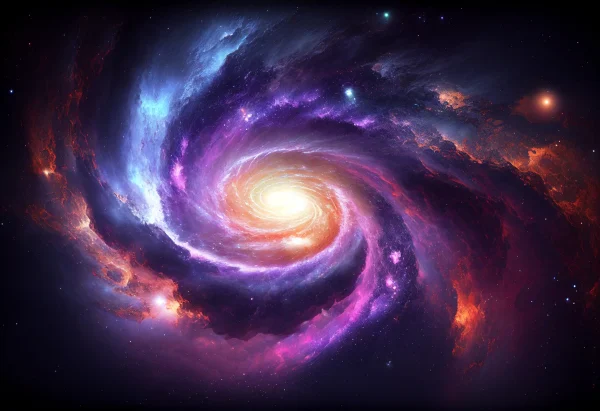
If we see galaxies moving apart today, we can imagine what happened yesterday. They must have been closer together. If we go back millions of years, they were very close. Eventually, if we go back 13.8 billion years, everything sits in the exact same spot. NASA’s Hubble mission highlights specify that the calculated rate of expansion places the age of the universe at roughly 13.8 billion years. The mission notes also explain that when redshift shows that galaxies recede at speeds proportional to their distance, it indicates the universe began from a hot, dense singularity and has been expanding ever since. Georges Lemaître called this origin point the "Primeval Atom."
Calculating the 13.8 Billion-Year Timeline
Scientists use the rate of expansion to find the birthdate of the universe. Through the measurement of the current Hubble Constant, they calculate how long it took for galaxies to reach their current positions. Redshift acts like a clock that never stops ticking. It allows us to pinpoint the moment when the first light broke through the darkness. Without this light-stretching data, we would have no way to know how long the universe has existed.
Examining Evidence Beyond the Redshift Spectrum
The Big Bang Theory does not rely on light waves alone. Other pieces of evidence fit into the puzzle to confirm the expansion story. Scientists look for "fossil" evidence left over from the first few minutes of existence. These findings match the predictions made by the expansion model perfectly. When multiple types of data agree, the theory becomes much stronger and more reliable for researchers.
The Cosmic Microwave Background (CMB)
In 1964, two scientists found a strange hum coming from every direction in the sky. This hum is the "afterglow" of the initial burst of energy. Originally, this light was white-hot and extremely bright. Over billions of years, the Big Bang Theory redshift and universe expansion stretched this light so much that it turned into microwaves. We cannot see it with our eyes, but our instruments detect it everywhere. This microwave background is the final proof of a hot, dense beginning for our cosmos.
Nucleosynthesis and Elemental Abundances
The early universe was like a giant nuclear reactor. It was so hot that it fused atoms together. Scientists predicted that a universe starting with a big bang should be about 75% hydrogen and 25% helium. When we look at the oldest, most redshifted gas clouds in space, we find exactly those numbers. This perfect match between math and reality proves that our model of expansion is correct. It shows that the universe cooled down at the exact rate we expected as it grew larger.
Dark Energy and the Future of the Universe's Expansion
The story of the universe took a strange turn in the 1990s. Astronomers expected the expansion to slow down because gravity should pull everything back together. Instead, they found that the expansion is getting faster. This finding relies heavily on the Big Bang Theory framework. It suggests that a mysterious force is pushing everything apart. According to NASA’s research on dark matter, this mysterious force, known as dark energy, makes up 68% of the universe, with dark matter and visible matter accounting for the remainder.
The Finding of Accelerated Expansion
To find this acceleration, scientists looked at Type Ia Supernovae. Technical details from the Roman Space Telescope mission describe these as standard candles because they peak at a known brightness, which allows scientists to determine their distance. When researchers measured the redshift of these explosions, they found they were further away than they should be. Why is the universe's expansion accelerating? Scientists believe a mysterious force called dark energy acts as a "repulsive gravity," pushing galaxies apart at an ever-increasing rate as space expands.
The Fate of the Cosmos
If expansion keeps speeding up, the universe faces a cold future. This idea is known as the "Big Freeze." Eventually, galaxies will move so far apart that their light can no longer reach us. The sky will turn completely black. NASA also suggests that unstable dark energy might lead to a "Big Rip," where the expansion becomes violent enough to pull stars, planets, and atoms apart. Both of these ideas come directly from our study of the Big Bang Theory, redshift, and universe expansion. These concepts help us prepare for the end of the cosmic story.
Why Redshift Remains the Big Bang Theory’s Most Vital Tool
We continue to use redshift because it never lies. It is a physical change in light that we can measure with high precision. No matter which direction we point our telescopes, we see the same expansion happening. This consistency makes the Big Bang Theory one of the most successful ideas in the history of science. It connects the physics of the very small to the physics of the very large.
The Consistency of Global Observations
Whether we look toward the north or the south, the redshift data remains the same. This proves the "Cosmological Principle," which says the universe is the same everywhere. We don't live in a special or central spot. Instead, we live in a growing system where every part moves away from every other part. This uniform movement is a core requirement of the Big Bang Theory redshift and universe expansion model. It shows that the laws of physics work the same way billions of light-years away as they do here on Earth.
Advancements with the James Webb Space Telescope
The James Webb Space Telescope (JWST) is our newest eye in the sky. It sees infrared light, which is light that has been redshifted past the point of being visible. Recently, JWST found a galaxy at a redshift of 14.32. This means we are seeing light that has been traveling for almost the entire history of the universe. These new measurements allow us to refine our understanding of the Big Bang Theory. Every new finding confirms that the universe began small and has never stopped growing.
The Lasting Legacy of the Big Bang Theory
Redshift represents a physical record of where we came from, rather than just a math problem or a line on a graph. Through the observation of the colors of distant stars, we have solved the mystery of the universe’s birth. We know that everything we see—from the atoms in our bodies to the furthest galaxies—started in the same place. The Big Bang Theory provides the framework that makes sense of these observations. It turns a chaotic sky into a logical, growing story.
The simple stretching of a light wave connects us to the first moments of time. We live in a rare period where we have the tools to see our own origins. As space continues to expand, the light from the past reminds us of our humble beginnings. We have moved from wondering about the stars to measuring their speed and distance with perfect accuracy. This process of finding proves that the universe is far more active and exciting than we ever imagined. Science allows us to witness the birth of the cosmos simply by watching the colors of the night sky change.
Recently Added
Categories
- Arts And Humanities
- Blog
- Business And Management
- Criminology
- Education
- Environment And Conservation
- Farming And Animal Care
- Geopolitics
- Lifestyle And Beauty
- Medicine And Science
- Mental Health
- Nutrition And Diet
- Religion And Spirituality
- Social Care And Health
- Sport And Fitness
- Technology
- Uncategorized
- Videos

