
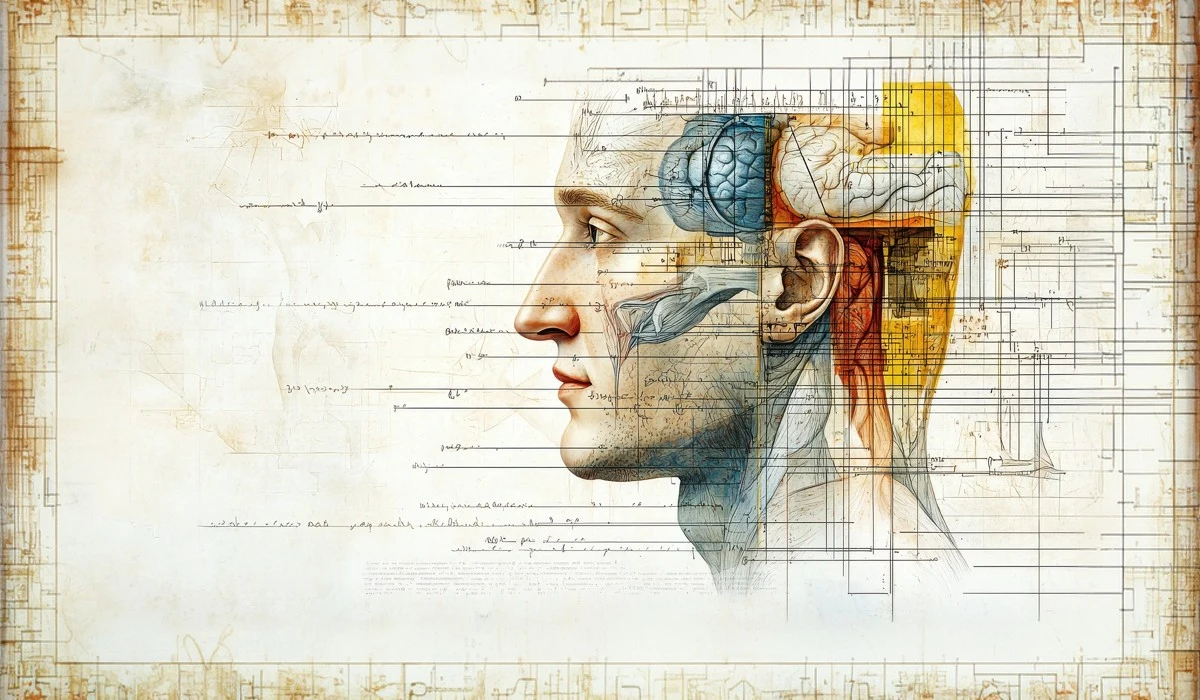
How Phrenology Changed 19th-Century Science
A white ceramic head sits on a Victorian desk. Black lines divide the skull into dozens of numbered sections. This object represents a major shift in how people understood the human mind. Before this time, philosophers argued that the soul existed in the heart or as a ghostly vapor. 19th-century brain science changed that view. It pulled the human personality out of the spiritual realm and locked it inside the skull.
This movement, known as Phrenology, turned the head into a map. Doctors and teachers believed they could read your future by feeling the bumps on your scalp. They transformed the brain from a mysterious blob into a collection of specialized tools. This shift forced the world to look at biology as the source of behavior. It changed the way we view our own identities today.
Franz Joseph Gall and the Biological Revolution
Franz Joseph Gall changed everything when he looked at the brain as a physical organ. He lived in a time when people still relied on ancient ideas about "humors" and spirits. Gall rejected these vague concepts. He spent his days dissecting cadavers and observing the shapes of heads in schools and prisons. He eventually claimed that the brain generates every thought and feeling we experience.
From Armchair Philosophy to Anatomy
Gall took the study of the mind out of the library and into the lab. He argued that the brain serves as the physical home of the soul. According to Britannica, he referred to his work as "Cranioscopy" before his followers later rebranded it as Phrenology. This new focus meant scientists finally prioritized the physical structure of the head. They stopped guessing about spirits and started measuring bone and tissue.
The 27 Faculties
Research published by the National Institutes of Health indicates that Gall identified 27 specific "faculties" or traits that he believed occupied different spots in the brain, almost all of which involved the cerebral cortex. He included basic instincts like "Amativeness" for sexual desire and "Destructiveness" for the urge to hunt or kill. As noted in an article from the National Park Service, he believed these traits grew like muscles; if a trait was highly developed, the corresponding brain area would expand and push the skull outward. 19th-century brain science relied on the idea that the skull perfectly mirrors the brain beneath it.
The Mechanics of 19th-Century Brain Science through Phrenology
An article from Carnegie Mellon University notes that practitioners, specifically those like George Combe, used spreading calipers and craniometers to measure the exact diameter of a person's head. These tools allowed them to turn a human personality into a set of numbers. They believed these numbers revealed the "true" nature of an individual, regardless of what that person said.
People often ask, what did phrenology believe about the brain? The National Park Service article explains that the core belief was that the brain consisted of multiple distinct organs, each responsible for a specific mental faculty, which would grow and create readable bumps on the skull. This physical approach made the study of the mind feel like a hard science for the first time in history.
Decoding the Map of Phrenology Faculties
A phrenology chart looks like a jigsaw puzzle on a human face. Each piece represents a different part of the human experience. Practitioners divided the head into zones based on the type of behavior they controlled. They believed they could predict a person's success in life when they measured these zones with their fingertips.
Moral vs. Intellectual Organs

The top of the head housed the "higher" faculties. Phrenologists looked for a high, rounded crown to indicate strong morality and religious devotion. They believed a flat top suggested a lack of empathy or "Benevolence." The forehead represented the intellectual organs. A wide, deep forehead signaled a talent for math, music, or logic. This mapping system gave Victorians a way to judge people at a single glance.
Domestic and Social Instincts
The back and base of the head contained the "lower" or social instincts. The Carnegie Mellon University research further identifies an area called "Philoprogenitiveness," located at the base of the skull, which represents the love of children. Practitioners checked this area in women to see if they would make good mothers. They also looked for "Adhesiveness," which governed friendship and loyalty. Analyzing these spots helped people choose business partners and even spouses during the height of Phrenology.
How Phrenology Democratized Victorian Knowledge
According to research in PubMed, this science quickly left the medical clinics and entered the streets as reformers like Spurzheim brought lecture tours to Britain. It became the most popular "self-help" tool of the 1800s. People attended traveling lectures and paid for head readings at county fairs. It offered regular people a language to describe their own strengths and weaknesses. It made the world of 19th-century brain science accessible to everyone, not just professors.
Many wonder, how did phrenology influence psychology? It shifted the focus of mental health toward the physical brain, which prepared the way for functional localization and the behavioral sciences we study today. This movement encouraged people to believe they could improve their characters by "exercising" specific parts of their brains.
The Dark Side of 19th-Century Brain Science
While many used these ideas for self-improvement, others used them for harm. The obsession with head shapes led to dangerous social theories. People began to use measurements to rank different groups of humans. This created a scientific-sounding excuse for prejudice and control that lasted for decades.
Scientific Racism and Colonialism
Samuel George Morton and other researchers used Phrenology to justify the mistreatment of non-Europeans. They filled skulls with lead shot to measure "cranial capacity." They claimed that smaller skulls proved lower intelligence. These biased results supported colonialism and slavery. They used the shape of the bone to argue that some people deserved freedom while others did not.
Criminology and Legal Reform
Lawmakers also looked at the skull to explain crime. They searched for the "bump of destructiveness" in prisoners. Some reformers argued that criminals suffered from "diseased" brain organs and needed treatment instead of punishment. Ironically, this led to the idea of the "born criminal." This theory suggested that some people were biologically destined to break the law because of their head shape.
The Scientific Backlash and the Rise of Experimentation
As the 1800s progressed, new experiments challenged these ideas. As noted in the journal PMC, serious scientists began to demand better evidence than just feeling bumps, leading curious individuals to witness examinations and engage in public debates. A report from Lehigh University adds that these experts realized that the thickness of the skull varies by individual, which made it impossible to reach consistent conclusions based on the shape of the brain. This realization started the slow collapse of the movement.
You might ask, is phrenology considered a real science today? While it is now categorized as a pseudoscience because its methodology was flawed, its central premise that different brain regions serve different functions remains an essential base of modern neurology. The PMC report also details how Pierre Flourens used ablation and stimulation methods on animals like rabbits and pigeons to remove specific parts of the brain and see which functions stayed and which disappeared. His work proved that the brain is more elaborate than a simple map of 27 bumps.
The Permanent Legacy of Phrenology in Modern Medicine
We still live with the results of this early 19th-century brain science. Every time a doctor orders an fMRI or talks about "brain regions," they follow a path Gall started. The specific bumps were a mistake, but the idea of "localization" changed medicine forever. We now know that specific areas really do control speech, vision, and movement.
Localization of Function
The hunt for brain maps led directly to breakthroughs. According to Britannica, in 1861, Paul Broca identified the speech center in the left frontal lobe. He found this because he was looking for localized functions, an idea he inherited from Phrenology. Shortly after, Carl Wernicke found the area for understanding language. These findings turned the old myths into modern neurological facts.
Improving Scientific Literacy
Studying this time helps us spot modern "neuro-hype." People today still make oversimplified claims about "right-brain" or "left-brain" personalities. These claims mirror the old phrenological charts. When we study the history of Phrenology, we learn to ask for real evidence. We learn that the brain is a physical organ, but it is far more unified than a simple list of traits.
See how Phrenology influenced 19th-century science
The ceramic bust on the desk eventually became a relic of a failed theory. However, it represents the moment we started looking inside our own heads for answers. Phrenology failed to prove that bumps on the skull reveal our secrets. It succeeded in proving that the brain is the engine of the human experience.
Modern neuroscience stands on the shoulders of these 19th-century pioneers. We no longer use calipers to judge a person's character, but we still map the cortex to save lives. This progression from pseudoscience to modern medicine shows how we refine our understanding of ourselves. Our current knowledge of the brain started with a simple, flawed attempt to read the soul through the skin.
Recently Added
Categories
- Arts And Humanities
- Blog
- Business And Management
- Criminology
- Education
- Environment And Conservation
- Farming And Animal Care
- Geopolitics
- Lifestyle And Beauty
- Medicine And Science
- Mental Health
- Nutrition And Diet
- Religion And Spirituality
- Social Care And Health
- Sport And Fitness
- Technology
- Uncategorized
- Videos

