
Decoding The Iron Ring and History of Wales
In December 1282, a man died in a cold skirmish near a stream in mid-Wales. Llywelyn ap Gruffudd was the last native prince and a figure of great importance; according to History Today, he had maintained an understanding with English rebel leader Simon de Montfort before his death. His death ended the war and turned a collection of ancient families into a managed province. The History of Wales changed from a story of independent kings to a story of subjects in a single afternoon.
While the change felt sudden, years of mounting tension preceded it. Soldiers stopped fighting for local lords and started obeying a distant crown. Laws that once focused on paying families for injuries shifted toward cold, hard prison time. This moment redefined the land forever. Grasping the History of Wales, medieval Welsh history involves examining how a native culture survived once its leaders vanished.
A Fragmented Land: Understanding the History of Wales Before the Conquest
Before the English arrived in force, Wales functioned like a patchwork quilt. Various leaders held different valleys. People called the native-ruled lands "Pura Wallia." Here, the History of Wales centered on the mountainous North, specifically Gwynedd. Meanwhile, research published by Oxford Academic notes that the remainder of the country was designated as the March of Wales, ruled by the barons of the March. These barons acted like mini-kings with their own private armies.
The Patchwork of Princedoms
Native rulers lived by strict family codes. Power didn't always go to the oldest son; instead, uncles and brothers often fought for the throne. This internal fighting made the country vulnerable. While the princes argued over borders, the Marcher Lords built small wooden forts and slowly pushed further into Welsh territory.
The Role of Gwynedd
Gwynedd served as the natural fortress of the North. Its high peaks and deep valleys made it hard for heavy English cavalry to move. Because of this, the leaders of Gwynedd became the primary defenders of medieval Welsh history. They controlled the best farmland on the island of Anglesey. Who was the last native Prince of Wales? Llywelyn ap Gruffudd, known as Llywelyn the Last, was the final sovereign prince of Wales before its conquest by Edward I. He held the title officially recognized by the English Crown until he died in 1282.
Llywelyn ap Gruffudd: The Rise and the Recognition
Llywelyn ap Gruffudd managed something his ancestors could not. He united the fragmented lords through a mix of force and clever talking. As noted in History Today, Llywelyn secured the Treaty of Montgomery from King Henry III in 1267.
The Treaty of Montgomery (1267)

This document provided him with the official title of Prince of Wales. The report further explains that for the first time, an English king admitted that a Welshman ruled over the other native lords. This title carried legal weight rather than being a mere honorific. It meant Llywelyn had the right to collect taxes and lead his people as a single nation.
The Burden of Tribute
Power came with a heavy price tag. To keep his title, Llywelyn had to pay the English Crown huge sums of money. This drained the Welsh economy. Tension grew when a new king, Edward I, took the English throne. Edward demanded total obedience. Llywelyn refused to attend Edward’s coronation or pay homage. This refusal turned a political disagreement into a full-scale invasion.
The 1282 Campaign: A Decisive Chapter in the History of Wales
The final war began with a surprise attack on a holy day. In March 1282, Llywelyn’s brother, Dafydd, attacked Hawarden Castle on Palm Sunday. He captured the English Justiciar, Roger de Clifford. This act forced Llywelyn into a war he wasn't fully ready to fight.
The Rebellion of Dafydd ap Gruffudd
Dafydd’s attack ended any hope of a peaceful deal. Edward I responded by gathering a massive army. He spent £173,000 on the war, which was four times his usual yearly income. He moved 15,000 foot soldiers and 1,000 armored knights toward the North. This massive force aimed to crush the History of Wales medieval welsh history once and for all.
The Death at Cilmeri
The war ended not in a grand battle, but in a confused scuffle. Llywelyn traveled south to find more supporters. Near Builth Wells, an English soldier named Stephen de Frankton ran him through with a spear. Frankton didn't even know who he had killed until he looked at the body later. Why did Edward I conquer Wales? Edward I sought to eliminate the threat of a unified Welsh state and solidify his authority across the British Isles after Llywelyn refused to pay homage. The conquest allowed Edward to redistribute Welsh lands to his loyal barons and secure the border.
The Statute of Rhuddlan: Establishing a New Legal Order
After the fighting stopped, the paperwork began. Edward I didn't just want to win a war; he wanted to change how people lived. As stated in materials from OpenLearn, Edward I passed the Statute of Rhuddlan, also known as the Statute of Wales, in 1284. This document officially brought the History of Wales under English control. It replaced native traditions with English bureaucracy.
Shires and Sheriffs
Edward carved the North into new counties. He created Anglesey, Caernarfon, and Merioneth. He appointed sheriffs to collect taxes and keep order. This system broke the old power of the Welsh lords. Instead of answering to a prince, the people now answered to a government official.
The Survival of Cyfraith Hywel
The English king knew he couldn't change everything overnight. OpenLearn also points out that while the king permitted Welsh law to continue for civil matters, the new statute replaced traditional criminal laws with the English legal system. People still used the Welsh method of dividing land among all sons. If someone committed a theft or murder, they now faced an English judge and a hangman’s noose. This shift in the History of Wales marked the end of ancient tribal justice.
Iron Rings and Stone Walls: The History of Wales and the Architecture of Domination
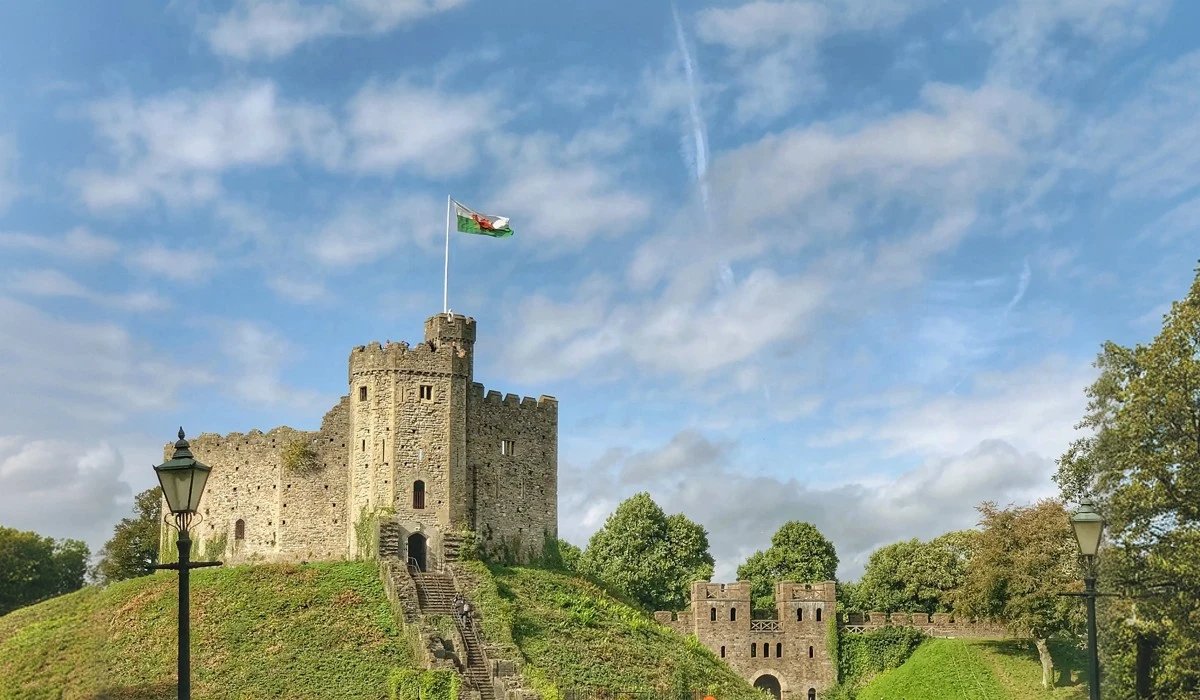
Edward I used stone to make his victory permanent. UNESCO records that Edward I constructed a sequence of significant fortresses along the North Wales coast, including Beaumaris, Caernarfon, Conwy, and Harlech. According to Cadw, these fortifications are commonly remembered as his "iron ring." These were symbols of a new period in the History of Wales.
Master James of Saint George
Documentation from UNESCO attributes the design of these castles largely to the architect James of St George, who was considered a leader in his field. These structures used the latest military technology. Caernarfon Castle even featured colored stone bands to look like the walls of Constantinople. This design signaled that Edward saw himself as a new Roman emperor.
Bastide Towns
The UNESCO report further notes that new towns were established within the massive walls of castles such as Caernarfon and Conwy. The king invited English merchants to live there and gave them special trading rights. Research from the Cambridge Urban History of Britain states that regulations ensured that borough lands were not to be transferred to the Welsh. This arrangement required the local population to stay in the countryside while the English controlled the money and the markets. It established a deep divide in the history of medieval Welsh history.
Cultural Resilience and the Legacy of Medieval Welsh History
Despite the loss of their princes and their laws, the Welsh people did not disappear. Their identity moved from the battlefield into their stories and songs. The History of Wales became a story of survival through culture.
The Bards and the "Prophecy"
Welsh poets, or bards, kept the memory of the princes alive. They sang about "Y Mab Darogan," a prophesied savior who would one day return to free the land. This belief kept the spirit of resistance burning in the small villages. While the English held the castles, the bards held the hearts of the people.
From Llywelyn to Owain Glyndŵr
The resentment from 1282 eventually boiled over again. Over a century later, a man named Owain Glyndŵr led a massive revolt. He used the same frustrations about English taxes and laws to unite the country one last time. Is Wales still a principality? No, Wales is a country and a recognized nation within the United Kingdom, rather than a principality. The title "Prince of Wales" is now a ceremonial title for the heir apparent to the British throne and does not carry sovereign power over the land.
The High Cost of Conquest: Economics of the 13th Century
Building the Iron Ring almost bankrupted the English Crown. Each castle costs thousands of pounds. Cadw highlights that Rhuddlan Castle was finished in 1282 at an astronomical cost of £9,613. This was a fortune in the 1200s. To pay for these walls, the English government taxed the Welsh people heavily.
The new economic system changed how farmers worked. Instead of providing food to a local prince’s court, they had to sell their goods in the new English bastide towns. This changed the History of Wales from a barter economy to a cash economy. Many Welsh families struggled to adapt to this new way of life, but they eventually became the backbone of the local markets.
Finalizing the Narrative of the History of Wales
The year 1282 remains a defining moment in the History of Wales. It marks the point where the native line of princes ended, and a new, more complicated identity began. The conquest did not erase the Welsh people. Instead, it forced them to find new ways to define themselves. They kept their language, their music, and their sense of place despite the massive stone castles looming over their homes.
Today, the ruins of Edward’s castles stand as tourist attractions. However, for those who know medieval Welsh history, they are reminders of a fierce struggle. The change from independent kingdoms to a unified nation within a larger union started in the mud of a 13th-century winter. That resilience defines the Welsh spirit to this day. The story of 1282 proves that while you can conquer a land with stone and iron, you cannot easily break the culture of the people who live there.
Recently Added
Categories
- Arts And Humanities
- Blog
- Business And Management
- Criminology
- Education
- Environment And Conservation
- Farming And Animal Care
- Geopolitics
- Lifestyle And Beauty
- Medicine And Science
- Mental Health
- Nutrition And Diet
- Religion And Spirituality
- Social Care And Health
- Sport And Fitness
- Technology
- Uncategorized
- Videos

