

Notepad++ Attack: Is Your PC At Major Risk Now?
Clicking "update" on a favorite text editor installs code while simultaneously handing over system keys based on blind faith. This specific trust creates a direct highway for intruders who prefer to ride in through the front door rather than break a window. A Reuters report cites that the program's researchers and developer, a Chinese-linked cyberespionage group exploited this highway in late 2025 to deliver a custom backdoor and malware to specific users.
The attack on Notepad++ supply chain exposed a serious flaw in how open-source projects manage the infrastructure designed to keep users safe. Users rely on updates to patch vulnerabilities, yet this incident turned the cure into the poison. Attackers compromised the delivery system itself, enabling them to bypass traditional defenses by riding on the back of a legitimate, trusted process. The software code remained clean, yet the delivery pipeline became a weapon. This breach challenges the assumption that official channels are always secure and highlights the fragile state of under-funded open-source infrastructure.
The Notepad++ Supply Chain Attack Timeline
Attackers bypassed the software entirely and compromised the delivery route instead. Don Ho, the developer of Notepad++, in a blog post reported by Reuters stated that hostile entities began targeting the update sequence for specific users starting in June 2025. This initial breach gave the attackers a foothold within the delivery system, permitting them to position themselves between the developers and the users. For months, this intrusion went unnoticed. The situation shifted on September 2, 2025, when the hosting provider patched the firmware and kernel. This action caused a partial remediation, temporarily locking the attackers out of their initial access point. But the threat actors adapted quickly.
A report by Hostinger reveals that although the attackers lost initial access in September, they retained internal service credentials active until December 2, 2025, which allowed the attackers to redirect traffic to their own servers. This pivot enabled continued access to their operations despite the provider’s updates. The Hostinger report further notes that they fixed vulnerabilities and rotated credentials on December 2, 2025, effectively locking out the malicious entities who unsuccessfully tried to re-exploit the system. Seven days later, on December 9, the developers released version 8.8.9, which included hardened verification to close the gap. Currently, remediation involves moving the entire infrastructure, with 8.9.1 or above now recommended for all users.
Exploiting the WinGUP Weakness
A locked door fails when the security guard recognizes the thief's uniform and lets them inside. The core of the attack relied on the WinGUP updater. This component manages the retrieval and installation of new versions. As outlined in the release notes on the Notepad++ website, a review identified a weakness in how the updater validates file integrity, specifically where versions preceding 8.8.9 failed to enforce strict cryptographic signature checks. This omission meant the updater did not rigorously check if the incoming data actually came from the rightful developers. It simply accepted the package if the connection looked correct on the surface.
Cybersecurity News reports that this flaw allowed interception or manipulate network traffic via TLS, substituting the legitimate installer with a rogue binary because the system failed to validate the legitimacy of the files. The system accepted this certificate as valid, allowing the malicious payload to flow onto the victim's machine. This technique transformed a routine maintenance task into a serious vulnerability. Don Ho expressed deep regret regarding this infrastructure breach. He acknowledged the manipulation of update traffic and confirmed that redirection occurred. This admission highlights how supply chain intrusions weaponize the tools users trust to keep their systems secure.
Surgical Targeting Strategy
A sniper rifle fires quietly compared to a shotgun, preventing panic until the damage is done. Distinct from cyber incidents aimed at mass infection, this campaign demonstrated extreme restraint. The targeting strategy focused on surgical precision rather than a "spray and pray" approach. While the compromise affected the update infrastructure, the malware delivery system filtered potential victims carefully. As detailed by Reuters, researcher Kevin Beaumont identified three specific organizations with interests in East Asia that experienced security incidents potentially tied to this campaign. This geographic and economic focus points to a motive beyond simple financial gain.
The hosting provider’s incident report supported this view, confirming that while the Notepad++ domain was specifically targeted, the general client base remained untouched. Kevin Beaumont noted that this precision explains why the breach went undetected for six months. If millions of users had received the malware, the noise would have alerted security firms immediately. By limiting the scope, the attackers operated in the shadows. Don Ho reported that despite reviewing 400 GB of server logs, specific indicators of compromise were absent in the general data, proving how selectively the attackers acted.
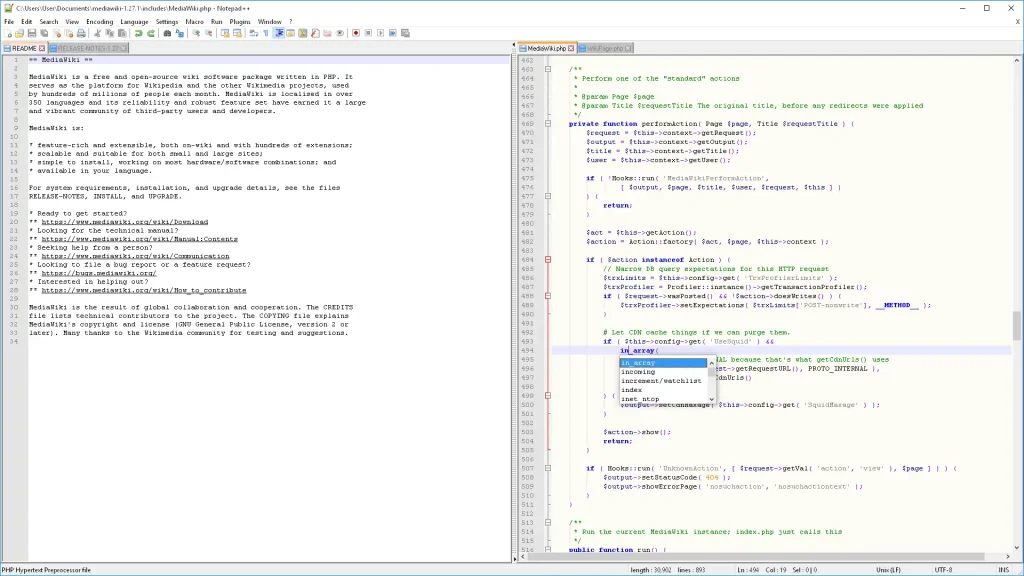
Image Credit - By Notepad++Original, Wikimedia Commons
Understanding the Chrysalis Malware
While some digital intruders smash and grab, others move in to watch victims for months. Rapid7 identified the payload delivered during the attack as a sophisticated custom backdoor they named "Chrysalis," describing it as a permanent tool with extensive capabilities rather than a simple throwaway utility. Differing from ransomware that locks files for payment, Chrysalis prioritizes long-term surveillance. Its design allows it to sit quietly on a compromised system, gathering intelligence without activating standard alarms. The malware disguised itself using legitimate-sounding filenames.
Incident responders found malicious binaries named update.exe, updater.exe, and AutoUpgrade.exe. These names appear standard, yet they are not native components of the authentic Notepad++ installation. This camouflage helps the malware blend in with normal system processes, making it difficult for automated scans to flag it as dangerous. Rapid 7's analysis noted the high capability of the tool. The features built into Chrysalis exceed those of standard disposable malware. It was built to persist, monitor, and extract sensitive data over extended periods. This aligns with the victim profile, as espionage against telecom and financial services requires tools that can remain obscured while exfiltrating high-value information.
Attribution: Lotus Blossom or Zirconium?
Two detectives looking at the same fingerprint might name different suspects if the records are messy enough. Identifying the exact group behind the Notepad++ attack has led to conflicting but related conclusions. Rapid7 Labs attributed the campaign to the Chinese APT group Lotus Blossom based on similarities to previous research. Conversely, a Dark Reading report notes that security researcher Kevin Beaumont attributed the attack to Violet Typhoon, also known as Zirconium or APT31. While the specific group names differ, the broader consensus points in the same direction.
Both Lotus Blossom and Zirconium are Chinese state-sponsored actors. The overlap in their targets—telecom and financial services with East Asian interests—suggests a coordinated effort aligned with national strategic interests. This attribution debate highlights the messy nature of modern cyber warfare. Groups often share tools or tactics, blurring the lines for researchers. Regardless of the specific label, the intent remains clear. The use of a supply chain compromise to deliver custom espionage tools indicates a well-resourced adversary with specific geopolitical goals.
Contradictions in the Investigation
Witnesses to a crime often describe the same event differently, revealing that truth is often a puzzle pieced together from partial views. The investigation into the breach produced several contradictions that complicate the narrative. A major point of divergence lies in the forensic evidence. Don Ho stated that no Indicators of Compromise (IoCs) were found in the server logs he reviewed. From the developer's perspective, the logs appeared clean. In contrast, Rapid 7 identified the Chrysalis backdoor through endpoint analysis on victim machines. This suggests the attackers scrubbed the server logs or bypassed logging protocols entirely, leaving evidence only on the final destination points.
Another nuance appears in the access method. The timeline shows a shift in tactics. From June to September, the attackers relied on the initial server compromise. They persisted after the firmware patch by using a different key to open the door, utilizing stolen credentials from September to December. This ability to adapt mid-campaign demonstrates agility. Is the software still vulnerable? While version 8.8.9 introduced hardening, older versions remain a risk. Users asking about malware must understand the vulnerability exists in the update process of legacy versions rather than the text editor's core code. The lack of binary verification in versions older than 8.8.9 means anyone running those iterations remains susceptible to similar interception attacks.
Broader Implications for Open Source
Closing a security hole often reveals how fragile the funding for the entire foundation was from the start. The supply chain attack shines a harsh light on the funding deficits in open-source software. Notepad++ is a critical tool used by millions of developers worldwide, yet its infrastructure operates with a fraction of the resources available to commercial giants. This disparity creates security gaps. Attackers know that while the code itself is often peer-reviewed and strong, the delivery infrastructure—websites, update servers, download mirrors—may be less defended.
The security community has warned that this incident is part of a larger trend. Search engines are currently saturated with trojanized clones of popular open-source tools. Attackers purchase ads or manipulate search rankings to present fake download sites to unsuspecting users. Browser extensions posing as legitimate tools also increase the risk profile. When users search for "Notepad++ download," they often encounter these imposters first. This creates an environment where verifying the source is difficult. The breach of the official update channel compounds this problem. If users cannot trust the official updater, and they cannot trust search results, the entire network of trust erodes.

The Role of Traffic Redirection
A roadmap is only useful if the street signs haven't been swapped by someone who wants you to drive off a cliff. The technical success of this attack relied heavily on traffic redirection. By manipulating the TLS handshake, attackers essentially kidnapped the digital conversation between the user's computer and the update server. In a standard secure connection, the user's computer checks the server's ID card (certificate) to ensure it is talking to the real Notepad++. In this case, the lack of strict enforcement allowed the attackers to present a fake ID—a self-signed certificate—that the updater accepted without question.
This allowed the attackers to sit in the middle of the connection. They could pass legitimate traffic through when they wanted to remain concealed, or inject the Chrysalis payload when they identified a target of interest. This "Man-in-the-Middle" capability is a potent weapon in supply chain attacks. It allows the adversary to be selective. They can let 99% of traffic flow normally, keeping the developers unaware of any issues. They only strike when the specific criteria of a high-value target are met. This selective redirection is why the breach lasted for six months without activating a massive outcry from the general user base.
Conclusion: Trust Verification
Trust acts as the foundation of the modern internet, but this incident proves that blind trust is a liability. The Notepad++ supply chain attack demonstrated how skilled actors exploit the gap between user assumptions and infrastructure reality. By compromising the update system, attackers bypassed the need to find flaws in the software itself, turning the patching process into an infection vector.
The six-month persistence of the attackers, despite partial remediation efforts, emphasizes the determination of state-sponsored groups like Lotus Blossom and Zirconium. For users, the lesson is clear: verify everything. Moving to version 8.9.1 is the immediate step, but the broader takeaway involves recognizing the vulnerability of the supply chain. Open-source projects require better funding and security resources to protect the infrastructure that powers the digital world. Until then, the "update" button remains a point of tension.
Recently Added
Categories
- Arts And Humanities
- Blog
- Business And Management
- Criminology
- Education
- Environment And Conservation
- Farming And Animal Care
- Geopolitics
- Lifestyle And Beauty
- Medicine And Science
- Mental Health
- Nutrition And Diet
- Religion And Spirituality
- Social Care And Health
- Sport And Fitness
- Technology
- Uncategorized
- Videos

