

Police Intelligence Reads A Killer’s “Signature”
A killer walks out of a house and shuts the door. He believes he left nothing behind. He wore gloves. He wiped the surfaces. He burned his clothes. But his mind still sits in that room. The way he moved the furniture tells a story. The path he took to get there reveals his home address. Most people see a tragedy, but detectives see a series of specific choices. These choices form a trail that exists long after the physical evidence fades.
Detectives used to rely on luck and physical clues. Today, they use data to read a killer's thoughts. This shift from traditional "gumshoe" work to modern Police Intelligence changed how we catch predators. It turns raw information into a suspect's profile. Investigators utilize specific offender profiling methods to bridge the gap between a cold crime scene and a suspect’s front door. They turn human behavior into a tracking tool.
Offender Profiling Methods: The Science of the Shadow
Profiling moves beyond simple guesses. It relies on behavioral science to categorize violent acts. Investigators look for "signatures" rather than just a way of working. A modus operandi (MO) describes what the killer does to finish the crime. According to research from the University of Pretoria, a signature is a distinct behavior that fulfills a specific psychological and emotional need.
For example, a killer might tie a knot in a specific way every time. He does not do this to kill the victim. He does it because it makes him feel powerful. These small habits help police link crimes across different cities. Behavioral scientists at the FBI’s Behavioral Sciencev Unit started this work in 1972. They proved that killers follow psychological rules.
Distinguishing Between Organized and Disorganized Killers
Offender profiling methods split killers into two main groups. Organized offenders usually have a higher IQ, averaging around 98.7. They plan their crimes carefully. They pick specific victims and bring their own weapons. They often follow the news to see what the police know. This behavior reveals a person who holds a steady job and fits into society.
Disorganized killers act on impulse. They have a lower average IQ of 94.7. They often leave the weapon at the scene. They do not hide the body. Their crimes look messy and chaotic. This tells investigators to look for someone who lives nearby and struggles with social or mental health issues.
Victimology: Why the 'Who' Matters as Much as the 'How'
Analyzing the victim's life provides the biggest clues. Detectives call this victimology; as noted in a textbook from JB Learning, this field is an essential part of investigating violent crimes and analyzing scenes to determine profile characteristics. They look at the victim's daily habits, friends, and risks. If a killer targets a person who never takes risks, the killer likely knows them. This suggests a personal connection or a long period of stalking.
If the victim is a stranger who takes high risks, like a runaway, the killer is likely a predator of opportunity. Profilers use this data to determine the offender’s risk level. They ask if the killer is getting bolder or staying within a comfort zone. Every detail about the victim sheds light on the person who targeted them.
How Modern Police Intelligence Changes Raw Crime Data
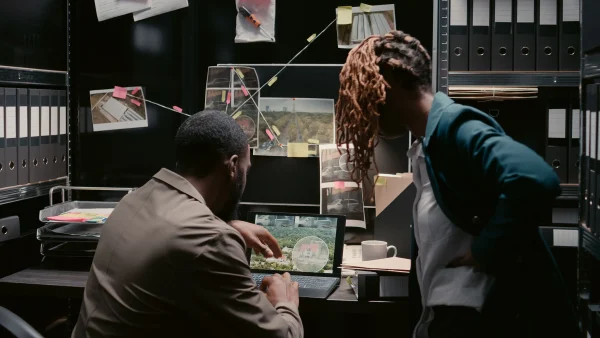
Modern investigations run on data. Police Intelligence involves collecting information from forensics, cameras, and bank records. According to the FBI, systems like the Violent Criminal Apprehension Program (ViCAP) store thousands of case files containing crime scene descriptions, offender identifiers, laboratory reports, and court records. The FBI notes that the system is built to collect and evaluate information regarding homicides, sexual assaults, missing persons, and cases involving unidentified human remains.
The speed of data processing allows for faster arrests. How do police track down unknown suspects? Law enforcement uses centralized databases to find patterns in behavior and location that human eyes might miss. Detectives cross-reference disparate data points to identify a suspect's likely demographic and habits. This technology helps officers focus on the most likely suspects immediately.
Connecting the Dots with Behavioral Evidence Analysis
Behavioral Evidence Analysis (BEA) is a four-step process. It uses physical evidence to reconstruct the killer’s actions. Unlike other offender profiling methods, BEA ignores general statistics. It focuses only on the specific evidence found at one scene. It assumes that every killer is unique.
This method requires a thorough examination of the physical space. Investigators look at where the struggle started and where it ended. They look for things that seem "off" or staged. This process helps police understand the relationship between the suspect and the environment. It turns the crime scene into a psychological map.
The Equivocal Death Analysis Phase
Sometimes, a scene looks like an accident or a suicide. Intelligence helps determine if a death is truly a homicide. Investigators perform "psychological autopsies" on the deceased; a report in PMC states that these examinations help clarify the mode of death in equivocal fatalities. Research published in PubMed further specifies that there should be a clear distinction between autopsies used for suicides and those for deaths labeled as equivocal. If the person was happy and making long-term plans, a sudden suicide seems unlikely. This pushes the investigation toward a murder case.
Identifying Forensic Awareness in Suspects
Some killers know how the police work. They might use bleach to destroy DNA or remove shell casings. This shows forensic awareness. Intelligence reveals if a suspect has a criminal record or military training. If a scene is too clean, it suggests a professional or someone who spent time studying crime. This narrows the search to people with specific backgrounds or previous arrests.
Geographic Profiling: Using Police Intelligence to Find the Anchor Point
Killers usually follow a spatial pattern. This is known as the "distance decay" principle. It states that most crimes happen close to where a killer lives or works. However, they rarely kill right on their own doorstep to avoid being noticed. They create a "buffer zone" around their home. A study published in ScienceDirect describes this buffer zone as a region of lower probability immediately surrounding that residence.
Police Intelligence software like Rigel creates a map of these locations. It looks at where bodies were found and where the victims were last seen. What is the goal of police intelligence in murder cases? The primary goal is to provide actionable leads that narrow a massive suspect pool down to a manageable few. Documentation from the Office of Justice Programs defines the offender's anchor point as the central point or mean of their geographic activity. This mapping points to the home base of the offender.
The Digital Fingerprint: Cyber-Intelligence and Profiling
Our lives exist online. This leaves a digital trail that killers cannot easily erase. Modern offender profiling methods now include analyzing social media and search history. Detectives look for "digital signatures" like specific words or interests. Even a killer’s GPS data from their phone can place them at the scene.
As detailed in an Interpol report, intelligence teams monitor the dark web to search for stolen data and accounts. Detectives look at the victim’s digital footprint to find where the killer first made contact. This often leads directly to a suspect’s IP address or account.
Predictive Analytics in Homicide Prevention
Intelligence can stop a murder before it happens. Threat assessment units look for "pathway to violence" indicators. This includes things like online manifestos or escalating threats toward an ex-partner. Police track these behaviors to intervene early. They use data to predict which individuals pose the highest risk of turning violent.
The Role of Dark Web Monitoring in Cold Cases
Cold cases often find new life through digital tools. Intelligence teams monitor the surface and dark web for people bragging about past crimes. They also use forensic genealogy. Since 2018, law enforcement has used investigative genetic genealogy to identify hundreds of violent offenders, according to PLOS Genetics. Research from the National Institutes of Health adds that this use of public genetic searches, highlighted by the Golden State Killer case, is rapidly becoming a routine procedure rather than an anomaly. They profile the killer's family tree until they find a match. This has solved cases that stayed cold for over forty years.
Overcoming the 'CSI Effect' with Authoritative Intelligence
Television makes profiling look like magic. In reality, it is hard work. Reliable Police Intelligence must support every profile. If a profile is too broad, it is useless. If it is too narrow, the police might ignore the real killer. This happened in the 1992 Rachel Nickell case, where Reuters reports that police focused on the wrong man, Colin Stagg, due to a flawed profile. The report mentions that investigators even used an undercover female officer as a "honeytrap" to try to get a confession.
Is offender profiling actually accurate? While not an exact science, when combined with forensic evidence, profiling has a high success rate in narrowing suspect lists. It is most effective when used as a directional tool rather than a stand-alone proof of guilt. Investigators use these tools to prioritize leads, not to replace physical evidence like fingerprints or DNA.
The Future of Criminology and High-Tech Investigations
Artificial Intelligence (AI) is the next step in catching killers. AI can analyze thousands of cases in seconds. It looks for "Marauders" who stay close to home and "Commuters" who travel to kill. It identifies patterns in how bodies are posed. This technology learns from decades of offender profiling methods and gets smarter with every case.
Machine learning helps police identify potential serial killers after their first crime. It flags "signature" behaviors that suggest a person will kill again. This allows police to put more resources into a case immediately. In the future, data will help solve murders before the trail even has a chance to go cold.
The Lifesaving Effect of Police Intelligence
Solving a murder involves the smart use of data and psychology in addition to standard investigative tools. When investigators combine human behavior with hard numbers, they create a net that is hard to escape. Every choice a killer makes becomes a tool for their own arrest.
The combination of psychological insight and Police Intelligence saves lives. It removes the guesswork from the hunt. Law enforcement focuses on the facts of the mind and the data of the world to ensure that no shadow remains for long. The future of public safety relies on this balance of science and strategy. We no longer wait for a killer to make a mistake; we use their own patterns to find them.
Recently Added
Categories
- Arts And Humanities
- Blog
- Business And Management
- Criminology
- Education
- Environment And Conservation
- Farming And Animal Care
- Geopolitics
- Lifestyle And Beauty
- Medicine And Science
- Mental Health
- Nutrition And Diet
- Religion And Spirituality
- Social Care And Health
- Sport And Fitness
- Technology
- Uncategorized
- Videos

