
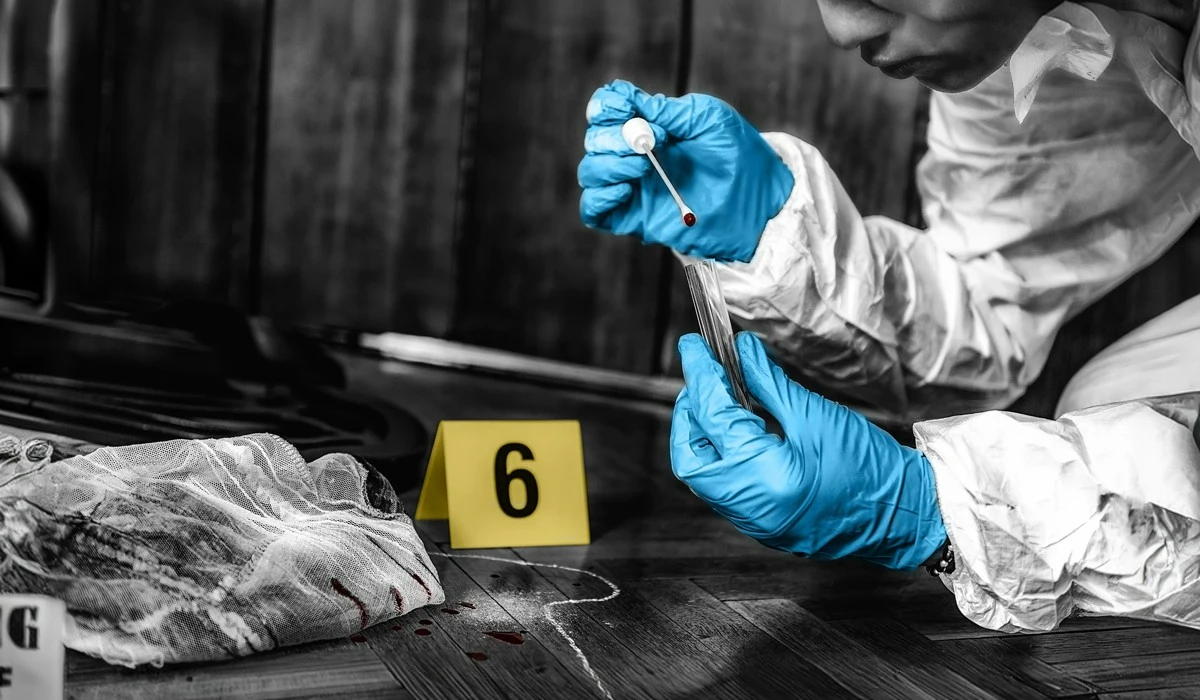
Detect Drug Shifts With Forensic Pharmacology Data
Watch any crime drama, and you will see a familiar scene play out. A body lies on a stainless steel table. A pathologist draws a vial of blood directly from the heart. Moments later, a printer spits out a number, and the detective declares a fatal overdose. The judge bangs the gavel, and the case is closed. It feels clean, precise, and scientific.
In actual practice, that heart blood sample often misleads investigators.
When a person dies, their body doesn't simply turn off like a light switch. It begins a chaotic, biological change. The energy pumps that keep cells intact fail. Barriers crumble. Fluids settle. According to a study in the Journal of Analytical Toxicology, site- and time-dependent variations known as postmortem redistribution can create a chemical mirage where a test result might show a lethal dose in a person who actually took a therapeutic amount.
Navigating this treacherous biological environment is Forensic Pharmacology. Without this specialized discipline, a standard toxicology report is just a list of numbers without context. We must understand the movement of drugs after death, a phenomenon known as postmortem redistribution, to distinguish between a tragic accident and a crime. This map of decay is the only thing standing between the truth and a miscarriage of justice.
Defining Forensic Pharmacology in Death Investigations
To understand why drug levels change after death, we first have to distinguish between two fields that are often confused. Forensic toxicology is the science of detection. It answers the question: "What is in the body?" It identifies substances, measures their weight, and creates a dataset. However, a dataset alone does not tell a story.
Forensic Pharmacology explains the behavior of that substance. It answers the questions: "How did it get there? When did it arrive? How did it move?"
This distinction is critical because a living body and a dead body follow different rules. In a living person, the heart pumps blood, the liver metabolizes toxins, and the kidneys filter waste. It is an active system requiring energy. In a dead person, those active systems stop. Gravity and chemistry take the wheel.
Forensic Pharmacology applies the principles of drug kinetics to a static, decomposing vessel. It recognizes that a blood sample is not a snapshot of the moment of death. Instead, it is a sample of a shifting environment. If an investigator relies solely on toxicology without the interpretive map of pharmacology, they are reading a map that is actively being rewritten by the decomposition process.
The Phenomenon of Postmortem Redistribution Explained
The Journal of Medical Toxicology describes postmortem redistribution as a toxicological nightmare, identifying it as the central challenge in modern death investigation. This term refers to the changes in drug concentration that occur after death, specifically the movement of compounds from solid organs into the blood. To understand why this happens, we have to look at how the body stores drugs while it is alive.
The Process of Movement

When you take a medication, it doesn't stay evenly mixed in your blood. As noted in a report in the Journal of Clinical Pathology, this movement involves substances redistributing into the blood from solid organs like the liver, lungs, and heart muscle, where many drugs prefer to reside during life. These organs act as reservoirs, soaking up high concentrations of the drug like a sponge. While the heart beats, the blood flows past these organs, maintaining a balance.
Research in the Journal of Medical Toxicology suggests that during the early postmortem period, passive diffusion from reservoir organs is the primary way drugs leak, seep, and flood into the bloodstream once circulation stops. Furthermore, an article in the Journal of Analytical Toxicology explains that the cessation of circulation causes a loss of membrane integrity, which initiates the release of intracellular enzymes and cell lysis; consequently, the cells in these organs break down, and the walls lose their integrity. Since there is no blood pressure to push them away, they seep into the nearest open space. Often, that space is a major blood vessel, such as the inferior vena cava or the pulmonary veins.
Concentration Gradients
This movement is not random. It is driven by physics. In life, the body uses energy (ATP) to push chemicals against the natural flow. In death, energy is gone, so substances obey the law of diffusion. They move from areas of high concentration to areas of low concentration.
Consider a drug stored heavily in the lungs. After death, the concentration in the lung tissue is massive, while the concentration in the stagnant blood of the nearby left atrium is low. Nature hates this imbalance. Over hours and days, the drug diffuses from the lungs into the heart blood.
This creates a serious problem for testing. If a coroner draws blood from that area, they aren't testing what was circulating in the brain at the time of death. They are testing a puddle of chemical runoff from the lungs.
Investigators often ask, "What causes postmortem drug redistribution?" It is primarily caused by passive diffusion of drugs from solid organs into nearby blood vessels along a concentration gradient after circulation stops and cellular membranes degrade. This passive drift can artificially inflate drug readings, making a safe dose look like a massive overdose.
Mapping the Body: Central vs. Peripheral Blood
Since we know drugs move, Forensic Pharmacology teaches us that location is everything. Where you draw the blood determines the accuracy of the result. We categorize blood sources into two main territories: Central and Peripheral.
The Heart Blood Trap
As highlighted in the Journal of Medical Toxicology, central blood taken from the heart or major torso vessels is significantly more prone to concentration shifts than peripheral blood. For decades, this was the standard source for testing because it is easy to access and provides a large volume of fluid. However, we now know the heart is a trap.
The report further explains that because the heart is physically connected to the lungs and sits right next to the liver, it acts as a "drainage basin" where drug concentrations are typically higher than those found in peripheral vessels. High concentrations of drugs from these reservoir organs leak directly into the heart chambers.
A famous case study presented at the National Association of Medical Examiners highlighted this danger. A deceased individual tested positive for fentanyl. The blood taken from the heart showed a concentration of 310 ng/mL, a level that screams "instant death." However, the blood taken from the leg showed only 17.6 ng/mL. The heart blood was contaminated by the release from the lungs. If the pathologist had only looked at the heart, they would have ruled it a massive overdose. The reality was much more involved.
The Femoral Standard
The Journal of Medical Toxicology also notes that experts prefer using the femoral vein because it is more abundant than other sites and less susceptible to these shifts. This vessel runs deep in the thigh, physically distant from the drug-rich organs like the liver and lungs.
Because these peripheral samples are anatomically isolated from the chest cavity, they are more likely to indicate the actual blood drug concentrations at the time of death. In the discipline of Forensic Pharmacology, the femoral sample is considered the gold standard. It offers the closest approximation to what was actually circulating in the brain and affecting the person when they died. It is the clean signal amidst the noise.
Drug Properties That Fuel Redistribution

Not all drugs behave the same way in a dead body. Some stay put, while others migrate aggressively. The severity of postmortem redistribution depends heavily on the chemical personality of the specific drug involved.
Volume of Distribution (Vd)
The most critical metric here is the Volume of Distribution (Vd). This is a theoretical concept used to describe how widely a drug spreads into the body's tissues.
A drug with a low Vd prefers to stay in the water of the blood. A drug with a high Vd prefers to leave the blood and hide in fat, muscle, and organs. Drugs with a high Vd are the most dangerous for forensic analysts. Because they hide in the tissues during life, they have a massive stockpile waiting to leak out after death.
If a drug has a Vd greater than 3 liters per kilogram (3 L/kg), it is almost guaranteed to undergo significant redistribution.
Lipophilicity and Basicity
Two other traits act as fuel for this movement: lipophilicity (fat-loving) and basicity (alkaline nature). Drugs that dissolve easily in fat can cross cell membranes with ease. This allows them to soak into organs quickly during life and leak out just as fast during decomposition.
Basic drugs, those with a high pKa, bind tightly to the acidic environments inside cells. For instance, research published in PubMed indicates that digoxin levels can increase after death, meaning high postmortem levels cannot reliably prove antemortem intoxication. The heart muscle is a magnet for basic drugs like Digoxin, which can detach from the muscle and float into the chamber. Tricyclic antidepressants (TCAs) are also notorious offenders.
This leads to a common query in the lab: "Which drugs are most susceptible to postmortem redistribution?" According to the Bulletin of Legal Medicine, basic and lipophilic drugs with a volume of distribution exceeding 3 l/kg, such as digoxin or tricyclic antidepressants like amitriptyline, are most prone to significant concentration changes. Recognizing these chemical traits allows the pharmacologist to predict which cases will be difficult and which data points might be inflated.
The Effect of Time and Decomposition
The map of the body changes by the hour. Forensic Pharmacology does not just look at chemistry; it looks at the clock. The Journal of Medical Toxicology states that the Postmortem Interval (PMI), the time that has passed since death, is a major variable in redistribution, alongside the body's position and the route of administration.
Algor Mortis and Diffusion
According to StatPearls, the internal cooling of the body that begins immediately after death is defined as Algor Mortis. Temperature plays a massive role in the speed of diffusion. Just as sugar dissolves faster in hot tea than in iced tea, drugs diffuse faster in a warm body.
In the first few hours, while the body is still warm, the rate of drug movement from organs to blood is at its peak. As the body cools to match the ambient temperature, the movement slows down. However, it never truly stops. Even in a cold body, the concentration gradient continues to pull drugs into the blood, albeit at a glacial pace. This means a sample taken 24 hours after death will look significantly different from a sample taken 48 hours after death.
Putrefaction Effects
As time marches on, bacteria take over. This stage, known as putrefaction, introduces a new layer of chaos. Bacteria are chemical factories. As detailed in the Journal of Analytical Toxicology, bacteria can demonstrate the bioconversion of nitrobenzodiazepines, such as flunitrazepam or clonazepam, which can lead to a false negative.
The article also mentions that microbial activity and the fermentation of glucose can cause bacteria to create new compounds, such as ethanol, which increases with the postmortem interval. This aligns with research in the Journal of Forensic and Legal Medicine stating that ethanol can also be produced after death through the bacterial degradation of glucose and other substrates. It is not uncommon to find a "ghost" alcohol level of 0.20 g/dL in a decomposed body that had not touched a drop of liquor. Forensic Pharmacology provides the tools to distinguish between the alcohol the person drank and the alcohol the bacteria produced.
Forensic Pharmacology Strategies for Accurate Analysis
So, how do we find the truth in this mess? If the heart is a trap and time is an enemy, what tools do experts use to fix the data?
The L/P Ratio
The most powerful mathematical tool in this field is the Liver-to-Peripheral (L/P) ratio. Experts measure the drug concentration in the liver and compare it to the concentration in peripheral blood, such as the femoral vein, and then calculate a ratio.
This ratio acts as a warning light. If the L/P ratio is low (typically less than 5), it suggests that the drug has not moved much. The blood result is likely stable and accurate. However, if the L/P ratio is high (often exceeding 20), it indicates massive postmortem redistribution. It tells the analyst that the drug has dumped out of the liver and potentially contaminated the blood samples.
Reference Tables
Forensic experts also rely on specialized data tables. In clinical medicine, doctors use "therapeutic" ranges. In a death investigation, those ranges are often useless because of the redistribution factor.
Instead, pharmacologists use tables derived specifically from postmortem cases. These tables account for the natural rise in drug levels after death. They provide a "redistribution factor" (F) for specific drugs. Analysts use this factor to mathematically adjust the raw number to estimate what the level likely was at the moment of death.
A frequent question arises during this analysis: "How do experts adjust for postmortem redistribution results?" Forensic experts often compare central blood concentrations to peripheral samples and utilize established redistribution factors to estimate the true antemortem drug levels. This cross-referencing is the only way to validate a finding before it ends up in a court report.
Real-World Consequences of Misinterpretation
The difference between reading the map correctly and getting lost can be the difference between freedom and prison. The principles of Forensic Pharmacology extend beyond theoretical discussion to decide the fate of human beings in courtrooms every day.
Consider a scenario involving a traffic accident. A driver hits a pedestrian, and the pedestrian dies. The driver admits to taking prescription medication but insists they were sober. The prosecution pulls a blood sample taken from the driver's heart during the autopsy (assuming the driver also died) or relies on a postmortem sample from a victim to prove impairment.
If the sample shows a high level of a drug like Methadone, the prosecution might argue for vehicular homicide, claiming the driver was grossly intoxicated.
However, a savvy defense attorney will hire a forensic pharmacologist. The expert will point out that Methadone has a high Volume of Distribution and is famous for postmortem redistribution. They will demonstrate that the sample came from a central source and was taken 24 hours after death. They will argue that the "lethal" level was actually a postmortem artifact, a ghost created by diffusion.
If the jury understands this, the charge might drop from homicide to a simple traffic violation. If they don't, an innocent person could be branded a killer based on bad science. These are the stakes.
The Final Map
Death tries to hide the truth. It blurs lines, shifts chemicals, and destroys evidence. But we are not helpless in the face of this decay.
Forensic Pharmacology Maps Postmortem Redistribution as it offers the scientific compass needed to navigate the dead body. It teaches us to ignore the deceptive high numbers found in heart blood and to seek the truth in the peripheral veins. It allows us to calculate the impact of time, temperature, and chemical properties.
While the biological chaos of postmortem redistribution makes the job difficult, the rigorous application of these principles restores focus. It ensures that when the dead speak through their chemistry, we are listening to what they are actually saying, not just the noise of their decomposition. In the end, science is the only map we have.
Recently Added
Categories
- Arts And Humanities
- Blog
- Business And Management
- Criminology
- Education
- Environment And Conservation
- Farming And Animal Care
- Geopolitics
- Lifestyle And Beauty
- Medicine And Science
- Mental Health
- Nutrition And Diet
- Religion And Spirituality
- Social Care And Health
- Sport And Fitness
- Technology
- Uncategorized
- Videos

