
Image Credit - by 9yz, CC BY-SA 4.0, via Wikimedia Commons
Waymo Brings Driverless Travel To London
Human drivers rely on eye contact and social cues to navigate traffic, yet machines replace this social layer with math. Why do we trust a stranger with a plastic license more than a computer that monitors every direction at once? Most people assume driving requires a "feel" for the road, but sensors prove that data beats intuition. Waymo represents a shift where software replaces the fallible human brain. This change moves people from reactive steering to predictive calculation.
Every mile driven by these vehicles builds a library of scenarios that no human could experience in a lifetime. We are moving toward a reality where the person in the front seat becomes a passenger in their own commute. This change relies on a system of constant observation that never suffers from a bad night's sleep or a wandering mind. The arrival of autonomous travel in the UK signals the end of the traditional driver-passenger relationship. People who want to grasp this shift must look past the shiny cars and into the logic of the systems running them.
The Arrival of Waymo and the 2026 Timeline
Rules written for humans often fail to account for software that never blinks or grows tired. Waymo records indicate that the project began in 2009 using a fleet of Toyota Prius cars to achieve ten uninterrupted 100-mile autonomous trips. Today, the focus shifts to the multi-layered streets of the United Kingdom. A report from HFW Law Firm notes that the legislative base arrived on May 20, 2024, with the Automated Vehicles (AV) Act. This law set the stage for a massive change in how people move through the capital. In December 2025, the government will launch an inquiry to handle licensing and incident investigations. This ensures every vehicle on the road meets a specific safety standard before the first commercial passenger hops inside. Spring 2026 marks the beginning of initial trials across multiple London boroughs.
According to Regit, Waymo will start its preliminary passenger service as a pilot scheme in April 2026. You might wonder, when will Waymo launch in London for the general public? A report by Auto Express states the company targets September 2026 for its earliest potential launch, with a goal for fully driverless ride-hailing by the end of that year. This timeline depends on a regulatory window in the first half of 2026. During this time, officials will grant permissions for commercial operations. The framework will shift again in the second half of 2027 when national self-driving regulations come into full force. This phased rollout allows the technology to learn the specific quirks of British driving before it scales across the entire country.
Economic Results and the New Job Market
Replacing a driver creates a chain of high-tech roles that previously lacked a purpose in the transport industry. Most people worry about job losses when they see a car driving itself, yet the data points toward massive growth. A publication from the Department for Transport projects the autonomous sector will contribute £42 billion to the UK economy by 2035. This expansion goes beyond saving money on fares; it builds an entire industry from the ground up. This growth engine will create between 38,000 and 40,000 new jobs. These positions range from remote vehicle monitors to specialized maintenance technicians who understand sensor calibration. The shift toward automation changes the way we value time and labor.
In the current model, a human driver represents a constant operating cost. In the autonomous model, the cost shifts toward the development and maintenance of the software and hardware. People often ask, are self-driving cars legal in the UK right now? As HFW Law Firm explains, the AV Act of 2024 makes them legal under specific testing and operational frameworks, clearing the path for full commercial use. This legal clarity attracts investment. Companies see the UK as a stable environment for high-tech deployment because the rules are clear and the economic results are vast. The government views these vehicles as a way to boost national productivity by reducing the time lost to traffic and accidents.

Image Credit by Dllu, CC BY 4.0, via Wikimedia Commons
Safety and the Tech Behind the Jaguar I-Pace
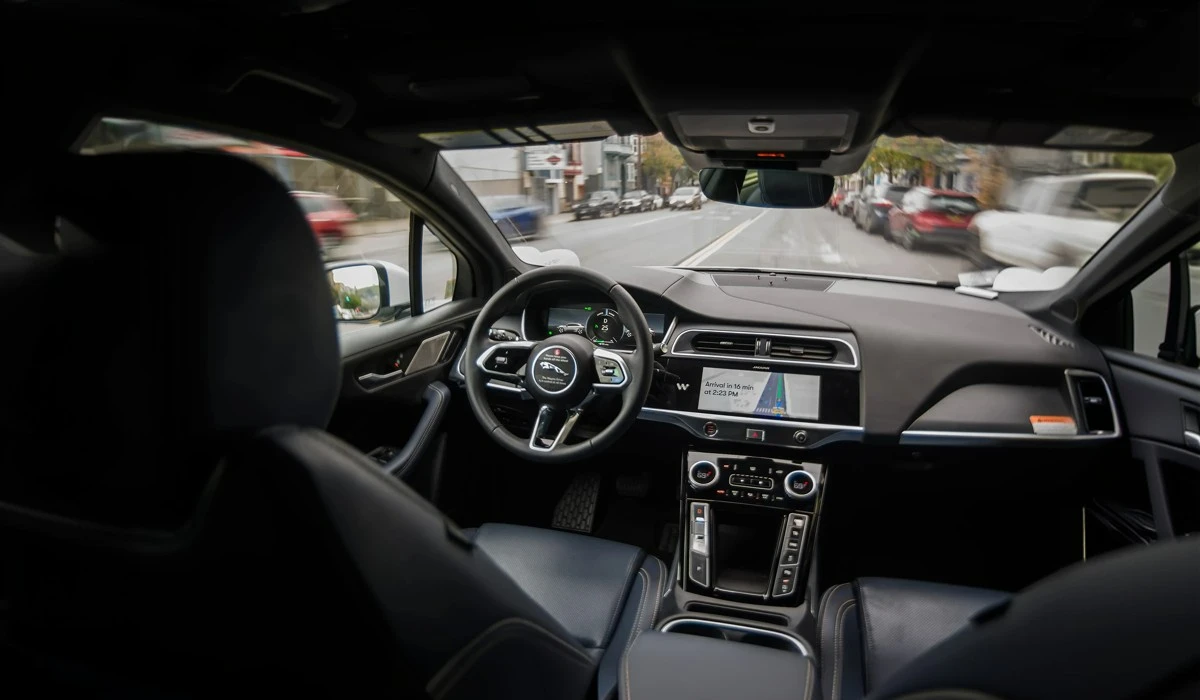
Machines eliminate human error by removing the emotions and physical limitations that typically drive a car. A computer does not get angry when another driver cuts it off, nor does it look at a smartphone while moving. Lilian Greenwood, the Minister for Transport, notes that these vehicles differ significantly from flesh-and-blood drivers. They offer zero exhaustion, zero loss of focus, and zero substance impairment. This technical readiness comes from real-time processing handled by a boot-mounted computer. This hardware joins data from multiple sources to make instant decisions. The Jaguar I-Pace serves as the primary hardware platform for this technology.
These tools allow the car to "see" and "hear" its surroundings with high precision. How safe are Waymo cars compared to humans? These vehicles use a 360-degree sensor suite that monitors everything within 300 meters, which is roughly the length of three football fields. This range far exceeds what a human can see through a rainy windshield at night. The system processes millions of data points every second to identify pedestrians, cyclists, and other hazards. Because the software has a cumulative history of 173 million miles, it has already "seen" almost every possible traffic scenario before it even arrives in London.
The Legal Framework: Security and Oversight
Laws usually react to the past, but current regulations must now predict how software handles an emergency it hasn't met yet. The UK government enforces strict security thresholds instead of letting these cars roam free. Minister Greenwood emphasizes that hacking prevention and digital safety protocols are mandatory for road access. This means the cars must be as secure against cyber threats as they are against physical crashes. As the government's Code of Practice outlines, organizations like the Department for Transport (DfT) and Transport for London (TfL) provide the oversight needed to keep the public safe.
The Center for Connected and Autonomous Vehicles (CCAV) also plays a major role in managing this change. They ensure that as the technology evolves, the laws evolve with it. One major focus is teleoperation, which allows a remote human to intervene during "edge cases." If a car encounters a situation it doesn't understand, a wireless network allows a human operator to take control or provide guidance. This Level 4 autonomy ensures the vehicle never stays "stuck" in a difficult spot. However, safety advocates have raised concerns about the workload of these remote workers and potential delays during handovers. The regulatory framework must address these human-machine interactions to maintain a high safety standard.
Navigating the Variety of London Streets
Faded paint and narrow lanes force computers to guess where humans usually just "feel" the road. London presents a unique challenge compared to the wide, grid-based streets of Phoenix or San Francisco. The city features ancient road layouts, confusing roundabouts, and dense pedestrian traffic. Waymo currently operates a mapping fleet of 24 Jaguars. These cars have human safety drivers who record every detail of the environment. They map the exact height of curbs, the position of traffic lights, and the typical flow of traffic in specific neighborhoods.
The 2026 testing zones include a wide variety of boroughs. Vehicles will navigate the busy streets of Westminster and the City of London, as well as residential areas like Greenwich, Hackney, and Islington. Other zones include Camden, Lambeth, Lewisham, and Southwark. When the system tests in diverse areas like Tower Hamlets, Wandsworth, and Ealing, it learns to handle everything from heavy industrial traffic to narrow suburban side streets. Even boroughs like Barking & Dagenham, Brent, Haringey, Newham, Redbridge, and Waltham Forest will see these cars. This broad geographic footprint ensures the software can handle the "London style" of driving, which often involves assertive movements and tight spaces.
Launching Waymo and the Global Race
Launching a robot taxi service requires winning trust before the first passenger even opens the door. While Waymo leads the pack, it is not the only player in the game. Companies like Uber are partnering with Wayve, a UK-based AI developer, to start their own trials. Lyft is working on a deal with Baidu to bring the Apollo Go platform to London. Even Tesla’s Elon Musk predicts millions of robotaxis will be on the road by the end of 2026. This competition drives innovation, but it also creates a race to see who can navigate the regulatory hurdles the fastest. The pricing of Waymo will likely follow a high-end positioning at first.
Fare increases during peak periods will help manage demand while the fleet is still growing. Ben Loewenstein, the Head of Policy, explains that the company is moving from a gradual US expansion to a global scaling model. This requires navigating strict oversight and the high costs of deploying advanced technology. Despite the competition from firms like Verne in Croatia or Nissan's partnership with Wayve, Waymo relies on its massive data lead. According to a Waymo blog post, the company has grown its fleet to over 1,500 vehicles across several major cities, which gives them more real-world experience than almost any other firm. This experience is the primary tool they use to convince Londoners that their technology is reliable and ready for the UK’s most crowded streets.

Image Credit - by Daniel Ramirez from Honolulu, USA, CC BY 2.0, via Wikimedia Commons
Operational Constraints and the Future Road
A machine's performance depends entirely on the boundaries set by its human creators and the environment it inhabits. Even with the best tech, Waymo will face constraints at launch. The service likely won't include airport drop-offs immediately. It will focus on specific routes and boroughs where the mapping is most complete. This gradual approach allows the system to prove its worth in controlled areas before expanding to the entire city. The goal is to provide a service that feels more like a utility than a novelty.
Waymo Co-CEO Tekedra Mawakana expresses enthusiasm for the arrival in London. She believes the service will improve transport access and make streets safer for everyone. When the company scales responsibly, it hopes to avoid the pitfalls that have slowed down other tech shifts. The focus remains on "responsible operation," a phrase that highlights their commitment to following local laws and cultural norms. As we move toward 2035, the sight of a Jaguar I-Pace without a driver will become a normal part of the London scene. The change marks a point where we stop looking at the driver and start looking at the destination.
The Logic of the Driverless City
The shift to autonomous travel reveals that most of our traffic problems stem from the unpredictability of human behavior. When every car follows the same logic and shares the same data, the "ghost" traffic jams caused by sudden braking begin to vanish. Waymo is the first major step in turning the city’s roads into a high-speed data network. The technology provides a ride without a driver and creates a road system that functions with mathematical precision. We are trading the freedom of the individual driver for the safety and reliability of a managed fleet.
This change requires a new way of thinking about urban life. We no longer need massive parking garages if cars can simply move to the next passenger. We don't need to worry about intoxicated drivers if the car itself is incapable of impairment. When the city integrates Waymo into the existing transport network, the streets can breathe easier. The focus shifts from the struggle of the commute to the productivity of the trip. As the 2026 launch approaches, the reality of the driverless city moves from a concept to a daily experience for millions of Londoners. Waymo engineers have completed the math, the sensors remain active, and the road waits for the first passengers.
Recently Added
Categories
- Arts And Humanities
- Blog
- Business And Management
- Criminology
- Education
- Environment And Conservation
- Farming And Animal Care
- Geopolitics
- Lifestyle And Beauty
- Medicine And Science
- Mental Health
- Nutrition And Diet
- Religion And Spirituality
- Social Care And Health
- Sport And Fitness
- Technology
- Uncategorized
- Videos

