
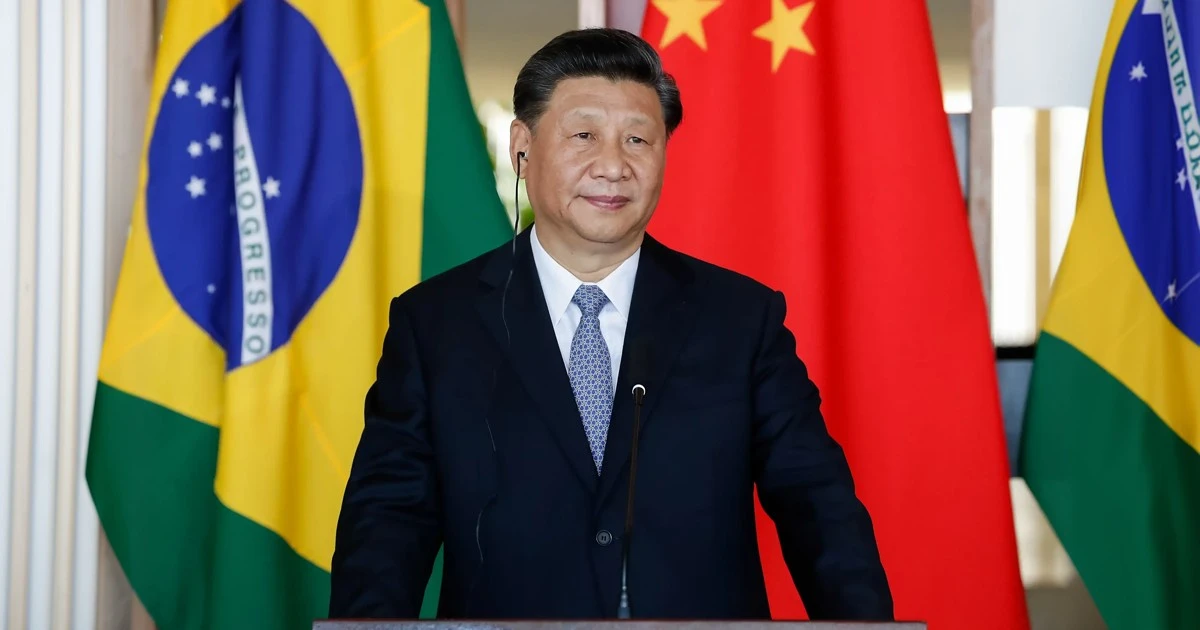
Image Credit - By Palácio do Planalto, Wikimedia Commons
Xi Jinping Purges 2 Key Military Leaders
Absolute control often requires the complete isolation of the leader. This reality drove the stunning events in Beijing over the weekend. According to a statement from the Defense Ministry reported by AP News, authorities are investigating Zhang Youxia, the senior vice chair, and Gen. Liu Zhenli, the head of the Joint Staff Department, effectively removing them from the Central Military Commission (CMC). This move stripped the country’s highest military body down to just two members. The decision shocked international observers and signaled a dramatic shift in how China manages its armed forces. Xi Jinping’s military purge has now reached a historic level of intensity, rivaling the centralization efforts of the Mao period.
Reuters notes that Zhang served as the second-in-command to President Xi and was viewed as his closest ally; his removal eliminates the buffer between the Party leader and the operational commanders. The removal of Zhang and Liu effectively cleared the board of experienced peers. The official narrative points to discipline, but the scale of these removals suggests a deeper systemic reset. The Defense Ministry stated that the generals were under investigation for suspected "serious violations of discipline and law," as reported by Reuters. This phrase typically serves as code for corruption. However, the resulting power vacuum creates a climate of suspicion that extends far beyond simple graft. The PLA now faces a leadership void that creates uncertainty about its decision-making capabilities.
The Weekend Shock: Dismantling the Hierarchy
Rapid dismissals of top officials usually signal a pre-emptive strike rather than a standard bureaucratic shuffle. The timing of this purge caught many off guard. Over the weekend, state media confirmed the removal of General Zhang Youxia and General Liu Zhenli. These were not low-level officers. They sat at the very top of the military pyramid. Their absence from a high-level party event in December offered a timeline clue, but the official confirmation cemented the reality.
The Central Military Commission (CMC) creates the strategy for the entire People’s Liberation Army (PLA). Historically, this body maintains a membership of about seven people. This structure ensures a distribution of responsibility. Xi Jinping’s military purge has whittled this membership down to just two people: Xi Jinping himself and Zhang Shengmin. Zhang Shengmin serves as the chief of discipline. This means the only people left at the table are the supreme leader and his enforcer.
Analysts point to the 1980s as the last parallel for this situation. During the Deng Xiaoping period, power concentrated heavily at the top. However, the current consolidation removes even the pretense of collective military advice. The removal of the top generals leaves Xi with unchallenged control. This centralization eliminates rivals, but it also removes the experienced voices needed during a crisis.
Why Zhang Youxia Matters
Shared history often accelerates a downfall instead of preventing it. Zhang Youxia possessed a background that usually guarantees safety in Chinese politics. At 75 years old, he held significant status as a "princeling." His father was a comrade of Xi Jinping’s father during the revolutionary days. This family connection typically offers a shield against political attacks. Zhang was also a close ally, considered by many to be a friend to the President.
Zhang stood out for another reason: his combat record. He joined the army in 1968. He fought in the border wars with Vietnam in 1979 and 1984. This made him one of the few serving leaders with active battlefield experience. Most current PLA officers have never seen actual war. Zhang represented a link to the PLA’s fighting past. His removal severs that link.
The betrayal of trust appears total. Alfred Wu notes that trust withdrew recently despite their long connection. The system promoted Zhang past the standard retirement age, signaling his importance. His sudden fall suggests that past loyalty provides no insurance against current suspicions. Xi Jinping’s military purge proves that even the deepest historical ties cannot protect a general who becomes a liability.
The Official Charge vs. The Reality
Generic legal labels frequently cover up specific political fears. The government charged the generals with "serious violations of discipline and law." Inside the opaque Chinese political system, this accusation functions as the standard euphemism for corruption. The state maintains a zero-tolerance policy for graft. However, observers see contradictions in the official story. Alfred Wu points out that graft is rarely a sudden occurrence. If corruption existed, it likely spanned years. The timing of the removal suggests other factors prompted the decision.
A report by the Wall Street Journal, cited by Bloomberg, introduces a much more serious allegation, suggesting that Zhang faced accusations of passing secret details regarding the country’s nuclear weapons program to the United States. Other rumors involve taking bribes for promotions. These specific allegations paint a darker picture than simple embezzlement. A leak of nuclear secrets constitutes treason. This possibility explains the severity and speed of the reaction.
What is the main reason for the PLA purge?
The state officially accuses the generals of corruption, but experts believe the real motive is to eliminate anyone who accumulates too much political influence or threatens centralized power.
Chong Ja Ian notes that speculation is now rampant. The secrecy surrounding the decision fuels wild rumors. Some talk of coup attempts. Others whisper about gunfights in Beijing. The official silence allows these narratives to spread. The contrast between the boring charge of "discipline violations" and the rumors of high treason creates a volatile atmosphere.
Decimating the Central Military Commission
A command structure with no members creates a direct line to the top that no one dares use. The reduction of the CMC is the most striking aspect of this event. A seven-member committee allows for debate, delegation, and specialized focus. A two-member committee consisting of a dictator and a disciplinarian creates a bottleneck.
Neil Thomas describes this as the most significant removal since the Mao period. He compares the magnitude of this event to the arrest of the Chairman of the US Joint Chiefs of Staff. Such an action in the West would signal a total collapse of military order. In Beijing, it signals a consolidation of party authority. Xi Jinping’s military purge completely alters the architecture of the state.
The remaining member, Zhang Shengmin, focuses on discipline, not warfare. This means the operational expertise within the supreme command body currently stands at zero. The leadership void is real. Lyle Morris argues that the PLA organization is now chaotic. Senior leadership helps translate political goals into military action. Without them, the chain of command breaks down.
The Loyalty Trap and Motivation
Excessive loyalty can look like a power base to a paranoid leader. Why would Xi remove his closest ally? Dennis Wilder offers a persuasive theory. He argues that the financial crimes serve merely as a pretext. The real motive was that General Zhang accumulated excessive influence. In an autocracy, a subordinate who becomes "too powerful" eventually becomes a threat.
This perspective aligns with the timeline. Zhang Youxia had links to the promotion of former Defense Minister Li Shangfu. The state expelled Li in 2024. The network surrounding Zhang began to look like a faction. Xi Jinping prioritizes the prevention of Soviet-style collapse above all else. Neil Thomas notes that Xi values Party discipline over individual loyalty. If a trusted friend creates a faction, that friend must go.
The centralization rivals the control exercised by Mao. However, Mao operated in a different time. Today’s military requires advanced technical knowledge. Removing the "too powerful" generals ensures no one can challenge his authority. But he also ensures that no one can save him from a bad decision. Xi Jinping’s military purge trades competence for security.

Image Credit - By CEphoto, Uwe Aranas
Effect on Taiwan Strategy
Political chaos in the capital creates hesitation on the front lines. The world watches these developments closely because of the implications for Taiwan. The U.S. Department of Defense’s Annual Report to Congress states that China expects to possess the capability to fight and win a war over Taiwan by the end of 2027. The purge throws a wrench into these plans.
Lyle Morris suggests that the purge creates a vacuum that leads to cautious and weak decision-making. Officers looking at the fate of Zhang Youxia will hesitate to take risks. Escalation decisions now depend solely on Xi’s instincts. There are no experienced generals left to advise him or check his impulses.
Will the purge stop China's Taiwan plans?
Analysts believe the political turmoil might slow decision-making and expose operational weakness, but the aggressive military goals regarding Taiwan remain unchanged.
However, contradictions exist here. Lyle Goldstein warns it is an error to assume command incompetence. He notes that the deployment of advanced weaponry continues. The ambition to take Taiwan remains unchanged. The machine of the PLA continues to operate even if the heads are rolling in Beijing. The purge might affect the quality of the leadership, but not the intent of the mission.
Modernization Meets Corruption
Pouring money into defense systems naturally invites the theft that undermines them. The PLA has ambitious goals for 2035 and 2049. They want a world-class military. Yet, the drive for modernization fuels the corruption that Xi Jinping’s military purge tries to stamp out.
The removal of Zhang is part of a wider pattern. The state targeted the Rocket Force in 2023. This unit manages China’s nuclear arsenal. Authorities expelled CMC Co-vice chair He Weidong in October 2025. Now, Zhang and Liu are gone. The pattern shows a systematic cleansing of the top ranks.
Alfred Wu suggests that graft in the military is rarely a sudden occurrence. It is woven into the procurement process. As the PLA spends billions on new ships and missiles, officers find ways to take a cut. Lyle Goldstein notes that procurement might slow due to these graft crackdowns. Officers will be afraid to sign contracts or approve deals. The fear of being labeled corrupt paralyses the modernization effort.
The Climate of Fear
When rank offers no protection, inaction becomes the safest survival strategy. The atmosphere within the PLA is now one of intense suspicion. A recent editorial in the PLA Daily emphasized that rank offers no protection against punishment. The message is clear: the Party authority comes first. Trust has been betrayed.
Chong Ja Ian highlights the uncertainty fueled by secrecy. When the government refuses to explain why top generals are vanishing, soldiers assume the worst. Rumors of leaked secrets and failed coups damage morale. The "serious violations of discipline" label is too vague to reassure anyone.
Who is left in China's military leadership?
Xi Jinping holds direct control alongside discipline chief Zhang Shengmin, while most other top seats on the Central Military Commission sit empty following the recent removals.
The climate of suspicion leads to paralysis. If a general acts boldly, he risks being seen as "too powerful." If he does nothing, he risks being seen as incompetent. The safest path is to wait for orders from Xi. Xi Jinping’s military purge has successfully terrified the officer corps. The question remains whether a terrified army can fight effectively.
The Gamble of Control
The removal of Zhang Youxia and Liu Zhenli marks a turning point in Chinese military history. The events of the weekend dismantled the leadership structure of the PLA. Reducing the CMC to just two members centralized power to a degree not seen since the 1980s. Xi Jinping’s military purge prioritizes political safety over military experience.
This strategy carries immense risk. The purge eliminates potential rivals and factions, securing Xi’s position. Yet, it strips the military of its most experienced combat veterans. It replaces trust with fear. The rumors of nuclear leaks and treason indicate deep cracks in the system. As the 2027 deadline for Taiwan readiness approaches, the PLA finds itself decapitated. The body of the army remains strong, but the head is now missing. The coming months will reveal if total control is worth the price of total isolation.
Recently Added
Categories
- Arts And Humanities
- Blog
- Business And Management
- Criminology
- Education
- Environment And Conservation
- Farming And Animal Care
- Geopolitics
- Lifestyle And Beauty
- Medicine And Science
- Mental Health
- Nutrition And Diet
- Religion And Spirituality
- Social Care And Health
- Sport And Fitness
- Technology
- Uncategorized
- Videos

