

Likability Science Turns Random Meetings To Bonds
You know that one person at the party. They don't beg for attention, yet they pull the whole room toward them like gravity. Then there’s the other person—the one handing out business cards, laughing too loudly, trying to force a connection that just isn’t happening. We usually write this off as "chemistry" or "natural charm." However, identifying it as such is an error.
Charisma is actually a predictable sequence of behavioral cues. It is Likability Science.
We tend to view social success as an art form, something ethereal that you either have or you don't. Research paints a different picture. Your brain runs specific checks when you meet someone new. When you understand how the human mind scans for safety and value, you can reverse-engineer the way people react to you. This post explains the specific social attraction factors that start positive responses in the brain, turning random encounters into genuine connections.
The Core Psychology Behind Likability Science
We like to think we judge friends based on complicated shared interests or deep philosophical alignment. In reality, our brains use a crude survival filter first. Research published in PubMed Central indicates that Likability Science serves as a survival tool because the brain is a high-energy organ, consuming roughly 20% of the body's oxygen and calories. Before you can impress someone with your intellect, you have to survive their amygdala. Our ancestors needed to know instantly if a stranger was there to help share the fire or steal the food.
The Safety-Bias Connection
The Stereotype Content Model, developed by social psychologists Fiske, Cuddy, Glick, and Xu, explains this rapid sorting process. They found that humans judge everyone on two primary dimensions: Warmth and Competence.
Warmth answers the question: "What are this person's intentions toward me?"
Competence answers the question: "Can they act on those intentions?"
Here is the catch. According to the Stereotype Content Model, the brain prioritizes warmth because intent predicts behavior, much like a sentry asking "friend or foe?" to ensure survival. You must establish trust before you establish power. If you project high competence but low warmth, people view you with envy or suspicion. If you project high warmth but low competence, they view you with pity. The "Golden Quadrant" of social attraction happens when you project both. You need to smile and show interest (Warmth) while clearly demonstrating you know what you are doing (Competence).
People often overcomplicate this and ask what makes a person scientifically likable? Research suggests it is a combination of perceived warmth (trust) and competence (capability) projected simultaneously. You cannot skip the warmth step and expect people to follow your lead.
Cognitive Ease and Attraction
The brain constantly looks for shortcuts. It loves "cognitive ease," which is the mental state where things feel familiar, simple, and safe.
According to research on processing fluency, consistent and easy-to-read behavior is preferred because it lowers the "processing cost" for the other person. A study published in PubMed notes that if you are erratic or hard to read, the other person’s brain must exert more effort to understand you. As noted in the Journal of Personality and Social Psychology, this mental effort produces a subtle feeling of discomfort. Likability Science dictates that you should be the path of least resistance. Simple language, clear intentions, and predictable manners make you mentally "easy to digest," which the brain interprets as attraction.
The Role of Similarity in Social Attraction Factors
Opposites do not attract. That is a myth from romantic comedies. As documented in a study published in PMC, the similarity-attraction effect determines social interaction, showing that higher attitude similarity leads to increased liking, with a correlation of r = 0.46. We gravitate toward people who reflect our own reality back to us. This happens because a similar person validates our own choices and beliefs. If they think like us, then we must be right.
The Mere Exposure Effect
Familiarity breeds comfort, not contempt. Robert Zajonc’s research in the 1960s established the "Mere Exposure Effect." He found that simply showing people a stimulus (like a foreign character or a face) multiple times increased their affection for it.
Research published by Oxford Academic indicates that this effect follows a logarithmic curve rather than a linear one, meaning the jump in likability from seeing someone zero times to seeing them ten times is significant before the effect eventually stabilizes. This is why "showing up" is half the battle in networking. You don't even need to have a deep conversation every time. Just being a consistent, visible presence makes you statistically more attractive to the group. The brain mistakes "I have seen this face before" for "This person is safe and good."
Echoing Values and Attitudes
You must distinguish between surface-level similarity and deep-level similarity. Surface-level similarity includes things like wearing the same brand of shoes or cheering for the same sports team. This creates a quick, short-lived bond.
Deep-level similarity drives lasting Likability Science. This involves shared values, morals, and attitudes. A study by Harrison et al. showed that while surface traits spark initial interest, deep-level alignment sustains the connection. When you discover you both value "radical honesty" or "family first," the bond solidifies.
When looking at your own circle, you might ask why do we like people similar to us? The answer is that shared attitudes provide social validation and reduce the mental load required to understand the other person. You don't have to explain your worldview to them; they already get it.
The Reciprocity Loop and Social Feedback
Humans have a hardwired debt-repayment system. If you buy me a coffee, I feel an urge to buy you one back. This applies to emotions just as much as money. One of the strongest social attraction factors is the knowledge that someone else likes you.
Reciprocal Liking
In a landmark study by Curtis and Miller, strangers were paired up. One group was told their partner liked them. The other group was told their partner disliked them. When they met again, the people who thought they were liked actually behaved with more warmth, openness, and likability.
It became a self-fulfilling prophecy. Because they believed they were liked, they dropped their defenses. This signals to the other person that you are safe. If you want someone to like you, find a subtle way to let them know you enjoy their company. The moment they realize they have your approval, their brain will begin to generate approval for you in return.
The Pygmalion Effect in Social Settings
The Pygmalion Effect states that higher expectations lead to an increase in performance. Rosenthal and Jacobson originally studied this in schools, but it applies perfectly to social dynamics.
When you treat an uninteresting person as if they are the most interesting individual in the room, they often rise to the occasion. Your interest acts as a social spotlight. They stand taller, speak with more animation, and actually become more interesting. When you give them the gift of your attention, you trigger a reward loop. They associate that feeling of greatness with you, cementing your place in their mind as a charismatic presence.
Applying Likability Science to Non-Verbal Cues
We judge people before they speak a single word. Research in PubMed indicates that this "thin-slice" judgment occurs in as little as 100 milliseconds. Your body language communicates your social value and safety levels directly to the observer's reptilian brain.
The Science of Mirroring (Isopraxis)
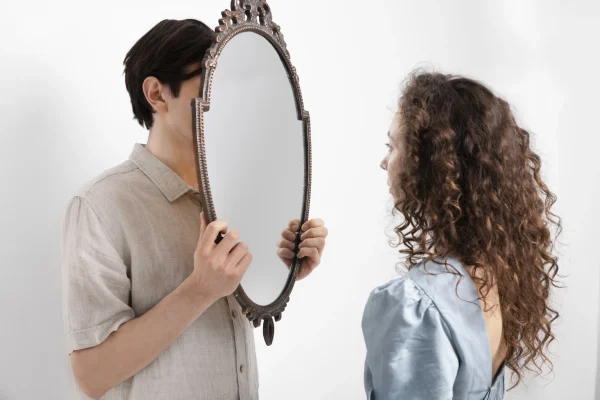
Isopraxis is the technical term for mirroring. It means "same behavior." A study in PMC found that participants liked partners more when their postures were subtly mimicked, leading to smoother interactions. This is driven by "mirror neurons." These neurons fire both when you do an action and when you see someone else do it. They are the biological basis of empathy. You can use this Likability Science by subtly mirroring the posture or tempo of the person you are talking to, which sends a silent signal: "I am like you."
The key is subtlety. If you mimic them like a mime, it feels like mockery. But if they lean back, and you wait ten seconds to lean back, their subconscious registers you as a synchronized, safe ally.
Signals of Openness
Your body language needs to communicate "safety." Closed postures—crossed arms, hiding hands, turning the torso away—trigger a defensive response in others.
To maximize social attraction factors, you need to display vulnerability signals. When you show the palms of your hands, you send a primitive signal that you hold no weapons. An "eyebrow flash" (a quick raising of the eyebrows) is a universal sign of recognition and welcome. These small physical adjustments bypass the skeptical logic center of the brain and speak directly to the emotional center.
The Pratfall Effect: Imperfection as an Asset
We often try to hide our mistakes to appear impressive. This backfires. Perfection creates distance. It makes you seem like a statue rather than a human. Likability Science offers a counterintuitive solution: be clumsy.
Vulnerability vs. Competence
A report by The Guardian describes an experiment by Elliot Aronson where an actor who answered 92% of questions correctly was rated significantly more likable after pretending to spill coffee. In one version, the actor simply finished the quiz. In the second version, the actor finished the quiz and then clumsily spilled a cup of coffee all over himself.
The results were noteworthy. The students found the clumsy contestant more likable than the perfect actor. The spill humanized him. It took him from "intimidatingly perfect" to "relatable."
Relatability Over Superiority
There is a major caution here. The Pratfall Effect only works if you have already established competence. If an average person spills coffee, they just look messy. You must demonstrate high value first.
Once people respect your ability, a small flaw bridges the gap between admiration and envy. It allows the other person to relax. They no longer feel they have to compete with your perfection. Revealing a weakness increases your social strength.
Communication Patterns That Trigger Attraction
Your words matter, but perhaps not in the way you think. According to a constructivist approach to listening published in ResearchGate, listening is an intentional process used to understand and respond to messages appropriately, rather than just waiting to speak.
The Power of Active Constructive Responding
Shelly Gable’s research identifies four ways we respond to good news. Let’s say your friend gets a promotion.
Passive Destructive: You ignore it. "What's for lunch?"
Active Destructive: You point out the downside. "Now you'll have to pay more taxes."
Passive Constructive: Low energy support. "That's nice."
Active Constructive: You celebrate with them. "That is huge! When did you find out? How did you feel?"
Only Active Constructive responding builds relationships. It validates the other person's joy. It creates a shared positive moment. People who use this style are viewed as significantly more attractive because they act as a multiplier for other people's happiness.
Spontaneous Trait Transference
Be careful what you say about others. Research cited by the American Psychological Association suggests that listeners form impressions of speakers based on how that speaker describes others; this is known as Spontaneous Trait Transference.
If you constantly complain that your boss is "lazy and dishonest," the person listening to you begins to link the concepts of "lazy" and "dishonest" to your face. The brain blurs the source of the trait. Conversely, if you describe your colleague as "brilliant and kind," the listener’s brain paints you with those same brushes.
In the context of conversation habits, readers often look for shortcuts and ask how I can improve my likability instantly. Studies show that asking follow-up questions and allowing others to speak about themselves triggers the same pleasure centers in the brain as food or money. Combine this with positive gossip about others, and you become a magnet for goodwill.
The Halo Effect and First Impressions
Your first impression sets the filter for every interaction that follows. This is due to the Halo Effect. As noted in OpenTextbooks, Edward Thorndike established the "Halo Effect" in 1920. This cognitive bias causes our brain to take one positive trait and assume the person possesses other unrelated positive traits.
Visual Cues and Assumptions
Research in the Journal of Personality and Social Psychology shows that people often attribute better personality traits and life outcomes to attractive individuals compared to unattractive ones. If someone is physically attractive or well-dressed, we subconsciously assume they are also intelligent, kind, and honest. It isn't fair, but it is reality.
This doesn't mean you need to be a supermodel. It means you need to control the cues you can manage. According to a study by the University of Alabama, grooming, punctuality, and a firm handshake function as the "Halo" because they create a strong first impression. If you are punctual, people assume you are also responsible and organized. When you polish your presentation, you use this bias to your advantage.
Utilizing the Primacy Effect
Research by Solomon Asch on the Primacy Effect shows that the order of information matters. He presented two lists of traits to participants.
List A: Intelligent, Industrious, Impulsive, Critical, Stubborn, Envious.
List B: Envious, Stubborn, Critical, Impulsive, Industrious, Intelligent.
Asch confirmed that these lists are identical in content, only differing in their order. Yet, the group who saw List A liked the person, while the group who saw List B disliked them. The study found that the first word acted as a filter, causing the group to interpret later traits based on the initial ones. If you start with "Intelligent," then "Critical" sounds like a smart person with high standards. If you start with "Envious," then "Critical" sounds like a bitter person. You must lead with your warmth and assets immediately. The first seven seconds weigh more than the next seven hours.
Learning the Art of Connection
Charisma results from specific behaviors that reduce social friction. Likability Science is not about manipulation or faking a personality. It is about understanding the biological and psychological hardware we all share.
When you understand these principles, you stop fighting against human nature and start working with it. We discussed several powerful social attraction factors:
Similarity: We trust those who are like us.
Reciprocity: We like those who like us.
Vulnerability: We connect with competent people who admit their flaws.
You do not need to overhaul your entire personality today. Pick one principle. Maybe you will try Active Constructive responding when your partner comes home. Maybe you will focus on the warmth cues of your body language. Test it. Watch how the dynamic changes. While the connection feels like chemistry, you now know it is grounded in Likability Science.
Recently Added
Categories
- Arts And Humanities
- Blog
- Business And Management
- Criminology
- Education
- Environment And Conservation
- Farming And Animal Care
- Geopolitics
- Lifestyle And Beauty
- Medicine And Science
- Mental Health
- Nutrition And Diet
- Religion And Spirituality
- Social Care And Health
- Sport And Fitness
- Technology
- Uncategorized
- Videos