

Finger Prick Blood Test Changes Alzheimer’s Care
You usually only treat a fire after you smell smoke, but in neurology, the damage often starts fifteen years before the first alarm bells ring. Doctors currently wait for memory loss to become obvious before they look for the cause. This creates a massive gap between the start of the disease and the start of treatment. Biology does not wait for a diagnosis. Proteins accumulate in the brain long before anyone notices a missing set of keys or a forgotten name. The Alzheimer’s finger-prick blood test aims to close this gap by moving diagnostics from the hospital to the mailbox.
According to the Mayo Clinic, current methods for finding these proteins involve painful lumbar punctures or expensive brain scans, as these were previously the only ways to detect amyloid plaques. These barriers keep most people from knowing their risk until it is too late to intervene effectively. A simple card sent through the mail changes the logistics of brain health. It removes the need for cold storage, specialized clinics, and invasive needles.
This shift allows researchers to spot warning signs in populations they previously could not reach. The ongoing Bio-Hermes-002 trial tests if this remote method holds up against traditional science. The goal is simple. We need to find the problem while there is still time to manage it.
The Logistics of the Bio-Hermes-002 Trial
Running a clinical trial usually requires participants to live near major hospitals, but this new approach decentralizes the entire process. As outlined by the Global Alzheimer's Platform, the Bio-Hermes-002 trial specifically targets older adults, seeking volunteers aged 60 to 90 who might not have easy access to advanced medical centers. The trial managers set a target of 1,000 volunteers. LifeArc reports that they currently have 883 participants enrolled. The design focuses on people over the age of 60. This demographic faces the highest risk, yet often struggles with the travel required for traditional testing.
The trial creates a direct comparison between home-based methods and clinical gold standards. Over 360 participants have already completed all required tests. This completion rate suggests that the home-based method encourages people to stick with the program. Traditional trials often see high dropout rates because the testing procedures are uncomfortable or inconvenient.
Diversity targets also drive this initiative. The trial aims for a minimum of 25% of participants to come from under-represented groups. Medical research historically relies on data from specific, easily accessible populations. This skews results. Using a postal kit allows the trial to reach a broader slice of humanity. HT World reports that the expected completion date for this study is 2028. The data collected here will determine if we can screen for brain disease as easily as we check cholesterol.
How the Alzheimer’s Finger-Prick Blood Test Works
Your blood carries waste products from your brain, and capturing them on paper creates a snapshot of your neural health. The Alzheimer’s finger-prick blood test looks for specific biomarkers that indicate trouble. The primary targets are amyloid and tau proteins. These proteins clump together in the brains of Alzheimer's patients. This accumulation process begins up to 15 years before symptoms appear.
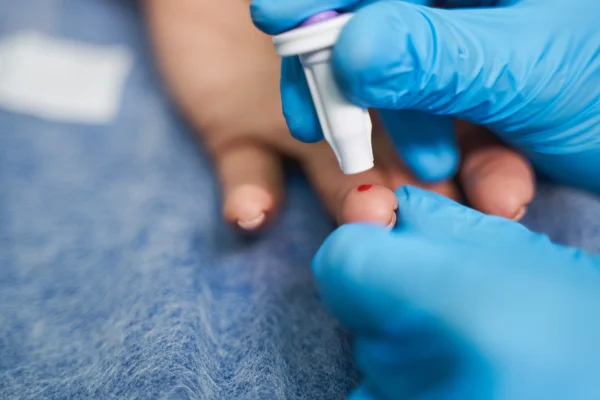
The technology uses Dried Blood Spot (DBS) cards. You prick your finger and drop blood onto the card. The card separates blood cells from plasma as the liquid dries. This separation stabilizes the biomarkers. Standard blood tests require immediate refrigeration to keep these proteins from degrading. The DBS card locks them in place.
The specific biomarkers analyzed include p-tau217. This protein is a strong indicator of amyloid plaques in the brain. The Strategy Director at LifeArc notes that analyzing these specific protein concentration levels gives a clear risk indication. The test transforms a biological sample into a data point.
Detecting these markers early matters immensely. Can you detect Alzheimer's from a blood test? Yes, research from Washington University School of Medicine and Lund University indicates that these tests identify abnormal levels of amyloid and tau proteins associated with the disease, performing as well as FDA-approved spinal fluid tests. The presence of these proteins does not guarantee dementia, but it signals high risk. This early warning system allows for monitoring long before behavioral changes occur.
The Problem with Current Diagnosis Methods
We currently rely on medical procedures that are physically demanding, financially draining, and geographically limited. Only about 2 in 100 Alzheimer’s patients receive a diagnosis through specialized scans or lumbar punctures. The rest rely on clinical observations of memory loss. This means the vast majority of diagnoses happen based on symptoms, not biology.
A lumbar puncture involves inserting a needle into the spine to collect cerebrospinal fluid. It is invasive. It requires a specialist. It hurts. Many patients refuse it. PET scans offer another option, but they are expensive and require large machines found only in major cities. These hurdles create a bottleneck.
The Policy Chief at the Alzheimer’s Society emphasizes that diagnosis is currently too slow. Limited test availability means patients wait months or years for answers. The Alzheimer’s finger-prick blood test removes the physical barriers. You do not need a neuro-radiologist present to prick your finger. You do not need to lie still in a scanner.
Dr. Sandberg, a participant in the trial, highlights the relief associated with this shift. His motivation stems from his mother's experience in a trial. He views knowledge as power. The prospect of screening without needles or costly scans excites him. For him, a negative result brings massive relief. This emotional benefit runs parallel to the clinical value. Easier testing reduces anxiety for patients who fear the diagnostic process itself.
The Stability Advantage
The postal nature of the test solves a major logistical flaw in blood analysis. Most biomarkers degrade quickly at room temperature. The DBS card technology stabilizes the sample immediately. It requires no refrigeration during transport. This feature allows samples to travel through standard mail systems without losing accuracy.
Contradictions in Accuracy Levels
A test that is easy to take loses its value if the results fail to match the reality inside the body. Data from the DROP-AD study reveals a gap between convenience and precision. This study is distinct from Bio-Hermes-002 and was published in Nature Medicine. It compared the results of finger-prick tests against standard venous blood draws and cerebrospinal fluid (CSF) analysis.
The results show a clear hierarchy of accuracy. Venous blood draws performed by a professional achieved 98% accuracy compared to CSF. The finger-prick method achieved 86% accuracy. While 86% is high, it is not perfect. This drop in precision creates a dilemma for regulators.
The Lead Investigator at Banner Health notes that while the pathology markers are measurable via home kits, clinical use remains years away. The current performance gap prevents the test from replacing hospital-grade diagnostics right now. It serves better as a screening tool than a final diagnostic authority.
How accurate is the finger prick test for Alzheimer's? Reuters reports that it is currently about 86% accurate compared to spinal fluid analysis, while standard blood draws are 98% accurate. The lower accuracy comes from the collection method itself. The challenge lies in bringing the reliability of the clinic into the uncontrolled environment of a living room.
The Overlooked Flaw in Self-Testing
Handing medical tools to untrained people introduces variables that laboratories work hard to eliminate. The DROP-AD study highlighted a specific technical difficulty with the Alzheimer’s finger-prick blood test. The issue lies with the finger squeezing rather than the chemistry.
When you prick your finger, you often have to squeeze it to get enough blood. A Researcher from the University of Gothenburg warns that squeezing the finger too hard contaminates the sample. The pressure forces interstitial fluid—the fluid between cells—out along with the blood. This dilutes the sample. A diluted sample shows lower levels of biomarkers than are actually present.
This action causes signal degradation. The chemistry on the card works perfectly, but the input is flawed. This creates a "garbage in, garbage out" situation. The test requires pure capillary blood. Squeezing risks bursting tiny vessels or mixing fluids.
Researchers emphasize that training is essential for home use reliability. You cannot simply mail a kit and expect lab-quality results without guidance. This user error factor explains part of the accuracy gap between venous draws and finger pricks. A phlebotomist draws blood directly from the vein, ensuring a pure sample. A patient at home squeezing their finger introduces inconsistency.
Expanding the Scope of Research
Science often ignores those who live far from cities or lack standard communication channels, but this technology forces a wider perspective. The DROP-AD study demonstrated that these kits function well in remote communities. The technology allows researchers to gather data from populations previously excluded from neuroscience.
The target populations extend beyond rural areas. The study included patients with Down syndrome, who face a high risk of early-onset Alzheimer’s. It also focused on developing regions in Africa, Southeast Asia, and South America. These areas often lack the infrastructure for PET scans or spinal taps.
A Professor at the University of Exeter calls this a major change in neuroscience research. The technology democratizes contribution to brain disease understanding. People can participate in groundbreaking studies without traveling. This broadens the genetic and environmental diversity of the data.
An investigator from Banner Health points out that the immediate effect is the inclusion of diverse populations. The long-term goal is accurate clinical diagnosis, but the short-term win is better data. Understanding how Alzheimer's develops across different demographics requires samples from those demographics. The postal test makes that possible.

Comparing Diagnostic Timelines
Speed determines the effectiveness of any treatment, yet our current systems operate on a massive delay. The lead time for protein accumulation is approximately 15 years. This means the biological disease starts a decade and a half before the clinical disease.
Current diagnostics wait for symptoms. By the time memory loss prompts a doctor's visit, the brain has endured years of damage. A Neuro-radiologist at ReCognition Health suggests the potential for ubiquitous and accurate testing could change this timeline. Detecting abnormal amyloid without difficult investigations allows for intervention during that 15-year window.
The Alzheimer’s finger-prick blood test acts as a pre-screening tool. It identifies high-risk individuals who need further investigation. This two-step process saves resources. Instead of scanning everyone, doctors scan only those with positive blood markers.
The Policy Chief at the Alzheimer’s Society identifies the priority as early detection for the NHS. The goal is quick and accurate access for all potential beneficiaries. Accelerating diagnosis leads to faster access to new treatments. As pharmaceutical companies develop drugs that target amyloid, finding patients with amyloid buildup becomes urgent.
The Roadmap for the Alzheimer’s Finger-Prick Blood Test
A tool can be scientifically valid but still be years away from your medicine cabinet. The distinction between "research use" and "clinical use" defines the current state of this technology. A researcher from Barcelonaβeta recommends against routine clinical use right now. This reflects scientific rigor. We must honestly acknowledge performance gaps.
The Bio-Hermes-002 trial continues until 2028. Regulators need this data to approve the test for general public use. The approval of a traditional blood test (using a needle and syringe) by US regulators last year marked a previous milestone. That approval paved the way for the finger-prick variation.
The future potential involves community identification for detailed diagnostics. The vision is a future where a yearly blood test monitors brain health just like it monitors blood sugar.
When will the Alzheimer's home test be available? It is currently for research only, with the major Bio-Hermes-002 trial expected to finish in 2028. Until the trial concludes and accuracy improves, the test remains a research tool rather than a consumer product.
Understanding the Biomarkers
You cannot see the enemy, so you have to track the footprints it leaves behind. As detailed in The Lancet, the specific biomarkers tracked—p-tau217, GFAP, and NfL—tell different stories about brain health. GFAP is identified as a marker for astrocytic activation, meaning the support cells in the brain are reacting to injury or stress. NfL stands for Neurofilament Light Chain. It indicates neurodegeneration. When brain cells die, they release NfL into the blood.
Combining these markers gives a fuller picture. This involves more than one protein; it concerns the connection between plaque buildup, brain inflammation, and cell death. The Alzheimer’s finger-prick blood test attempts to capture this difficult relationship on a piece of paper.
The separation of plasma on the DBS card makes this analysis possible. Red blood cells interfere with the detection of these tiny proteins. The card acts as a filter. It ensures that the lab analyzes the plasma, where the biomarkers float.
The Future of Screening
The gap between biological onset and symptom discovery remains the biggest challenge in treating dementia. The Alzheimer’s finger-prick blood test offers a tangible solution to close this distance. It replaces fear and invasive procedures with a simple card and a mailbox. While accuracy issues regarding sample collection persist, the ongoing Bio-Hermes-002 trial works to validate the method. The shift from centralized clinics to home testing democratizes access to brain health data. We are moving toward a future where we identify risk years before memory fades, giving us the necessary time to act.
Recently Added
Categories
- Arts And Humanities
- Blog
- Business And Management
- Criminology
- Education
- Environment And Conservation
- Farming And Animal Care
- Geopolitics
- Lifestyle And Beauty
- Medicine And Science
- Mental Health
- Nutrition And Diet
- Religion And Spirituality
- Social Care And Health
- Sport And Fitness
- Technology
- Uncategorized
- Videos

