
Image Credit - by Nohat (concept by Paullusmagnus), CC BY-SA 3.0, via Wikimedia Commons
Wikipedia 25th Anniversary : Fight For Survival
We trust the encyclopedia not because experts wrote it, but because thousands of strangers argued about it until they gave up. That friction creates the reliability we rely on daily. But that foundation is cracking. As the Wikipedia 25th Anniversary arrives, the site faces a brutal reality. The human volunteers who built this digital library are disappearing. Tech giants now scrape its data to build bots that might replace it entirely. The "edit button" generation is aging out, and their replacements demand payment.
The platform that killed the printed encyclopedia now finds itself on the chopping block. Traffic has plummeted by over a billion visits in just three years. Political attacks from both sides create a hostile environment for the remaining contributors. This isn't just a birthday celebration. It is a standoff against obsolescence. The site must reinvent itself or become a ghost town of static information. The internet’s "town square" is empty, and the lights are flickering.
AI Eaters Starve the Source
Chatbots devour data to learn facts, but eventually, they starve the hand that feeds them. This reality defines the current crisis. AI models scrape the encyclopedia to train their intelligence. They digest the info and serve it to you directly in a chat window. You get the answer, but you never visit the source. This dynamic creates a severe traffic drain. Between 2022 and 2025, the site lost over one billion monthly visits.
The Model Collapse Danger
This traffic drop triggers a dangerous chain reaction. Fewer visitors mean fewer potential editors. Without new editors, the information stops updating. It goes stale. Then, the AI starts training on its own outdated or hallucinated data. Researchers call this "model collapse." The AI eats its own tail. The Wikipedia 25th Anniversary highlights this specific vulnerability. The site improved its performance by allowing AI to train on it, but that same training now threatens to make the website irrelevant.
Is AI killing Wikipedia traffic? Yes, AI chatbots answer questions directly in search results, which drastically reduces the need for users to click through to the actual website.
The Scraper War
The organization now fights back against this data harvesting. They struggle to differentiate between good bots and bad bots. Some bots help maintain the site, but others just steal content. The technical team faces a constant strain on their servers from aggressive scraping. This isn't just about server costs. It is about the value of human knowledge. If machines take the data without giving back traffic, the human community withers away.
The End of The Volunteer Era
The internet used to be a community project, but now it is a gig economy where nobody works for free. Early contributors in 2001 believed in the "techno-optimism" of the web. They wrote articles for the glory of open access. They saw themselves as building a "Free Universal Encyclopedia." That spirit is dying.
Gen Z Wants a Paycheck
Younger users see things differently. Gen Z views unpaid labor as a scam. Why work for a massive platform for free when you could make money on TikTok? One young editor, Clover, notes that writing for free feels like a luxury when rent is due. Economic precarity acts as a barrier. If you work two jobs to survive, you do not have time to edit history pages for fun.
Does Wikipedia pay its writers? No, the site relies entirely on unpaid volunteers to write and edit articles, which creates a barrier for younger people who prioritize paid work.
The Graying of the Temple
The data proves this shift. New user registrations dropped by more than 33% between 2016 and 2025. Veteran editor Henner describes the site as a "temple" of aging volunteers. These long-time contributors fear irrelevance. They worry the content they lovingly curated will be ignored by the public. The "graying" of the editor base creates a cultural gap. The topics that interest a 50-year-old software engineer often differ from what a 20-year-old wants to read. If the youth won't work for free, the library stops growing.
Political Crosshairs and Narrative Control
Neutrality infuriates partisans because it refuses to validate their specific version of the truth. Being the middle ground puts a target on your back. In the early days, the site flew under the radar. Now, it influences how AI thinks and how voters vote. That makes it a battlefield.
The "Wokepedia" Label
Critics now claim the site biases reality. Elon Musk publicly labeled the platform "Wokepedia." He alleged far-left activists control the narrative. This isn't just a stray comment. It represents a shift in public perception. People used to see the site as a collection of facts. Now, powerful figures frame it as a weapon of ideology.
Targeting the Editors
The pressure gets personal. The Heritage Foundation, a conservative think tank, announced plans to track and expose individual editors. They want to show who writes the articles. This creates a climate of fear. Volunteers usually work anonymously. If editing a controversial topic puts your real identity at risk, you stop editing.
The Carlson Attack
In late 2025, Tucker Carlson released a 90-minute podcast episode dismantling the platform. He called the site "dishonest" and claimed it controlled the narrative on critical issues. This level of media scrutiny is new. The Wikipedia 25th Anniversary takes place in a spotlight that burns rather than celebrates.
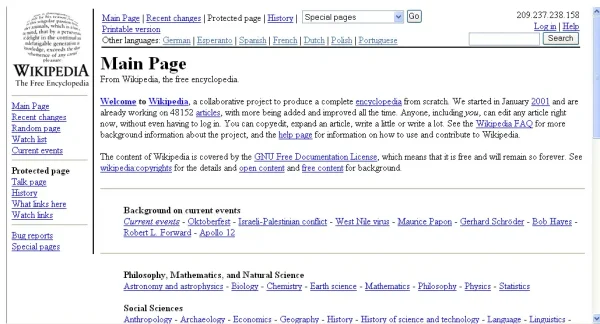
Image Credit - by The original uploader was L337p4wn at English Wikipedia., CC BY-SA 4.0, via Wikimedia Commons
From Rebel to Diplomat
Defiance works when you are small, but diplomacy becomes necessary when you become a global target. The organization’s legal strategy has shifted completely over the last 15 years.
The FBI Showdown
In 2010, the FBI demanded the removal of their official seal from the site. They claimed it violated federal law. The foundation simply refused. They cited the law back to the agency and essentially dared them to sue. A Wikimedia lawyer publicly disputed the FBI's interpretation and prepared for court. They won that stare-down.
The New Conciliatory Approach
That swagger is gone. The current era requires a softer touch. Threats now come from Congress and major foreign governments. The legal team leans on explanation rather than confrontation. The Chief Communications Officer, Alikhan, notes that the CEO's diplomatic background is now a crucial asset. They must negotiate their existence. They adapt to partisan administrations rather than fighting them head-on. Survival now requires suits and ties, not just hacker ethos.
The World Closes Its Digital Doors
Physical borders are easy to cross, but digital borders are becoming impenetrable concrete. The dream of a universal library hits hard limits in authoritarian states. A global encyclopedia cannot function if the globe is chopped into pieces.
Total Blockades
China blocks the site entirely. They have done so intermittently since 2004, but the current blockade is total. Citizens there cannot access the information, and they cannot contribute to it. This creates a massive hole in the "sum of all human knowledge."
The User Safety Crisis
The stakes are higher than just access. In Saudi Arabia, authorities imprisoned high-ranking editors. Contributing factual information became a crime. This terrifies the volunteer base. How do you recruit editors in a country where fixing a typo could land you in jail?
Why is Wikipedia banned in some countries?Governments ban the site to control the flow of information and prevent citizens from accessing content that contradicts state-approved narratives.
Western Legislation
Even free nations pose threats. The UK proposed age-gating laws to protect children online. While well-intentioned, these laws destroy the anonymity the site relies on. If every user must verify their age with an ID, the number of editors will collapse.
Chasing the TikTok Attention Span
Text creates depth, but video captures the eyes that have forgotten how to read long-form. The foundation knows it is losing the battle for attention. A wall of text feels like homework to a user raised on 15-second clips.
The Video Pivot
In October 2024, the organization launched a massive short-form video initiative. They are not just hosting text anymore. Over 800 videos now circulate on Instagram, YouTube, and TikTok. These videos generated 23 million views quickly. The goal is to hook viewers with visuals and drag them back to the articles.
Meeting Users Where They Are
This is a desperate bid for relevance. The Wikipedia 25th Anniversary marks the moment the encyclopedia admitted text is not enough. They must compete with influencers. If they cannot meet users on their phones, the desktop site becomes a museum. They are trying to translate deep research into snackable content without losing the nuance. It is a difficult balance.
Rich Coffers, Poor Future
You can be rich in cash but bankrupt in the only currency that matters—relevance. Financially, the organization is healthier than ever. This creates a strange contradiction.
The Money vs. Mission
They pulled in over $180 million in donations and grants in 2023 alone. The Wikimedia Endowment holds massive reserves to ensure long-term survival. They have enough money to keep the servers running for decades. Yet, they still ask Big Tech companies to pay for API access.
The Limit of Wealth
Money keeps the lights on, but it cannot buy enthusiasm. You can pay for bandwidth, but you cannot pay people to care about obscure history if they don't want to. The "graying" of the community continues despite the full bank account. The organization has the funds to survive 100 years, as Jimmy Wales predicts, but it might end up as a well-funded library with no visitors.
The "Toilet Seat" That Won
We forget that the most reliable source on earth started as a joke about public toilet seats. The site's history proves that experts are often wrong about what works.
The Expert Failure
Before the current site, there was Nupedia. It relied on experts and peer review. It moved at a glacial pace, producing only 12 articles in its first year. It failed because it was too rigid. Larry Sanger, the co-founder, proposed a wiki to speed things up. He wanted a "low maintenance" format.
Chaos vs. Order
Britannica editors mocked the new concept. They compared it to a public toilet seat, implying it would be filthy and unreliable. They were wrong. A 2005 study in the journal Nature showed the amateur site had near-parity in accuracy with Britannica. The "bug" of open editing turned out to be the feature. The ability to fix errors instantly made it stronger than the static books.
The 100-Year Bet
The Wikipedia 25th Anniversary forces us to look at the internet we built. We traded community for convenience. The site stands as the last artifact of a web where people helped each other for free. Jimmy Wales predicts the platform will last another century, outliving the tenure of critics like Elon Musk. That prediction depends on us.
The threats are real. AI cannibalizes the content. Politics poisons the community. Youth apathy starves the volunteer base. Yet, the site remains the default source of truth for billions. It survives because it is useful. If we stop showing up to argue over facts, the truth gets decided by a robot. The encyclopedia isn't just a website; it is a test of human cooperation. We have passed for 25 years. The next 25 will be much harder.
Recently Added
Categories
- Arts And Humanities
- Blog
- Business And Management
- Criminology
- Education
- Environment And Conservation
- Farming And Animal Care
- Geopolitics
- Lifestyle And Beauty
- Medicine And Science
- Mental Health
- Nutrition And Diet
- Religion And Spirituality
- Social Care And Health
- Sport And Fitness
- Technology
- Uncategorized
- Videos

