
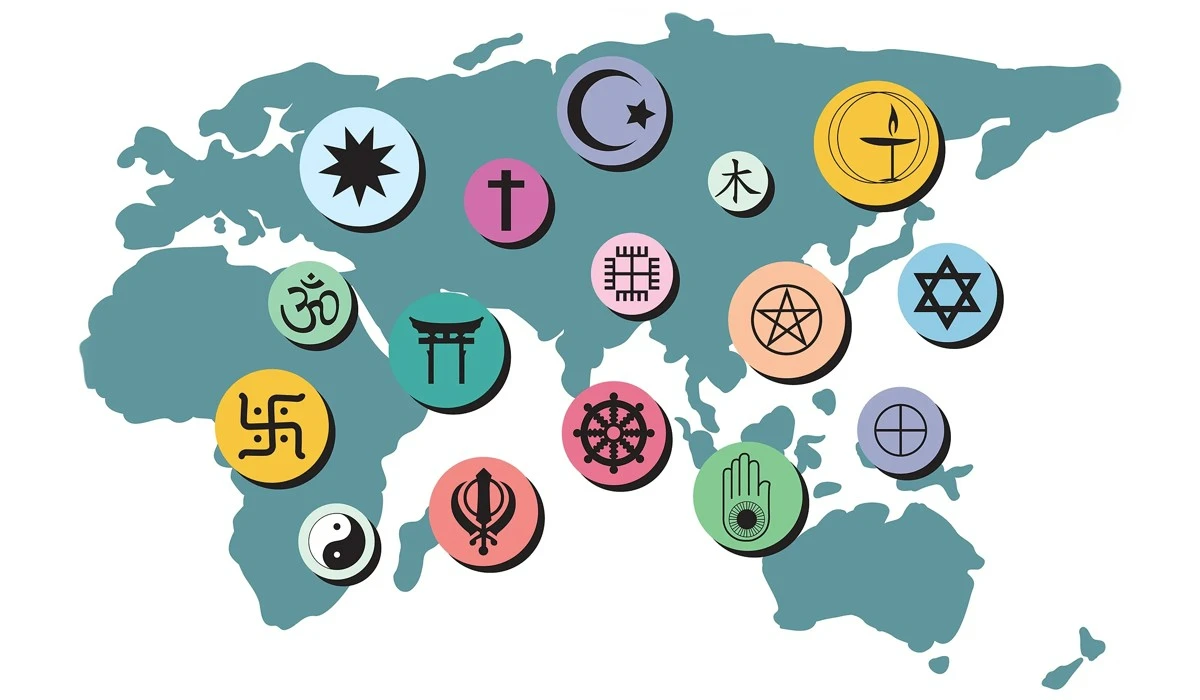
World Religions Reveal Many Universal Truths
People often assume that a monk in a mountain temple and a tech executive in a city skyscraper have nothing in common. They see different clothes, languages, and rituals as walls that keep us apart. These differences distract us from a deeper reality. If you strip away the external labels, you find a shared human software running in the background.
This drive connects billions of people across the globe. Exploring World Religions shows that most people are actually asking the same questions and reaching for the same answers. We all seek a way to handle suffering, celebrate life, and build a better society. When we look past the surface, we see a map that humanity has been drawing together for thousands of years.
Learning about these connections changes how you see your neighbors and the world. It replaces suspicion with curiosity. A grasp of the core of World Religions helps us find the universal truths that keep our communities together.
Stripping Away the Superficial
Scholars use specific tools to look at faith without bias. This field, known as comparative religion studies, began in earnest during the 19th century. Friedrich Max Müller, who established the discipline in 1870, believed that understanding a single religion in isolation is impossible; as noted in a biography by Britannica, he famously stated that those who know only one religion actually know none.
He wanted people to compare different faiths to find the basic patterns of human thought. Instead of arguing about which faith is "right," researchers look at how each one functions in a person's life. They use the German concept of Religionswissenschaft, or the "Science of Religion." This approach moves away from defending one view and moves toward observing how all views work.
Meanwhile, as highlighted by Saint Mary's Press, modern experts utilize scholar Ninian Smart’s seven dimensions of religion to analyze a faith. They look at things like rituals, stories, and social structures. The use of comparative religion studies shows that while the names of the gods change, the way humans organize their lives around them stays remarkably similar.
The Global Standard of the Golden Rule
Most people think their moral code is unique to their specific culture. Ironically, almost every major faith teaches the exact same core ethic. We call this the Golden Rule. In Confucianism, research published in Springer Link points to a passage in the Analects where Confucius advises followers not to impose on others what they do not desire for themselves.
The Hindu text, the Mahabharata, mirrors this by commanding people never to do something that they would find injurious to their own selves. This isn't a coincidence. It is a universal human realization. What is the most common belief in all religions? Most global faiths center on the principle of reciprocity, often called the Golden Rule, which instructs followers to treat others as they wish to be treated.
In 1993, a group called the Parliament of the World’s Religions met to formalize these shared values. They created the Global Ethic Declaration. According to the Global Ethic document published by the Parliament of the World’s Religions, they identified four major rules: you shall not kill, steal, or lie, and there should be an equal partnership between men and women. These principles show that World Religions share a rock-solid foundation for human decency.
Rites of Passage as a Universal Experience
Humans hate being in "between" states. We need clear markers to tell us when a child becomes an adult or when a spouse joins in marriage. This is why rituals exist. Research by Britannica notes that in 1909, Arnold van Gennep proposed that every rite of passage follows a three-step path consisting of separation, a liminal phase, and incorporation.
First, you leave your old group. Then, you enter a "liminal" state where you are neither here nor there. Finally, the community welcomes you back with a new status. You see this in the Hindu Upanayana ceremony and the Jewish Bar Mitzvah; according to Britannica, the Bar Mitzvah is celebrated after a child’s 12th or 13th birthday, though the Upanayana rite can take place at various times between ages 5 and 24.
These rituals provide psychological comfort and keep the community strong. They create a state called "communitas," which is a feeling of intense equality. During the Islamic Hajj, everyone wears the same simple white cloth. This removes social status and forces everyone to see each other as equals. World Religions use these moments to remind us that we all go through the same stages of life.
Mindfulness and Prayer as Mental Anchors
Many people use spiritual practices to manage stress and find focus. Modern science now backs up the benefits of these ancient methods. Dr. Harold G. Koenig studied over 2,000 cases and found that active religious participation correlates with lower depression and substance abuse rates.
Prayer and meditation act as mental anchors during chaotic times. When a person repeats a Catholic Rosary or performs Islamic Dhikr, their body enters a "relaxation response." This physical state lowers the heart rate and calms the nervous system. Which religion is the oldest? Hinduism is generally considered the oldest organized religion, with roots and traditions stretching back over 4,000 years into the Vedic period.
These ancient traditions created mindfulness long before it became a modern trend. Buddhist Vipassana meditation focuses on "insight," which helps people regulate their emotions. These practices across World Religions offer a toolkit for staying sane during busy times. They teach us that inner peace usually comes from discipline and silence.
Shared Myths and Heroic Archetypes
If you look at the stories told by different cultures, you start to see the same characters. A study by CCCS Pressbooks explains that Joseph Campbell defined the "Monomyth" or Hero’s Path as a seventeen-stage process organized into the sections of departure, initiation, and return. He noted that figures like Buddha, Jesus, and Muhammad all followed this path.
Our ancestors used these stories to explain the human experience. Meanwhile, the Axial Age between 800 and 200 BCE saw a massive shift in human thinking. During this time, thinkers in Persia, India, China, and Israel all started emphasizing individual morality at the same time.
Even our scariest stories match up. The Sumerian Epic of Gilgamesh, the Hindu Matsya Purana, and the Hebrew Book of Genesis all describe a massive flood that destroyed the world. The application of comparative religion studies allows us to see these myths as a way our ancestors processed collective trauma. They show that humans have always shared the same fears and the same hopes for a fresh start.
Strengthening Social Cohesion in Pluralistic Societies
Within a globalized economy, you will likely work with someone who believes something different from what you do. Understanding these differences has moved beyond being a hobby and has become a professional skill. We call this religious literacy. It allows you to navigate social situations without causing accidental offense.
By 2050, the number of Muslims and Christians will be nearly equal for the first time in history. Much of this growth happens in places like sub-Saharan Africa. If you understand the core values of these World Religions, you can build stronger bonds with partners across the globe.
How many people follow a religion today? Roughly 85% of the global population identifies with a religious group, making faith a primary driver of cultural identity and social interaction. Religious intelligence helps you see the "why" behind people's actions. It reduces conflict and makes it easier to find common ground in a business meeting or a neighborhood gathering.
The Intersection of Faith and Human Rights
Many people believe that human rights and religion are at odds. In reality, modern human rights laws often grow out of religious teachings. The concept of Dharma in India and the Tao in China both suggest a basic cosmic order. This order requires humans to act fairly to maintain balance.
These ideas influenced some of the greatest social movements in history. Mahatma Gandhi used the Jainist principle of Ahimsa, or non-violence, to lead a revolution. Later, Martin Luther King Jr. used those same tactics to fight for civil rights in America. They turned ancient spiritual truths into modern political tools.
Today, this continues with environmental issues. As reported by the Parliament of the World’s Religions, trustees expanded the Global Ethic in 2018 to include a fifth directive focused on a commitment to caring for the Earth. They realized that saving the planet is a goal that fits into every faith. When we focus on these universal goals, we move past small arguments and work toward the survival of everyone.
Embracing Our Shared Humanity
The specific rituals of a faith act like the packaging on a gift. The packaging looks different depending on where and when it was made. However, when you open the gift, the contents remain remarkably consistent. World Religions provide us with a shared map for living a good life, even if we use different names for the landmarks.
The use of the tools of comparative religion studies allows us to see the world as it really is. It reveals a humanity that is more united than the evening news suggests. We all want to belong, we all want to be good, and we all want to find peace. Focusing on these universal truths allows us to turn our diverse beliefs into a source of strength rather than a cause for division.
Recently Added
Categories
- Arts And Humanities
- Blog
- Business And Management
- Criminology
- Education
- Environment And Conservation
- Farming And Animal Care
- Geopolitics
- Lifestyle And Beauty
- Medicine And Science
- Mental Health
- Nutrition And Diet
- Religion And Spirituality
- Social Care And Health
- Sport And Fitness
- Technology
- Uncategorized
- Videos