
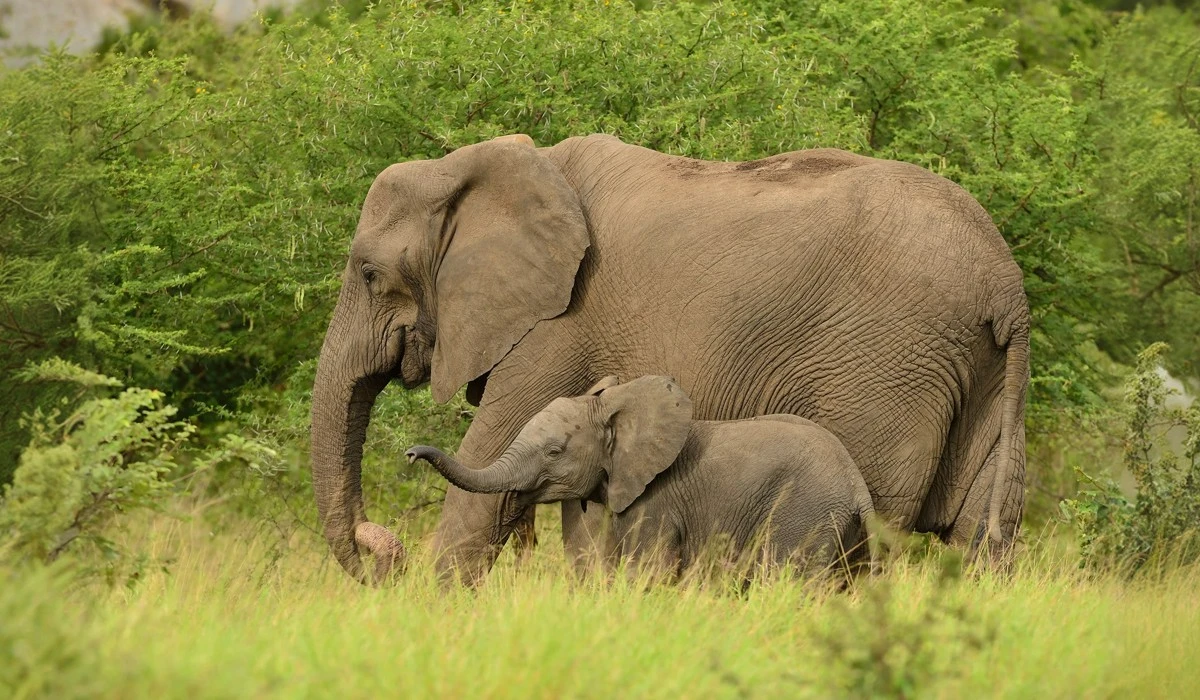
Elephant Studies Prove Matriarchs Ensure Survival
In 1993, a brutal drought scorched the grass in Tanzania’s Tarangire National Park. Dust replaced the wetlands, and newborn calves began to collapse from thirst. Survival during this crisis depended on the memory of the oldest female in the group rather than physical strength or speed.
Younger leaders stayed put, hoping for rain that never came. Their herds suffered a 63% mortality rate. Meanwhile, the oldest matriarchs remembered a drought from decades earlier. They led their families out of the park boundaries toward distant, permanent water sources. These families survived. Modern Elephant Studies reveal that the survival of this species relies on this female-led hierarchy.
We often view animals as driven by instinct alone. Research published in Nature found that having a grandmother residing in the same location as the grandcalf significantly decreased calf mortality. These massive mammals operate within an advanced social web and rely on the lived experience of grandmothers to navigate a changing environment. Examination through the lens of Elephant Studies shows that leadership determines life or death.
Establishing the Foundation of Elephant Studies
The formal study of these animals changed forever in 1972. Cynthia Moss and Harvey Croze founded the Amboseli Elephant Research Project (AERP) in Kenya. This project represents the longest-running study of wild elephants in history. Before this work, people mostly viewed elephants as nomadic targets or zoo attractions.
According to the Amboseli Trust for Elephants, researchers now use ear-pattern recognition to identify individuals by tracking natural markings such as tears, notches, and holes in the ear pinnae, as well as tusk characteristics. This methodology allows scientists to follow over 3,500 individual elephants over five decades. These Elephant Studies moved beyond simple tracking to analyze layered behavioral patterns.
Scientists no longer see elephants as mere individuals. They view them as deeply interconnected units. This change in perspective proves that an elephant’s mind functions best within a community. Today, researchers even use deep learning models like ElephantCallerNet to classify vocalizations with 89% accuracy.
Deconstructing the Multi-level Elephant Social Structure
The elephant social structure functions like a set of nesting dolls. It starts with the smallest unit and expands into massive networks. This system ensures that every individual has a place and a protector.
From Nuclear Families to Bond Groups
At the center sits the mother-calf unit. This bond forms the bedrock of the entire society. As the unit grows, it merges with sisters and their offspring to form a family. Scientists watch how these groups interact during the dry season to understand their bonds. How do elephants organize their families? Elephant families organize into multi-generational, female-led groups called herds, which often join other related families to form larger clans. This tiered elephant social structure allows for both intimate care of calves and large-scale protection against external threats.
These groups exhibit philopatry. This means females stay with their birth family for their entire lives, often reaching 70 years of age. This permanent membership creates a stable environment for raising young.
The Role of Bulls in the Social Web
Male elephants follow a different path. A policy report from the New South Wales Department of Primary Industries notes that pubertal males between 9 and 18 years of age leave their natal family group through a gradual process that can span four years. They do not just wander. They join loose "bachelor herds" where they learn social rules from older males.
Information from the San Diego Zoo Wildlife Alliance explains that healthy adult males experience musth, a state where they compete with older males as their testosterone levels and aggression rise sharply. This separation highlights the unique nature of the female-led herd.
The Mechanics of Matriarchal Herd Interactions

Matriarchs do not rule through brute force. Their power comes from consensus and trust. Matriarchal herd interactions rely on a style of leadership that prioritizes the group's safety over individual ego.
The oldest female possesses a "quiet authority." When she remains calm, the stress levels of the entire herd drop. If she becomes alert, the rest of the family immediately prepares for action. She often uses a low-frequency "let-us-go" rumble to suggest movement.
The group usually waits for this signal before migrating. This democratic approach prevents internal conflict. It keeps the family cohesive even when resources become scarce. Observation of these matriarchal herd interactions shows that the best leaders listen as much as they lead.
How Elephant Studies Reveal the Importance of Generational Memory
Research in Frontiers in Aging describes the matriarch as a living library, acting as the primary repository for social and ecological knowledge within the family. She stores decades of data about the terrain, predators, and social ties. Elephant Studies show that this memory serves as the herd's most valuable asset.
Navigating Terrains in Times of Crisis
Older females hold "social capital" that younger elephants simply lack. They remember the exact location of water holes from fifty years ago. This knowledge becomes a survival tool during extreme weather events. How long do elephant matriarchs live? National Geographic data indicates that African elephant matriarchs can live into their 60s or 70s, accumulating decades of ecological knowledge. Recent Elephant Studies suggest that this longevity is vital, as herds led by older matriarchs are significantly more likely to survive extreme environmental shifts.
Without these grandmothers, the herd loses its map. Their ability to navigate ensures the lineage continues through the hardest seasons.
Recognizing "Friends" and "Foes"
Memory also applies to security. Research published by National Geographic and led by Karen McComb in 2011 proved that older matriarchs recognize the roars of different predators. They can distinguish between a male lion and a female lion by sound alone.
The study also suggests that older matriarchs prompt a defensive response the moment they hear a male roar. Younger, less experienced leaders often fail to react correctly. They put their calves at risk because they haven't learned the difference yet.
Tactical Defense and Group Protection Strategies
The physical protection of the herd involves precise maneuvers. Every movement has a purpose, and the matriarch coordinates the defense.
The "Circle of Protection"
When a threat appears, the herd forms a circle. The adults face outward, tusks ready. They place the vulnerable calves in the center. This physical barrier stops predators from isolating a single baby.
The matriarch decides when to stand her ground and when to charge. Her decision-making prompts these movements instantly. This coordination demonstrates the high level of trust within the family.
Mentoring the Next Generation of Leaders
Leadership is a taught skill. As documented by ElephantVoices, younger females participate in "allomothering" by helping care for calves that are not their own, a behavior that increases the survival rate of the infants.
It also trains the young females for their future roles as matriarchs. They shadow the current leader, watching how she reacts to humans or lions. This mentoring ensures the matriarchal herd interactions remain strong for the next generation.
The Social Risks Identified in Modern Elephant Studies
A review published by the University of York indicates that poaching often targets the largest elephants, specifically those with large tusks. The death of an old elephant results in the loss of both an individual animal and a repository of knowledge. When a matriarch dies, the family often falls apart. How do elephants organize their families? Elephant families organize into multi-generational, female-led groups called herds, which often join other related families to form larger clans. This tiered elephant social structure allows for both intimate care of calves and large-scale protection against external threats.
What happens when an elephant matriarch dies? When a matriarch dies, the remaining elephant social structure can collapse, leading to increased stress levels and a loss of navigational knowledge. Elephant Studies have shown that groups without an experienced leader often struggle to find resources and may exhibit signs of collective trauma. These groups sometimes show symptoms similar to human PTSD.
Scaling Success: Global Effects of Elephant Studies
Knowledge of these giants helps humans protect the planet. Conservationists now use data from Elephant Studies to create "protected corridors." These paths follow the ancient migration routes stored in the matriarchs' memories.
We also learn about human leadership from these herds. They show us that resilience comes from emotional intelligence and group cohesion. Protecting the oldest members of a group helps to secure the entire community's future.
Conservation efforts are expanding to include social preservation alongside population counts. We must keep the "social glue" intact to ensure these animals survive in the wild.
The Enduring Legacy of the Matriarch
The survival of the elephant species is tethered to the wisdom of its oldest females. These grandmothers carry the history of their people in their minds. They know where the water hides and which voices carry a threat.
Continuing our work in Elephant Studies involves preserving an advanced culture of care and memory. The elephant social structure provides an expert lesson in collective survival. Every time we watch a herd cross a dry savanna, we see the power of female-led matriarchal herd interactions in action. These leaders lead and ensure the next generation has a world to inherit.
Recently Added
Categories
- Arts And Humanities
- Blog
- Business And Management
- Criminology
- Education
- Environment And Conservation
- Farming And Animal Care
- Geopolitics
- Lifestyle And Beauty
- Medicine And Science
- Mental Health
- Nutrition And Diet
- Religion And Spirituality
- Social Care And Health
- Sport And Fitness
- Technology
- Uncategorized
- Videos

