
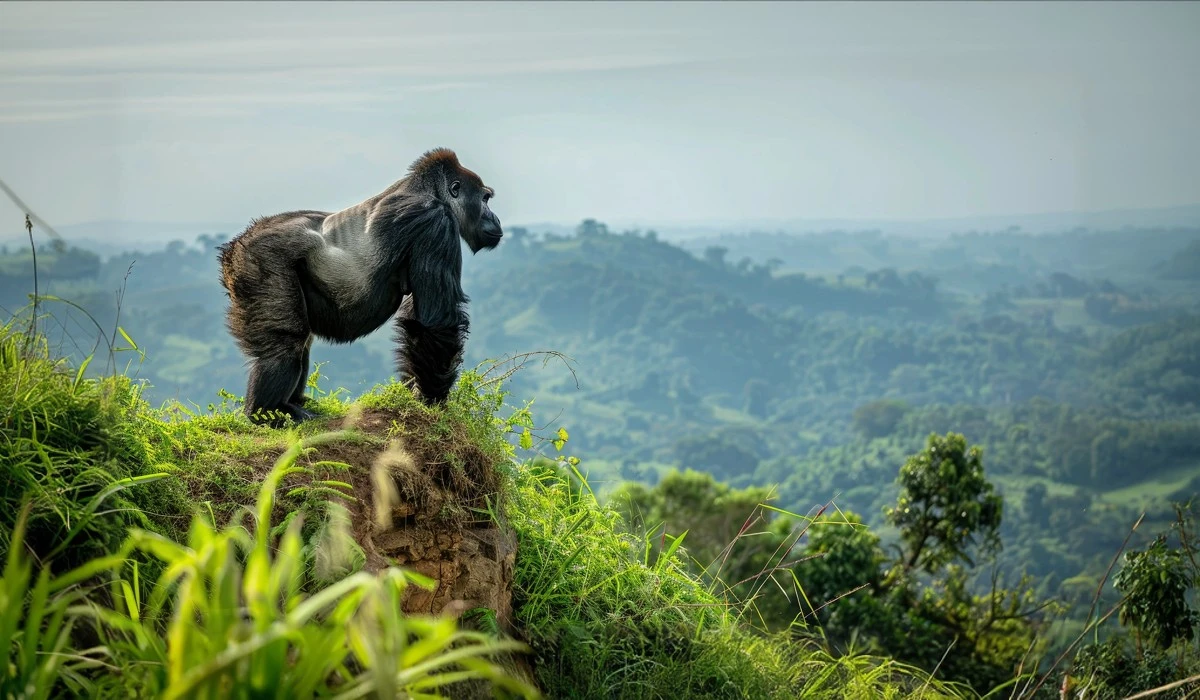
Wildlife Tourism May Save Mountain Gorillas
Imagine standing in a thick, wet forest in the Virunga Mountains. Your lungs burn from the steep climb. Suddenly, a 400-pound silverback mountain gorilla emerges from the bamboo. The thought that bringing humans into this wild space would disturb him or destroy his world is common.
The reality is different. Your presence creates a protective shield around his family. In the 1980s, these animals nearly vanished, with only about 240 left. According to a report in The Guardian, the population surpassed 1,000 by 2018 and has continued to rise. This recovery did not happen by accident. It happened because wildlife tourism turned these animals into the most valuable living assets in their countries.
Research published in PMC indicates that a single trekking permit provides value beyond a simple photograph; it funds a massive security operation because staff salaries are mainly covered by income from ecotourism and non-governmental organizations. If tourists stop coming, the guards leave, and the poachers return. We now see a system where looking at an animal actually saves its life. This post explains how your travel choices can rescue a species from the brink.
Saving a species through conservation-based tourism
Conservation-based tourism works like a subscription model for a species' survival. High fees for permits pay for the salaries of hundreds of people. These workers spend every day in the forest. Their work involves more than guiding tourists; as noted in Parasitology, they patrol for illegal traps, and the Gorilla Doctors veterinarians regularly monitor the gorillas' health.
Without this constant presence, the forest would fall to illegal logging and hunting. People often wonder, how much does a gorilla trekking permit cost? In Rwanda, permits currently cost $1,500, while Uganda offers them for $700 to $800, with nearly all proceeds going directly back into park management and local communities. This money buys boots, radios, and medical kits for the teams on the front lines.
The role of the park ranger
Rangers are the backbone of this system. They use the Spatial Monitoring and Reporting Tool (SMART) to collect data on gorilla movements. This technology creates a digital map of park security. It allows teams to spot human intruders or illegal snares before they cause harm.
Britannica Kids notes that Dian Fossey initiated this "active conservation" legacy in 1967 when she founded the Karisoke Research Center in the Virunga Mountains. She realized that only a physical presence in the woods could stop extinction. Research in PMC explains that permit fees maintain her mission by financing round-the-clock protection teams that confiscate over 1,500 wire snares annually.
The core principles of ethical wildlife tourism

Good ethical wildlife tourism prioritizes the animal over the visitor. It sets non-negotiable rules for every encounter. These rules protect the gorillas from the very people who pay to save them. According to the World Wildlife Fund, gorillas possess a 98.3% genetic match with humans, meaning a common cold can be fatal for a troop.
This is why strict health protocols exist. You must wear a mask during the encounter. You must also stay at least 10 meters away from the animals. These rules ensure that our curiosity does not become a death sentence for the Great Apes.
Health and safety protocols
A study published in PMC states that since the COVID-19 pandemic, Rwanda, Uganda, and the DRC have required surgical masks for all trekkers within 10 meters of the apes. The study also suggests this measure reduces the danger of reverse zoonotic transmission, where human sicknesses pass to animals. Scientists worry about respiratory infections, particularly.
Parks also limit the number of visitors. The Uganda Wildlife Authority stipulates that no more than eight people may visit a single gorilla family per day. Additionally, The Guardian reports that the duration of these encounters is capped at exactly 60 minutes. This limit prevents the gorillas from becoming stressed or overly dependent on humans. It keeps their wild nature intact while still allowing for essential funding.
Economic Influence of Wildlife Tourism
Wildlife tourism changes how local people see the forest. In the past, a local farmer might see a gorilla as a competitor for land. Today, that same farmer sees the gorilla as a source of income and stability. This shift in perspective is the most powerful tool in conservation.
In Rwanda, the government gives 10% of all tourism revenue back to local villages. This money builds schools, health centers, and water tanks. Travelers frequently ask, are mountain gorillas dangerous to humans? While they are powerful wild animals, the groups visited by tourists are habituated to human presence and are generally peaceful and curious unless they feel their family is threatened.
Empowering former poachers
The "Porter Program" provides a direct path out of poverty. Hiring local villagers to carry bags provides a job to people who might otherwise resort to poaching. A porter earns at least $15 to $20 per trek, which is a significant wage in rural areas.
Organizations like the Sabyinyo Community Livelihood Association (SACOLA) use tourism profits to build houses. They have constructed over 40 homes for survivors of the 1994 genocide. When the community benefits from the gorillas, they become the species' greatest defenders.
Scientific breakthroughs in conservation-based tourism
Money from conservation-based tourism pays for world-class medical care in the middle of the jungle. National Geographic highlights that the "Gorilla Doctors" consist of 15 veterinarians who provide medical treatment to the wild population. They perform surgeries to remove snares and treat infections right there in the forest.
This is only possible because tourism provides a steady stream of cash. These doctors monitor every individual gorilla, keeping a medical history for the entire population. This level of care is unique to the mountain gorilla.
Funding the Gorilla Doctors
As documented in Parasitology, these medical teams provide "in-situ" veterinary care. According to the Gorilla Doctors organization, they never remove a gorilla from the forest, instead performing all treatments within the natural habitat to minimize stress. Your permit money pays for the expensive anesthesia and specialized tools needed for these operations.
The Gorilla Doctors also study how climate change affects the gorillas' food. Rising temperatures push bamboo and celery to higher altitudes. Ongoing funding allows scientists to track these changes and plan for the future of the habitat.
Navigating the world of Wildlife Tourism
Choosing where to go changes the effect of your visit. Each of the three countries offers a different experience. Rwanda provides a luxury experience with short drives from the capital. Uganda offers a more rugged trek through the Bwindi Impenetrable Forest.
Many first-time trekkers ask, where can you see mountain gorillas in the wild? These Great Apes are found only in two isolated pockets: the Virunga Massif (spanning Rwanda, Uganda, and the DRC) and the Bwindi Impenetrable Forest in Uganda. Each location faces its own challenges, from civil unrest to high human density.
Choosing the right destination
The Democratic Republic of Congo (DRC) houses Virunga National Park. It is the oldest national park in Africa. However, it is also the most dangerous for rangers. Over 200 rangers have died protecting this park in the last 20 years.
Visiting helps support these brave individuals. Uganda’s Bwindi Impenetrable Forest holds about half of the world's mountain gorillas. Here, the focus is on large-scale community involvement. Your choice of destination helps maintain balance in these fragile regions.
Long-term benefits of ethical wildlife tourism
We have proof that ethical wildlife tourism works. Mountain gorillas are the only great ape subspecies with a growing population. Their numbers climbed from 242 in 1981 to over 1,000 today.
In 2018, the IUCN reclassified mountain gorillas from "Critically Endangered" to "Endangered." This is a massive victory. It shows that human presence can be a positive force when managed correctly.
Population growth statistics
The population growth happens because of "active conservation." Humans are constantly in the forest protecting the animals. Without the money from visitors, this level of protection would vanish. The 2020 global travel shutdown proved this.
Research in PMC explains that when tourism ceased, funding for park protection fell, leading to an immediate rise in poaching. The researchers observed that snare retrieval doubled within the first three months of the travel shutdown. This highlights why a steady stream of ethical travelers is vital for long-term survival. Your trip is part of a permanent security plan.
Preparing for your first trek
Trekking is hard work. You will climb steep, muddy slopes and push through thick vines. You need sturdy boots and long pants to protect against stinging nettles. Being fit makes the experience better for you and the guides.
If you are struggling, you might distract the rangers from their primary job. They must keep the gorillas safe and monitor the environment. Preparation shows respect for the animals and the people who protect them.
Gear and fitness requirements
You should pack waterproof clothing and garden gloves for gripping thorny branches. The terrain is unpredictable and can change from sun to rain in minutes. Expect to hike anywhere from two to six hours.
The human population density around these parks is very high. Over 600 people live on every square kilometer of land. Staying fit and prepared helps minimize the footprint you leave on this crowded but beautiful environment.
The future of Wildlife Tourism
This action creates a wall between the gorillas and extinction. Through participation in ethical wildlife tourism, you become more than a spectator. You become a financier of a global success story. You prove that a living gorilla is worth more to a nation than a dead one.
The mountain gorilla’s survival depends on our willingness to value their lives. When you leave the forest, you carry the responsibility of their story with you. You tell others that conservation works. Wildlife tourism gives these kings of the mountain a chance to reign for another century. Their future is literally in your hands.
Recently Added
Categories
- Arts And Humanities
- Blog
- Business And Management
- Criminology
- Education
- Environment And Conservation
- Farming And Animal Care
- Geopolitics
- Lifestyle And Beauty
- Medicine And Science
- Mental Health
- Nutrition And Diet
- Religion And Spirituality
- Social Care And Health
- Sport And Fitness
- Technology
- Uncategorized
- Videos

