
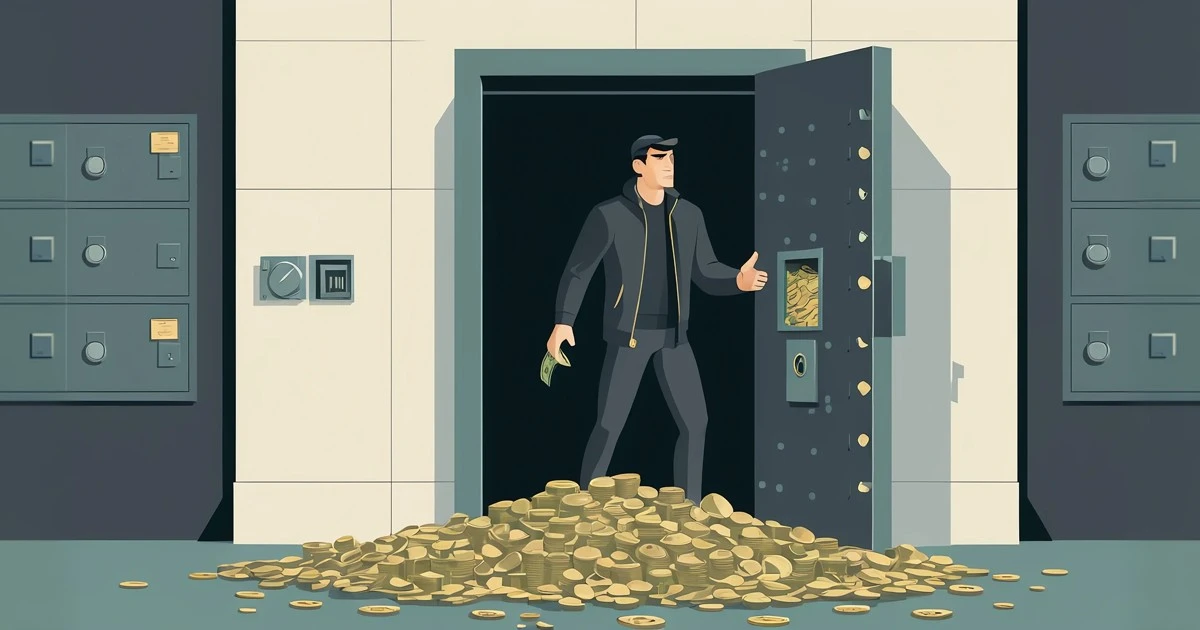
Sparkasse Hit By 30 Million Euro Bank Heist
Most people think banks keep money behind heavy doors. They actually rely on city noise to hide the sound of a drill. During the Christmas holidays, the usual bustle of Gelsenkirchen stopped. This quiet turned the Sparkasse branch on Nienhofstrasse into a perfect workspace. According to police reports shared by AP News, thieves broke into the vault during the holiday lull to steal property worth tens of millions of euros. They knew the bank’s security sensors expected routine rather than a sustained strike from a neighboring garage. While the town celebrated, a team of professionals worked through 18 inches of reinforced concrete. This heist demonstrates that a bank's location in a busy district becomes a weakness when the calendar turns to a holiday. The heist proves that a locked door means nothing if the walls around it are the only thing standing between a thief and €30 million.
How the Sparkasse Bank Heist Used the Calendar
Thieves treat holiday schedules as a way to extend their working hours without interruption. The crew picked the Christmas holidays for a specific reason. Empty streets meant no one would report vibrations or strange smells. They entered the building through a parking garage staircase. ABC News reports that witnesses spotted several men carrying large bags in the parking garage stairwell between Saturday night and Sunday morning. These men didn't run; they walked with purpose.
How long does a bank heist take?
Most robberies last minutes, but these professionals spent two to four hours inside the vault area. They navigated through an archive room to reach the vault wall. Euronews reported that police and firefighters arrived at the bank branch following a fire alarm just before 4:00 AM on Monday, but the criminals had already fled. They used a black Audi RS 6, a stolen vehicle, to flee the scene before police arrived. This timing ensured that no one discovered the breach for nearly two days.
Specialized Tools for a Professional Operation
Heavy security relies on mass, but friction turns that mass into a temporary obstacle. The vault at the Sparkasse branch featured 18-inch thick concrete walls. Standard drills cannot penetrate this material. A report from Need To Know suggests the crew used a 20kg core drill featuring a synthetic diamond-coated tip. According to AP News, investigators believe the thieves used this industrial tool to cut through the basement wall, which generates extreme heat. To manage this, the crew required a constant flow of water to prevent the bit from melting.
Investigators found jerry cans, water hoses, and pumps at the site.
These tools don't come from local hardware stores. Police representatives noted that such equipment belongs in high-end industrial settings. Are bank safe deposit boxes insured? A report by ABC News notes that the Sparkasse website lists insurance coverage for each box up to €10,300 unless a customer additionally insures it privately. This gap in coverage leaves many victims facing massive financial losses. The thieves worked with precision, focusing on the 3,300 compartments inside. They knew exactly how much force the concrete could take before giving way.
Assessing the Damage of the Sparkasse Bank Heist
A bank vault functions as a concentrated point of value for organized groups. ABC News reports that the thieves broke into roughly 3,000 boxes, representing over 95% of the total inventory. Police spokesperson Thomas Nowaczyk told the outlet that investigators estimate the theft value between 10 million and 90 million euros, though other initial reports suggested a loss of about 30 million euros.
Because owners often keep private valuables in these boxes, the true total remains difficult to pin down. Approximately 2,700 individuals now face the loss of their property. What do thieves do with stolen jewelry? Most criminals sell the metal to refineries and the stones to underground dealers to avoid detection. This process turns unique heirlooms into untraceable cash. The sheer volume of the heist makes it one of the largest bank thefts in recent history. The perpetrators handled thousands of individual boxes in just a few hours.
Using the Parking Structure as a Backdoor
Secure buildings often leave their weakest points in shared spaces like parking garages. The thieves did not walk through the front door. They used the adjacent parking structure to gain access to a staircase. From there, they moved toward a secured door leading to the archive room. This room sat right next to the vault. They chose this path to avoid the most heavily monitored areas of the bank.
Surveillance footage later showed a black Audi RS 6 leaving the garage on Monday morning. One witness reported seeing several men, while investigators currently look for two or three masked individuals. This contradiction highlights the difficulty of tracking professional teams who use common entry points to disguise their movements. They turned a public utility into a private staging ground. The garage provided cover for their vehicle and a path for their heavy equipment.

Similarities to the Hatton Garden Robbery
Criminal patterns often repeat when a specific method proves successful against physical barriers. This event mirrors the famous 2015 Hatton Garden heist in London. In that case, thieves drilled through a 20-inch vault wall over a holiday weekend. Both crews used similar industrial equipment and diamond-tipped bits. Both teams exploited the quiet of a long break to mask their activity.
The heist followed this established pattern of patience and power. Is a bank vault ever 100% secure? No physical barrier can stop a determined team with enough time and the right equipment. This reality forces banks to monitor vibration and heat alongside movement. The Gelsenkirchen crew likely studied the Hatton Garden case to refine their own approach. They improved upon the timeline and entry strategy to ensure a faster exit.
Why Victims Fear for Their Future
A person's life savings often sit in a small metal box that relies entirely on a bank's structural integrity. On the Tuesday following the discovery, a crowd gathered outside the closed bank branch. Police stood at the entrance while customers waited for news. One male customer described his sleepless nights and the absence of official updates. He worried about his nest egg for his elderly years.
For many, these boxes held family history and lifelong security alongside their cash. The bank spokesperson promised to contact all box holders, but the process takes time. The heist took both the money and the peace of mind of 2,700 people. People rely on banks to act as fortresses. When that fortress fails, the emotional damage lasts much longer than the financial recovery. Many victims now wonder if any location provides true safety for their valuables.
Investigating the Sparkasse Crime Scene
Every physical action leaves a trace, but professional crews work to minimize their biological and digital footprints. Police currently search for witnesses who might have heard the drilling. They are also performing a forensic sweep of the vault and the archive room. The thieves left behind heavy tools, which may provide clues about where they obtained such specialized gear.
The use of a stolen Audi suggests a high level of logistical planning. Investigators are reviewing every second of surveillance footage from the surrounding Buer district. They need to find where the water for the drills came from and where the crew disposed of the concrete dust. The heist left behind a massive amount of physical evidence, yet the suspects remain at large. Forensic teams are looking for DNA on the discarded water hoses and jerry cans. They also want to identify the specific type of diamond crown used on the drill.
A New Reality for Safe Deposit Boxes
The Sparkasse Bank Heist changed the way people look at "secure" storage. It showed that 18 inches of concrete cannot stop a team with industrial tools and a holiday weekend. Security requires active monitoring rather than thick walls alone. This event serves as a reminder that professional criminals study a bank's routine better than the customers do. As the investigation continues, 2,700 people wait to see if they will ever recover their lost treasures. The bank now faces the difficult task of rebuilding trust while processing the consequences of a nearly perfect theft. Walls only provide safety if the people outside are listening for the sound of a drill.
Recently Added
Categories
- Arts And Humanities
- Blog
- Business And Management
- Criminology
- Education
- Environment And Conservation
- Farming And Animal Care
- Geopolitics
- Lifestyle And Beauty
- Medicine And Science
- Mental Health
- Nutrition And Diet
- Religion And Spirituality
- Social Care And Health
- Sport And Fitness
- Technology
- Uncategorized
- Videos

