
Google Gemini 3: War for Your Digital Memory
The smartest person in the room means nothing if you have total amnesia. Intelligence without context is useless. OpenAI realizes that raw processing power is no longer the only way to win the AI race. Sam Altman is pivoting the company toward a different battlefield entirely. While the world obsesses over which model scores higher on a math test, a more permanent shift is happening in the background. Building a genius chatbot is no longer the sole objective. As described in a report by inkl, the goal is to build a vault that holds every conversation, document, and preference you ever create.
As announced on blog.google, the release of Google Gemini 3 forced this shift. It forced competitors to look at their own weaknesses. OpenAI is now betting everything on "infinite memory" rather than just improved reasoning. They know that once a user uploads their entire life history into a system, they never leave. This article breaks down the reality of the current AI war, the trillion-dollar infrastructure bet, and why your digital memory is the most valuable asset in tech.
The Code Red Reality Check
Companies often exaggerate external threats to force their own teams to work faster. According to the DEV Community, the arrival of Google Gemini 3 in November 2025 caused a media storm. Headlines claimed OpenAI was in trouble. Internally, the leadership declared a "Code Red." But the panic on the outside did not match the reality on the inside. This "emergency" was actually a routine 6-to-8-week operational sprint. The leadership used the rival launch to sharpen their own focus.
As reported by The Indian Express, Sam Altman admitted that Google Gemini 3 exposed specific product weaknesses. However, the actual impact on their user base was milder than feared. The "Code Red" served as a useful tool to fix internal flaws rather than a scramble for survival. OpenAI currently holds about 71% of the market. This is down from 87% the previous year, but they still command an estimated 800 million users compared to Gemini's 650 million. They view competitive paranoia as a healthy way to stay alive.
How did Google Gemini 3 affect OpenAI?
It served as a catalyst for OpenAI to fix internal product flaws rapidly rather than dealing a fatal blow to their business.
The market numbers tell a story of stabilization rather than collapse. Google grew its share from roughly 5% to over 15%. This growth proves that competition is real, but the market leader remains secure for now. The response to the threat mattered more than the threat itself.
Why Perfect Recall Beats Higher IQ
A mediocre assistant who remembers your anniversary outperforms a genius who forgets your name. Humans have biological limits. We forget conversations, lose documents, and misremember dates. Sam Altman argues that the next major breakthrough in AI requires more than better logic. The priority is "infinite, perfect memory." The target for 2026 is to integrate a system that retains every user detail forever. This capabilities shift changes the value proposition of the software completely.
Currently, you might switch between ChatGPT and Gemini based on which one writes better code that day. But memory creates a "moat." If an AI remembers your entire work history, your medical records, and your writing style, you will not switch to a rival. The switching cost becomes too high. This turns a simple convenience feature into a powerful form of vendor lock-in.
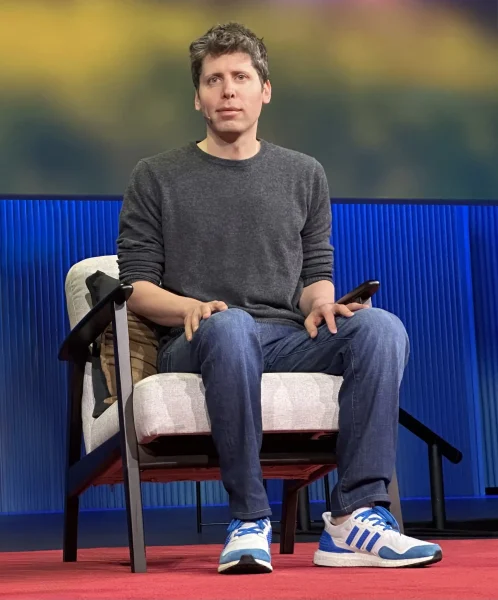
Image by- Steve Jurvetson, CC BY 2.0, via Wikimedia Commons
What is the benefit of AI infinite memory?
It allows the system to retain every spoken word and document forever, creating a helper that knows your history better than you do. Altman states that human assistants will always struggle with total recall. AI does not have that flaw. Solving the memory problem allows OpenAI to make their product indispensable. They are trading raw intelligence battles for long-term utility.
The Trillion-Dollar Infrastructure Gamble
Profitability in modern tech usually comes from software code, but this era requires building power plants.
The scale of investment here is hard to visualize. The long-term payout plan involves an estimated $1.4 trillion in infrastructure. This money goes into the "concrete and silicon" needed to run these massive models. Revenue projections are tied directly to this build-out. OpenAI expects to generate $20 billion, a number that tracks perfectly with the growth of their compute fleet.
Supply creates its own demand in this sector. Altman notes that demand consistently exceeds supply. Every time they bring a new unit of compute online, they monetize it immediately. The business model relies on the idea that the world has an insatiable appetite for intelligence.
Why is AI infrastructure so expensive?
The costs come from the massive physical requirements of data centers, energy consumption, and specialized hardware needed to run advanced models.
Profitability will eventually come from "inference" (running the models) rather than training them. But right now, the focus is on expansion. The company believes that whoever owns the most servers wins the long game.
Product Strategy: The Triad to Win
Raw horsepower is useless if the steering wheel falls off. Sam Altman believes a superior model is only one-third of the equation. The winning formula is a "Strategic Triad." This consists of the best models, the best product wrapping, and massive infrastructure scale. You need all three to dominate. A great model with a bad interface fails. A great interface with a dumb model fails.
This is where Google faces a unique challenge. Altman argues that you cannot simply retrofit existing platforms with AI. A legacy search engine is a constraint. You need a total redesign for an AI-native future. Google has a distribution advantage, but their reliance on old ways of showing information is a potential weakness. OpenAI forces a "cohesive product wrapping" around their intelligence.
What is the Strategic Triad?
It is the combination of having the best AI models, the best product design, and the largest infrastructure scale to support global usage. The approach is aggressive. They do not want to fix the old internet. They want to build a new layer on top of it.
Hardware and the Screenless Future
The most useful computers of the next decade will likely disappear into the background. We currently interact with AI through chat boxes on screens. This is a temporary state. OpenAI is collaborating with legendary designer Jony Ive to build a "small family of devices." These devices will likely have no screens at all. The goal is proactive context awareness. The device should know what you need without you staring at a phone.
This hardware push aligns with the memory strategy. If the device hears what you hear and sees what you see, it feeds the "infinite memory" engine. It creates a seamless loop of assistance. This moves the battle away from apps and into the physical world.
What is Jony Ive building with OpenAI?
They are designing screenless hardware devices that use AI to understand context and help users proactively without traditional interfaces. The shift is from reactive to proactive. Instead of typing a question, the system anticipates the answer. This creates a deeply personal, always-on connection.
GPT 5.2 and the Agentic Future
We treat AI like a chatbot, but the real value appears when we treat it like an employee. The launch of GPT 5.2 introduced a "thinking" model. This system performs well on scientific and coding benchmarks. But the real game-changer is the "Codex" update. This coding agent handles long-horizon tasks. It does not just write a snippet of code; it plans and executes complex projects. It uses "context compaction" to keep track of massive amounts of data at once.
The developer community is expanding to match this capability. OpenAI is opening up to developers on a scale comparable to the launch of the Apple App Store. With nearly 900 million users (according to some supporting sources), the platform is ready for third-party innovation. The focus is shifting from "chatting" to "doing."
What does the GPT-5.2 Codex agent do?
It is capable of handling long-term coding tasks and complex problem-solving by compacting context and executing multiple steps autonomously. The enterprise sector demands this higher reasoning. While the public prioritizes a fun experience, businesses need systems that can work for days without supervision. Future updates will target these specific optimizations.
Public Markets vs. Private Control
Public investors demand quarterly growth, which often kills long-term generational projects. Sam Altman has expressed 0% excitement for a public listing. He prefers private control. An IPO (Initial Public Offering) brings scrutiny and pressure to show short-term profits. OpenAI operates on a timeline of years and decades. Altman even proposed a new definition for "Superintelligence": a system more capable than a human CEO or Head of State. You do not hand the keys to such a system over to day traders.
There is also a delicate emotional component. Altman acknowledges that users prioritize emotional connection and warmth. People form relationships with these bots. There is a potential for "unhealthy attachment." Managing this requires careful ethical oversight rather than a sole focus on stock prices.
Why does OpenAI want to stay private?
Staying private allows the company to maintain control over powerful technology and long-term goals without the pressure of quarterly public market expectations. The Department of Energy "Genesis Mission" partnership further complicates this. Utilizing National Labs data for science requires security and trust. A private structure supports these sensitive collaborations better than a public spectacle.
The Memory War
The battle has moved beyond who has the smartest machine to who holds the keys to your history. Google Gemini 3 proved that the competition is awake, but it also clarified the true objective. OpenAI is moving beyond simple Q&A. Through the combination of infinite memory, screenless hardware, and agentic capabilities, they are building a second brain for every user. The "Code Red" was just a drill. The real war is for retention.
The winner of this race will not be the company with the highest benchmark scores. It will be the company that remembers your life better than you do. In 2026, memory is the ultimate product.
Recently Added
Categories
- Arts And Humanities
- Blog
- Business And Management
- Criminology
- Education
- Environment And Conservation
- Farming And Animal Care
- Geopolitics
- Lifestyle And Beauty
- Medicine And Science
- Mental Health
- Nutrition And Diet
- Religion And Spirituality
- Social Care And Health
- Sport And Fitness
- Technology
- Uncategorized
- Videos

