
Yoon Suk Yeol Martial Law Support & Youth Rage
Political suicide usually ends a career, but sometimes it starts a movement. According to Euro News, the world watched South Korea’s former President Yoon Suk Yeol self-destruct with his martial law declaration in December 2024, a surprising group rallied to his defense. Young men in their twenties, typically disillusioned with politics, did not see a dictator destroying democracy. They saw a lone warrior fighting a rigged system. This counterintuitive reaction reveals a deep fracture in South Korean society where economic hopelessness overrides respect for democratic norms.
The emergence of groups like "Freedom University" highlights this shift. Led by 24-year-old Park Joon-young, these organizations reject the status quo. They view Yoon’s imprisonment not as justice, but as martyrdom. According to the Washington Post, even after the Constitutional Court unanimously removed Yoon in April 2025, his base did not scatter. Instead, they hardened. The chaotic scenes of metal beams smashing into courthouses and paramilitaries forming in the streets prove that Yoon Suk Yeol martial law support has mutated into something far more volatile than standard partisan bickering.
The Economics of Desperation
When you cannot afford a home, you stop caring about preserving the system that priced you out. South Korea’s youth face a grim reality that fuels their radicalization. Economic growth has crawled at a painful 1–2% since the pandemic, leaving young workers stranded. The median income for this demographic sits around $1,600 a month. In a city like Seoul, that amount barely covers survival, let alone a future. This financial suffocation creates the perfect breeding ground for extremism.
Experts like psychiatrist Kim link this hardship directly to online radicalization. When a young person feels abandoned by the economy, they look for someone to blame. The Democratic Party became the target for its failures in housing policy. Yoon’s aggressive stance offered an outlet for this accumulated rage. High housing costs and stagnant wages make stability feel impossible. Therefore, blowing up the system feels like a viable option.
A New Kind of Youth Rebellion
Rebellion used to mean fighting for more democracy, but now it means fighting for a strongman. Park Joon-young and his peers at Freedom University represent a stark departure from traditional student activism. They do not march for liberal ideals. They march against what they call "left-wing hegemony." For them, a victory for Yoon matters less as a policy endorsement and more as a defeat for their rivals. They operate on animosity. The goal is to crush the opposition rather than build consensus.
This movement rejects "political correctness" and feminism, embracing a "Korea for Koreans" nationalism. They see the status quo as a threat to their identity and their future. Why do young Koreans support Yoon? Many young men view him as the only figure willing to break the rules to dismantle a system they believe is rigged against them. This belief persists even when 50% of people under 30 believe he is guilty of insurrection. The loyalty is emotional, not logical.
The Martial Law Catalyst
Total failure often strengthens loyalty because it demands total commitment from the believers. The events of December 3, 2024, should have ended Yoon’s influence. He declared martial law and attempted to deploy troops to parliament. Instead of abandoning him, his core supporters framed the act as a necessary sacrifice. They argued he wagered his life to save the nation from anti-state forces. The failure of the coup did not break the spell; it sealed the bond.
Yoon’s behavior in prison amplifies this narrative. Facing a potential life sentence, he resists questioning. Reports describe him stripping off his clothes and lying on the floor to evade prosecutors. To his followers, these are acts of defiance, not desperation. This behavior mirrors the "martyrdom" narrative his supporters crave. The 27% of the public who still agree with pro-Yoon views see a hero unfairly persecuted, not a criminal facing justice.
Digital Echo Chambers and Media
Truth loses its value when anger pays better dividends on a screen. Legacy media no longer controls the narrative for Yoon’s base. Right-wing YouTube channels like "Young Perspective" and "A Stroke of Genius" have replaced traditional news. Yoon himself encouraged this shift, urging people to consume YouTube over mainstream outlets. These digital spaces allow conspiracy theories to flourish without challenge. They create a sealed environment where Yoon is always right and his enemies are always evil.
In this ecosystem, facts become optional. The National Election Commission and the Supreme Court found no evidence of election manipulation. Yet, Yoon and his supporters insist North Korean hackers and unfolded ballots stole power from them. How did Yoon Suk Yeol communicate? He bypassed traditional press conferences to speak directly to his base through sympathetic YouTube channels that reinforced his worldview. This direct line keeps the anger hot and the mobilization constant.
America as the Blueprint
Foreign anger often provides a convenient script for local grievances. The Freedom University and other pro-Yoon groups look to the American right wing for inspiration. Park Joon-young explicitly cites the U.S. right-wing ecosystem as a model. They want a platform free from the fear of "cancel culture." This admiration manifests in physical symbols. Supporters wear MAGA-style red hats that cost about $5.50 and carry signs reading "Stop the Steal."
Expert Schattle calls this intentional alignment unsettling. By mimicking the strategies of the U.S. extreme right, Yoon’s supporters hope to court international attention, specifically from figures like Donald Trump. They view Yoon’s removal as a parallel to Trump’s 2020 loss. They expect intervention or at least solidarity from overseas. These imitation imports foreign culture war tactics directly into South Korean politics, escalating the tension.
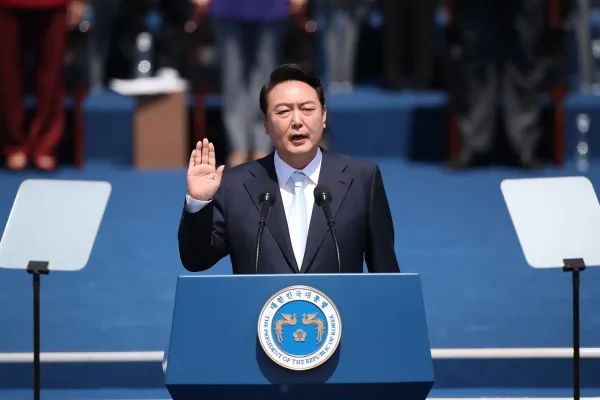
Image by - Korea.net / Korean Culture and Information Service (Photographer name), CC BY-SA 2.0, via Wikimedia Commons
Scapegoats and Enemies
Defining yourself by who you hate is easier than defining yourself by what you build. The movement relies heavily on identifying external enemies to explain internal failures. Anti-China sentiment runs high, with accusations of Beijing interfering in elections. In September 2024, Freedom University organized an anti-China march in Myeongdong. This scapegoating deflects attention from domestic policy failures. If the Chinese Communist Party is to blame, then local incompetence gets a pass.
This "Korea for Koreans" nationalism also targets internal enemies. The Democratic Party is viewed not just as the opposition, but as subservient to China and North Korea. This framing turns political disagreement into treason. It justifies extreme measures because the enemy is seen as an existential threat. Rally attendees like Bae label government policies as absurd, viewing their vocal opposition as a natural response to years of neglect.
Escalation to Violence
Rhetoric always turns physical when words fail to deliver results. Following Yoon’s removal in April 2025, the protests turned dangerous. A group known as the "White Skull Squad" (Baekgoldan) formed, signaling a return to paramilitary violence. Supporters stormed the Seoul courthouse armed with metal beams. The desperation reached tragic levels when an elderly supporter committed self-immolation. This was no longer a political debate. It was a physical clash.
The violence stems from a belief that the legal system is broken. Pro-Yoon supporter Won expressed that the court ruling crushed all hope. When institutions fail to deliver the desired outcome, the mob takes over. Did religion play a role in Yoon's support? Yes, evangelical leaders like Rev. Jun Kwang-hoon framed the conflict as a spiritual war against communism, adding religious fervor to the political violence. This spiritual dimension raises the stakes, making compromise impossible.
The Aftermath of Rage
The imprisonment of a president rarely kills the ideology that built him. Yoon Suk Yeol sits in a cell today, facing a life sentence, but the anger that put him in power remains free. The Yoon Suk Yeol martial law support movement proved that economic despair can twist democracy into something unrecognizable.
in Yoon. They used him to smash a system they felt abandoned them. Even with Yoon gone, the underlying fracture remains. Until the economy offers a real future to these young men, they will continue to look for leaders who promise to burn it all down.
Recently Added
Categories
- Arts And Humanities
- Blog
- Business And Management
- Criminology
- Education
- Environment And Conservation
- Farming And Animal Care
- Geopolitics
- Lifestyle And Beauty
- Medicine And Science
- Mental Health
- Nutrition And Diet
- Religion And Spirituality
- Social Care And Health
- Sport And Fitness
- Technology
- Uncategorized
- Videos

