
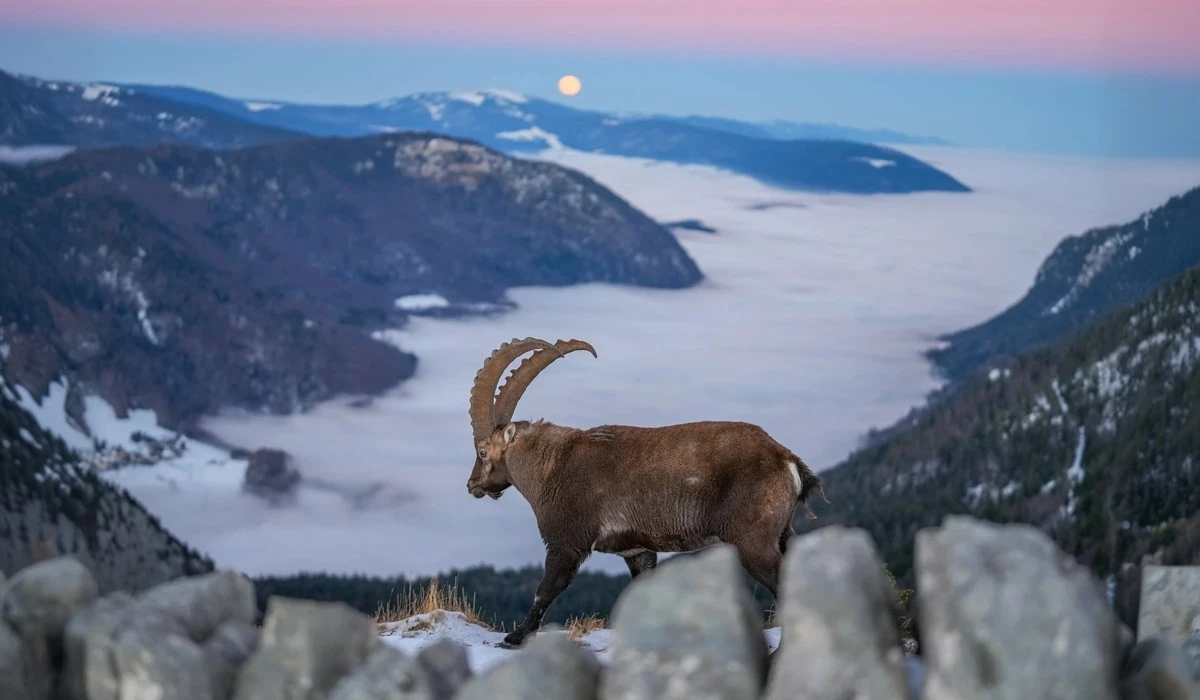
Image by- © Giles Laurent, gileslaurent.com, License CC BY-SA, CC BY-SA 4.0, via Wikimedia Commons
Alpine Ibex: Hunting For Profit Or Survival?
We assume legal protection builds a solid wall between wildlife and hunters. In Switzerland, that wall has a door, and it opens for the highest bidder. The Alpine Ibex returned from the edge of extinction only to become a central figure in a complex financial arrangement. Local regions now rely on the revenue generated by selling the lives of these animals to wealthy tourists. This creates a situation where the safety of a species depends on the very activity that once destroyed it. The line between conservation and commercialization blurs when a protected animal carries a price tag equal to a small car.
The Price of a Trophy
Financial incentives often turn wild animals into line items on a regional budget sheet. In the Valais region of Switzerland, the pursuit of the Alpine Ibex has evolved into a lucrative industry. Hunters arrive with heavy wallets and specific goals. They seek the massive, backward-curving horns of older males. These horns can grow up to a meter in length, making them a prized acquisition for trophy collectors. The local government charges a premium for this access.
A single license to kill a male Alpine Ibex in Valais costs approximately 13,000 Swiss francs. This converts to roughly £10,170 or $13,113. This fee grants the holder a one-day window to secure their prize. The high cost limits participation to those with significant disposable income.
For the Valais canton, these fees add up quickly. The region generates about 650,000 Swiss francs annually from hunting activities alone. This revenue stream creates a powerful motivation to keep the hunt active. Supporters argue that this money supports the local economy and funds management efforts. However, critics see it differently. They view it as a system where nature pays the rent.
How much does an ibex hunting license cost?
In the Swiss region of Valais, a license to hunt a male ibex with trophy-sized horns costs around 13,000 Swiss francs ($13,113).
Hunters like Olivia Nalos Opre defend the practice. She describes the acquisition of a "massive male" as a significant prize. For her, the experience often involves companion success, leading to a "dual kill" where multiple trophies are taken. This perspective highlights the disconnect between recreational killing and the animal's biological reality. The animal becomes a commodity, valued by the centimeter.
A Tale of Two Cantons
Local autonomy allows neighboring regions to rewrite national expectations with drastically different rules. Switzerland handles wildlife management through a cantonal system. This means local regions possess immense power over their wildlife populations. This structure leads to conflicting approaches within the same mountain range. Valais takes a commercial approach, welcoming foreigners and charging high fees. Their system prioritizes revenue and utilizes a quota system of about 120 licenses per year.
Meanwhile, the neighboring canton of Graubünden operates on a completely different philosophy. Professor Ulf Büntgen from the Swiss Federal Institute for Forest, Snow and Landscape Research (WSL) highlight this contrast. Graubünden restricts hunting primarily to locals. The rules there are strict and focus on population management rather than trophy collection. Hunters in Graubünden must often shoot a female first before they are allowed to target a male.
This prerequisite eliminates the "vanity" aspect of the hunt. It forces hunters to participate in population control rather than just headhunting for the largest horns. Professor Büntgen describes the Graubünden approach as meticulous targeting. He contrasts this with the trophy pursuit seen in Valais, which he views as distinct from actual wildlife management. The annual kill count in Graubünden sits at around 500 ibex, slightly higher than the 450 taken in Valais, yet the motivation differs fundamentally. One system manages a population; the other sells an experience.
The Biological Reality of the Alpine Ibex
Physical traits dictate survival strategies that look impossible to the human eye. The Alpine Ibex, known scientifically as Capra ibex, is built for life on the edge. These animals are sexually dimorphic, meaning males and females look quite different. A male can weigh between 67 and 117 kilograms and stand up to 101 centimeters tall. Their defining feature is the massive set of horns that curve backward, reaching lengths of up to 98 centimeters.
Females are much smaller. They weigh between 17 and 32 kilograms and have shorter horns measuring only 18 to 35 centimeters. This size difference gives females a distinct advantage in agility. They can navigate steep terrain with greater ease than the heavier males. This agility is crucial for their survival in the high Alps.
What is the scientific name for the Alpine Ibex?
The scientific name for the Alpine Ibex is Capra ibex, and they belong to the genus Capra. These animals typically live at altitudes above 2,000 meters. They inhabit the rocky, treacherous slopes where few predators can follow. However, their survival involves more than just climbing. They are herbivores, grazing on grasses, herbs, and shrubs. This diet creates a nutritional gap. They often struggle to find enough salt.

Image by- Rosellino, CC BY-SA 4.0 , via Wikimedia Commons
The Salt Desperation
Mineral deficiency drives animals to ignore gravity and risk death on man-made structures. The need for salt forces the Alpine Ibex to perform feats that seem to defy physics. At the Cingino Dam in Italy, observers often see goats scaling the nearly vertical concrete wall. The dam face has a slope of up to 123-161%, yet the animals move across it with confidence.
They are not showing off. They are licking the stones. The concrete releases ettrigite, a substance that provides calcium salts and other soluble minerals. The ibex diet is naturally salt-deficient, so they take extreme risks to access these deposits.
Researcher Alice Brambilla explains how they manage this. Their hooves have a specialized structure. The outer rim is hard, while the inner pad is soft and rubbery. This combination allows them to grip the tiny irregularities in the concrete surface. Interestingly, you will mostly see females and their kids on the wall. The heavier males, with their massive horns and bulkier bodies, usually stay on solid ground. They cannot risk the fall. This behavior highlights the extreme lengths these animals go to just to maintain their basic health.
Conservation vs. Commercialization
Profit motives often wear the mask of necessary management to justify their existence. The conflict between hunting revenue and conservation ethics has drawn sharp criticism. Organizations like the WWF argue that the species' protected status should make it off-limits to trophy hunters. Jonas Schmid of the WWF states clearly that species safety does not justify recreational killing. He questions the legal basis of the Valais hunting licenses.
From the conservationist perspective, the "unfavourable-inadequate" status classified by the European Environment Agency should trigger stricter protections. The total Alpine population stands at over 40,000, with about 16,000 residing in Switzerland. While these numbers seem high compared to their near-extinction history, the population is not entirely secure.
Is the Alpine Ibex endangered?
While they have recovered from near extinction, the European Environment Agency currently classifies their conservation status as "unfavourable-inadequate."
Proponents of the hunt argue that removing old males has a minimal impact on population stability. Professor Büntgen notes that the habitat elevation is extreme and the targets are elusive. Local ranger guidance is mandatory for these hunts. If a hunter kills the wrong animal, they face financial penalties and license forfeiture. This strict supervision supposedly keeps the practice sustainable. Yet, the ethical question remains: should a protected animal be sold to balance a regional budget?
The Heat and the Wolves
Temperature regulates behavior more strictly than the threat of being eaten. Recent studies have uncovered a surprising shift in Alpine Ibex behavior. Traditionally, biologists assumed these animals were active during the day to avoid predators. Wolves, their main natural enemy, hunt primarily at night. Logic suggests the ibex would sleep at night and graze when the sun is up.
New data contradicts this. Researcher Francesca Brivio found that ibex activity peaks at night, even in areas where wolves are present. The driving force behind this change is heat. The animals prioritize heat avoidance over predator safety.
As the climate warms, the daytime temperatures in the high Alps become uncomfortable for the cold-adapted ibex. They choose to rest in the shade during the day and forage under the cover of darkness. This shift exposes them to a higher risk of wolf encounters. Brivio notes that the expectation was to see high night activity only in wolf-free zones. The reality is that the fear of heat overrides the fear of fangs.
The Silent Climate Threat
Timing mismatches do more damage to a population than bullets ever could. While hunting grabs the headlines, a quieter threat is killing the next generation of Alpine Ibex. The survival rate for kids has dropped from 60% in the 1980s to just 35% today. The culprit is a phenomenon known as "phenological mismatch."
Spring is arriving earlier in the Alps. Dr. Achaz von Hardenberg explains that the warm weather accelerates the growth of nutritious grasses by about three weeks. However, the ibex birth timing remains static. The kids are born at the same time they always have been. By the time they arrive, the best fodder has already grown and degraded in quality.
The mothers cannot find enough high-quality food to produce rich milk. The kids starve or grow weak because the restaurant opened and closed before they were even born. Marco Grosa, a ranger, observes that plants are now found 800 meters above their normal range. The ecosystem is altering rapidly, and the ibex cannot reset their biological clocks fast enough to keep up.
Genetic Ghosts and Bottlenecks
A recovered population count often hides the weakness in the bloodline. The current population of over 40,000 Alpine Ibex looks like a success story. In the late 20th century, the species faced near extinction. The recovery was only possible because of a small stock preserved in Italy. King Victor Emanuel II created a hunting reserve in 1856 called Gran Paradiso. This royal playground inadvertently saved the species from disappearing entirely.
However, this history comes with a cost. All living ibex today are descendants of that tiny group. This creates a genetic bottleneck. The genetic diversity within the population is low, leading to risks of inbreeding depression.
This lack of genetic variation makes the population vulnerable to diseases. Outbreaks of Brucella and severe eye infections have been noted. While the headcount is high, the genetic health of the herd is fragile. A single potent virus could do what hunters and wolves cannot. The recovery is real, but it stands on a shaky foundation.
Survival in a Changing World
The Alpine Ibex stands at the intersection of human commerce and environmental chaos. The species has survived extinction once, thanks to a king who wanted to hunt them. Today, they face a similar irony. Their value as trophies protects their habitat, yet that same value turns them into targets.
The Alpine Ibex must navigate a world where grass grows too early, heat pushes them into the dark, and wealthy tourists pay thousands for their heads. The revenue from Valais supports the region, but the biological cracks are showing. With kid survival rates plummeting and genetic diversity low, the future of the King of the Alps is far from guaranteed. The real challenge isn't just surviving the hunt; it is surviving the world we have built around them.
Recently Added
Categories
- Arts And Humanities
- Blog
- Business And Management
- Criminology
- Education
- Environment And Conservation
- Farming And Animal Care
- Geopolitics
- Lifestyle And Beauty
- Medicine And Science
- Mental Health
- Nutrition And Diet
- Religion And Spirituality
- Social Care And Health
- Sport And Fitness
- Technology
- Uncategorized
- Videos

