
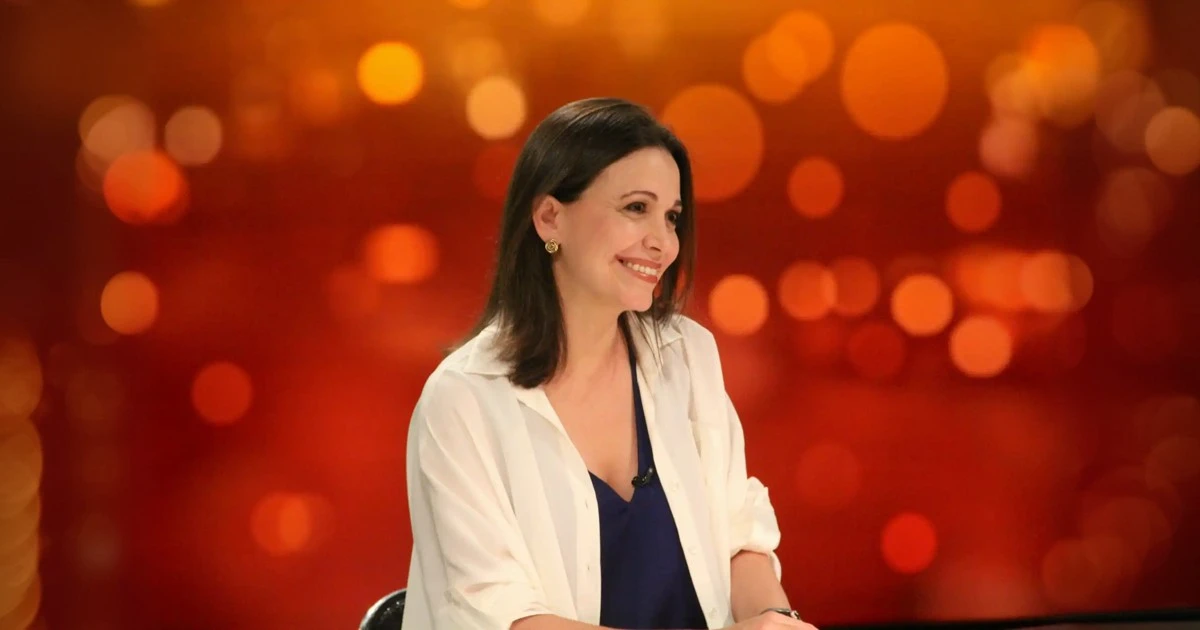
Image by- Gabo Bracho, CC BY-SA 4.0
Maria Corina Machado: The Missing Nobel Winner
Fame usually puts a leader directly in front of the cameras, but survival sometimes demands they vanish completely. The world turns its eyes to Oslo for a celebration of peace, yet the guest of honor remains a ghost. This silence speaks louder than any acceptance speech ever could. Maria Corina Machado has not appeared publicly in nearly a year. The Nobel Institute waits without answers. Security risks dictate every move.
The 58-year-old laureate exists currently as a voice on a phone or a name in a headline. Her physical location stays a mystery. This absence creates a powerful tension in Venezuela and beyond. A regime classifies her as a fugitive while the international community calls her a hero. The space between those two labels is dangerous. Maria Corina Machado navigates a reality where accepting an award might cost her freedom. Her empty chair in Oslo proves exactly why the committee selected her.
The Silence from the Nobel Institute
Planners usually control every minute of a prestigious ceremony, yet this event revolves entirely around a missing person. The Nobel Institute normally operates with precision. This year, they work in the dark. Organizers cancelled the traditional pre-ceremony press conference scheduled for Tuesday. They simply had no speaker to present.
The Institute openly admits they lack information regarding the laureate's logistics. According to Al Jazeera, the Nobel Institute stated the press conference was canceled because “Machado’s whereabouts remain unknown.” Security concerns override all protocols. A spokesperson confirmed that the journey to Oslo carries immense risk, with The Guardian noting she is “still expected in Oslo post journey of ‘extreme danger’.” They cannot confirm how, when, or even if Maria Corina Machado will enter Norway. This uncertainty disrupts the standard flow of the Nobel week. The focus shifts from the celebration of past achievements to the immediate danger of the present moment.
Rumors swirl about her movements. Some reports suggest she might have arrived in secret. Others claim she remains trapped within Venezuela’s borders. Where is Maria Corina Machado now? No one knows for sure because she went into deep hiding to avoid arrest by the Venezuelan government. The Institute maintains a stance of waiting. They acknowledge the difficulty she faces. This lack of clarity forces the world to pay attention to the severity of her situation.
Legal Threats and Government Pressure
Leaving a country usually grants a political dissident freedom, but here it triggers an immediate criminal designation. The Venezuelan government watches the borders closely. Attorney General Tarek William Saab made the stakes clear. He stated that any departure from Venezuela by Maria Corina Machado automatically triggers a fugitive classification. The legal system stands ready to act the moment she steps into the light.
Authorities have multiple active criminal probes against her. The charges are heavy. They accuse her of conspiracy. They allege links to terrorism. They claim she incites hate. These are not minor infractions in the eyes of the state. They carry severe prison sentences. The government views her international travel not as a victory lap, but as an escape from justice.
This legal pressure creates a cage. If she stays, she remains in hiding. If she leaves to receive the Maria Corina Machado award, she can likely never return. The regime uses the judicial system to freeze her movement. Saab’s comments serve as a warning. The charges sit on a desk, waiting for a signature. The threat of arrest hangs over every logistical choice she makes.
The Disputed 2024 Election Roots
Official results often mask the real count, turning a statistical loss into a forced victory. The current crisis did not appear out of nowhere. It stems directly from the 2024 Venezuelan election. The opposition contends that the vote was stolen, with The Guardian reporting on a "meticulously planned operation" that "succeeded in gathering 83% of voting tallies" and claims of an opposition win in 2024. They possess tally sheets that show a different winner. They argue that Edmundo González won the legitimate vote.
Maria Corina Machado championed this cause. According to Reuters, she “was blocked by Venezuela's courts from running for president” in 2024. She threw her support behind González. The regime, however, declared victory for Nicolás Maduro. This marked the beginning of his third presidential term. Protests erupted immediately. The streets filled with people demanding transparency.
The government cracked down on this dissent. January 9 marked the last time anyone saw Machado in public. She attended a protest in Caracas against the inauguration. Since that day, she has operated from the shadows. The 11-month disappearance underscores the intensity of the conflict. She challenges the validity of the entire administration. The election dispute remains the central engine of this standoff.

Image by- World Economic Forum/(Photo by Bel Pedrosa), CC BY-SA 2.0
The Trump Administration’s Complex Reaction
Public criticism often hides private respect when political alliances shift. The reaction from the United States presents a fascinating contradiction. Donald Trump’s team issued sharp words regarding the Nobel Committee’s decision. Steven Cheung, incoming White House communications director, claimed the Committee prioritized politics over peace. He argued they ignored Trump’s track record.
Cheung highlighted the "seven wars ended" during Trump’s previous term. He cited peace deals and willpower as superior credentials for the prize. The statement advised that the award had become a tool of liberal bias. However, the public narrative does not match private actions. Reports from CBS indicate a different reality behind closed doors. Donald Trump reportedly held a private phone call with Maria Corina Machado.
In this conversation, he allegedly congratulated her. He called her deserving of the honor. What did Donald Trump say about the Nobel Prize? His spokesperson criticized the committee for ignoring his peace deals, but reports say he privately congratulated the winner. This duality reveals the complexity of high-level diplomacy. The public stance appeals to a political base. The private call acknowledges the reality of her struggle. Machado herself views Trump as a vital ally. She emphasizes the need for US support in her fight for freedom.
A Portrait of the "Iron Lady"
Nicknames often reveal the stubbornness required to survive decades of opposition. Supporters and critics alike call her the "Iron Lady." This moniker reflects her unyielding stance against the Venezuelan government. Maria Corina Machado did not start as a politician. She began as an industrial engineer. Her mind works on structures and systems.
She founded Súmate, a vote-monitoring organization. This group focused on election integrity long before the 2024 crisis. She built her career on technical scrutiny of the political process. This background separates her from typical career politicians. She approaches governance with an engineer’s demand for precision and law.
Her personal life bears the scars of her work. She has three children. All of them live abroad. The separation from family is a standard cost for Venezuelan dissidents. She remains in the country while her children build lives elsewhere. This isolation adds a personal layer to her professional fight. The "Iron Lady" title suggests strength, but it also implies a necessary hardness to endure such separation.
Ideological Battles and Labels
Political labels frequently obscure the actual policies a leader proposes. The media and the government struggle to categorize Maria Corina Machado. Critics often tag her with extreme labels. They call her "far-right." Some use the term "radical." Others have coined the phrase "MAGAzuelan" to link her to the American political movement. These tags paint a picture of extremism.
Her own descriptions tell a different story. She identifies as a centrist or liberal. She promotes a concept she calls "Popular Capitalism." This economic theory focuses on individual empowerment rather than state control. Her ideology appears clearly in her "Freedom Manifesto." This document, published in the Washington Post, serves as a proto-constitution for a transition of power.
The Manifesto prioritizes specific pillars. It calls for privatization of state industries. It demands strict adherence to property rights. It emphasizes the rule of law above all else. These are classical liberal tenets, not radical inventions. The conflict over her label is part of the political battle. The regime benefits from painting her as an extremist. Maria Corina Machado argues simply for a return to market democracy.
The Ceremony and Family Dynamics
A celebration becomes a protest when the winner’s chair sits empty among their own family. The Nobel ceremony in Oslo proceeded with a glaring absence. While Maria Corina Machado remained in hiding, her family stepped onto the global stage. Her mother, Corina Parisca, aged 84, traveled to Norway. Her daughter, Ana Corina Sosa, also arrived in Oslo.
They wait in a city ready to honor their matriarch. The anticipation of a reunion remains high, yet unfulfilled. Machado participated only via phone. In a call to the Nobel Director, she expressed deep humility. She questioned her own individual merit. She insisted the recognition belongs to the collective struggle of the Venezuelan people.
This deflection of praise is typical of her recent rhetoric. She frames the prize not as a personal trophy, but as a tool for the movement. Why is the Nobel Peace Prize important? It highlights struggles for democracy and protects activists by giving them global attention. The presence of her family highlights her absence. The 84-year-old mother accepting applause for her missing daughter creates a poignant image. It humanizes the political headline.
Global Context: Democracy in Retreat
Awards often serve as signal flares for broader global trends. The Nobel Committee did not choose Maria Corina Machado in a vacuum. The 2025 prize carries a specific theme: "Democracy in retreat." The Committee sees a pattern of authoritarianism rising globally. They selected a laureate who stands on the front line of this conflict.
Chair Frydnes defended the selection against all criticism. He cited Alfred Nobel’s will as the sole criteria. He insisted the Committee ignores political pressure. The decision rests entirely on merit and courage. By choosing a Venezuelan dissident, they shine a light on Latin America. They declare that the fight for ballot boxes in Caracas matters to the peace of the world.
This context elevates Machado’s struggle. She is not just fighting a local dictator. She represents a global counter-movement. The "Freedom Manifesto" and the "Iron Lady" persona fit into this larger narrative. The prize acknowledges that peace requires the ability to choose one's leaders. The retreat of democracy stops only when individuals refuse to move.
The Role of International Allies
External support often determines the lifespan of a resistance movement. Maria Corina Machado knows she cannot win alone. She openly identifies her necessary allies. She lists the United States as critical. She points to Latin American neighbors as vital. She even cites Donald Trump as a crucial figure in her strategy.
The victory threshold is near, according to her statements. She believes the pressure is working. The prize creates a new layer of diplomatic cover. It forces foreign governments to take a stance. Ignoring a Nobel Laureate is harder than ignoring a standard opposition leader. The award acts as a shield and a megaphone.
However, allies bring complications. The White House criticism shows that support is never guaranteed. Different administrations prioritize different goals. Machado navigates these waters with pragmatism. She accepts congratulations where she can get them. She ignores political slights to focus on the objective. The goal remains freedom, and she accepts help from any quarter that offers it.
The Power of Absence
The empty chair in Oslo proves exactly why the committee chose her. Maria Corina Machado fights a dictatorship that fears her presence enough to criminalize her travel. The regime’s threat to label her a fugitive validates the effectiveness of her resistance. Silence creates the noise that the world now hears.
She credits the achievement to Venezuelan society, yet she bears the personal cost. Her mother and daughter stand in the spotlight while she remains in the shadows. This prize forces the world to look at the reality of Venezuela. The "Iron Lady" may be missing from the stage, but her influence has never been more visible. The struggle concludes only when the hiding ends.
Recently Added
Categories
- Arts And Humanities
- Blog
- Business And Management
- Criminology
- Education
- Environment And Conservation
- Farming And Animal Care
- Geopolitics
- Lifestyle And Beauty
- Medicine And Science
- Mental Health
- Nutrition And Diet
- Religion And Spirituality
- Social Care And Health
- Sport And Fitness
- Technology
- Uncategorized
- Videos

