
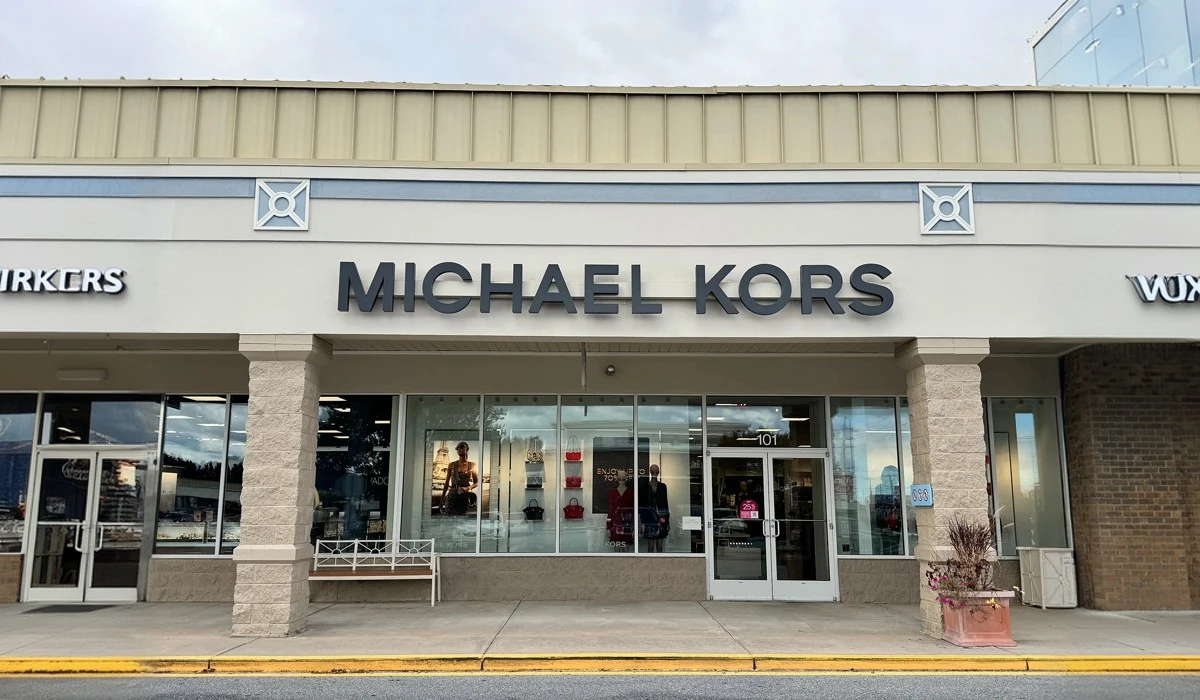
Image by Harrison Keely, CC BY 4.0, via Wikimedia Commons
Michael Kors Pivot Follows $1.4B Sale
Fashion empires often crumble when they mistake applause on a runway for credit card swipes in a store. Brands frequently chase prestige so aggressively that they forget the actual products funding their existence. Capri Holdings recently encountered this exact friction between high-end ambition and business reality. According to a press release from Capri Holdings, the group has completed the sale of Versace to Prada S.p.A. for $1.375 billion in cash, subject to adjustments. This divestment strips away the distraction of ultra-luxury competition to prioritize the group’s true financial anchor.
Michael Kors remains the dominant force within the portfolio, generating the vast majority of total sales. The strategic pivot moves away from global empire-building and back toward the core customer who actually buys handbags. Management is correcting previous pricing missteps and doubling down on what works. Management prioritizes the accessible mid-tier over the top 1% of the market. This decision reveals a clear preference for reliable revenue over high-stakes glamour.
The Versace Divestment and Strategic Clarity
Holding onto a prestige asset usually drains resources from the engine actually keeping the lights on. Capri Holdings acquired Versace in 2018 for $2.1 billion with the intent of achieving luxury dominance. Six years later, the decision to sell the brand for $1.4 billion highlights a stark reality. The math simply did not work in favor of holding the asset.
Proceeds from this sale are designated for debt reduction and strengthening the balance sheet. A company announcement regarding Q2 fiscal 2026 results confirms the expectation for the deal to close in the fiscal 3rd quarter. This move allows the leadership team to remove split focus. CEO John Idol stated that the brand is now "fully focused on the growth" of its two remaining iconic brands. The divestment clears the path for a streamlined operation. Resources previously tied up in managing a volatile ultra-luxury house can now support the steady demand for Michael Kors products.
Understanding the Michael Kors Revenue Engine
A company's public identity rarely matches the boring ledger lines driving seventy percent of its income. While runway shows garner press, the balance sheet tells a different story about where the money comes from. An SEC filing reveals that Michael Kors accounts for approximately 70% of the group's total revenue.
In the 2nd quarter of Fiscal Year 2026, the brand generated $725 million. This figure represents a reported decline of 1.8%, yet the group’s total revenue of $856 million still exceeded analyst estimates. The contrast between revenue and profitability remains sharp. Capri Holdings reported a net loss of $34 million for the quarter, a sharp contrast to the net income of $42 million recorded the prior year.
Who owns the brand?
The brand is owned by Capri Holdings, a global fashion luxury group that also owns Jimmy Choo. Despite the net loss, the sheer volume of sales confirms the brand's position as the primary breadwinner. On November 4, 2025, the Board of Directors authorized a 3 year share repurchase program of up to $1 billion, indicating confidence in the brand's ability to generate cash.
Why Wearability Outlasts Trends
Designers who ignore the grocery run in favor of the gala eventually find themselves designing for nobody. The fashion sector often prioritizes spectacle over function, turning clothing into entertainment rather than utility. Kors has consistently rejected this approach since launching his brand in 1981.
He argues that fashion insiders view "wearable" as a dirty word. Critics often dismiss practical clothing as "commercial," framing it as a negative attribute. Kors counters this by suggesting that trend-obsessed designers fail to move the industry forward. He believes that locking oneself in an atelier surrounded only by friends limits creativity. "You have got to stay curious," he asserts. This philosophy drives the brand's longevity. By focusing on items people can actually use, the brand avoids the volatility of passing fads.
The Pricing Correction and Market Reality
Raising prices to chase elite status often alienates the core buyers funding the operation. Over the last few years, Michael Kors attempted to elevate its positioning to cushion against tariffs and rising costs. This strategy backfired by pushing loyal customers away.
Luxury price inflation has hit +25% since 2019. However, the business is now reversing course. The current strategy involves a return to accessible luxury. The target price point for mid-tier bags, such as the Quinn tote or Hamilton bag, sits between £230 and £275.
Is Michael Kors considered a luxury brand?
It is positioned as an accessible luxury brand, sitting in the mid-tier market rather than the ultra-luxury pricing of brands like Hermes. This correction acknowledges that the brand's strength lies in accessibility, not exclusivity. The target audience is the aspirational consumer, not the ultra-wealthy. This pivot aims to recapture the volume of sales lost during the attempt to move upmarket.
Inclusivity Against the "Size Zero" Tide
Fashion cycles tend to regress toward exclusion whenever the economy tightens, leaving the majority behind. The current industry trend reflects a return to "extreme thinness," influenced partly by the popularity of Ozempic. Many luxury houses are reverting to casting only the smallest sample sizes.
Michael Kors stands in opposition to this regression. He insists on casting models of diverse sizes and ages. "We all have families. We all know different people of different ages and different sizes," he notes. His goal is to ensure everyone feels "invited to the party." This stance serves both ethical and commercial purposes. By refusing to alienate customers who do not fit a specific mold, the brand expands its total addressable market.
Political Neutrality and Celebrity Power
A brand survives political polarization by dressing the role rather than the platform. In a divided cultural landscape, taking a hard line often limits commercial reach. Kors is a known Democrat who has supported causes like God’s Love We Deliver for over 25 years. Yet, his designs appear on figures across the political spectrum.
He has dressed First Ladies from Michelle Obama to Melania Trump. A portrait of Michelle Obama in a black sleeveless dress famously sparked a controversy over "bare arms," cementing the brand in American history.

Image by Masaki-H, CC BY 2.0, via Wikimedia Commons
Where is Michael Kors from?
He is an American designer who started his career in New York boutiques before launching his own label. The brand maintains a "Jet-set" identity that appeals to both Taylor Swift and Gwyneth Paltrow. This ability to separate personal politics from professional output allows the business to serve a wide range of clients without shrinking its audience.
Financial Future for Michael Kors and Capri
Stock buybacks often signal that management believes the market has undervalued their actual cash flow. The authorization of a $1 billion share repurchase program suggests Capri Holdings sees a discrepancy between its stock price and its value. This moves capital back to shareholders while the company reorganizes.
The retail footprint is also changing. According to a presentation at the Morgan Stanley Global Consumer and Retail Conference, the brand closed around 125 stores over the past three years. Simultaneously, flagship locations like the Rockefeller Center store are receiving "open plan" revamps with lounge areas. These changes aim to modernize the shopping experience. Capri Holdings stated that proceeds from the sale of the Versace brand will repay debt and provide fiscal adaptability to invest in growth. With the deal closing in the fiscal 3rd quarter, the company can fully commit to stabilizing its primary revenue source.
Conclusion: The Return to Core Strength
The sale of the Versace brand marks the end of an era of expansion and the beginning of a period of focus. Capri Holdings effectively admitted that chasing ultra-luxury dominance distracted from the company's real strength. Kors remains the engine that powers the entire operation. By correcting pricing errors, embracing inclusivity, and focusing on wearable products, the business is realigning with the customers who built it. Success in the coming years depends on serving market reality rather than relying on exclusivity.
Recently Added
Categories
- Arts And Humanities
- Blog
- Business And Management
- Criminology
- Education
- Environment And Conservation
- Farming And Animal Care
- Geopolitics
- Lifestyle And Beauty
- Medicine And Science
- Mental Health
- Nutrition And Diet
- Religion And Spirituality
- Social Care And Health
- Sport And Fitness
- Technology
- Uncategorized
- Videos

