
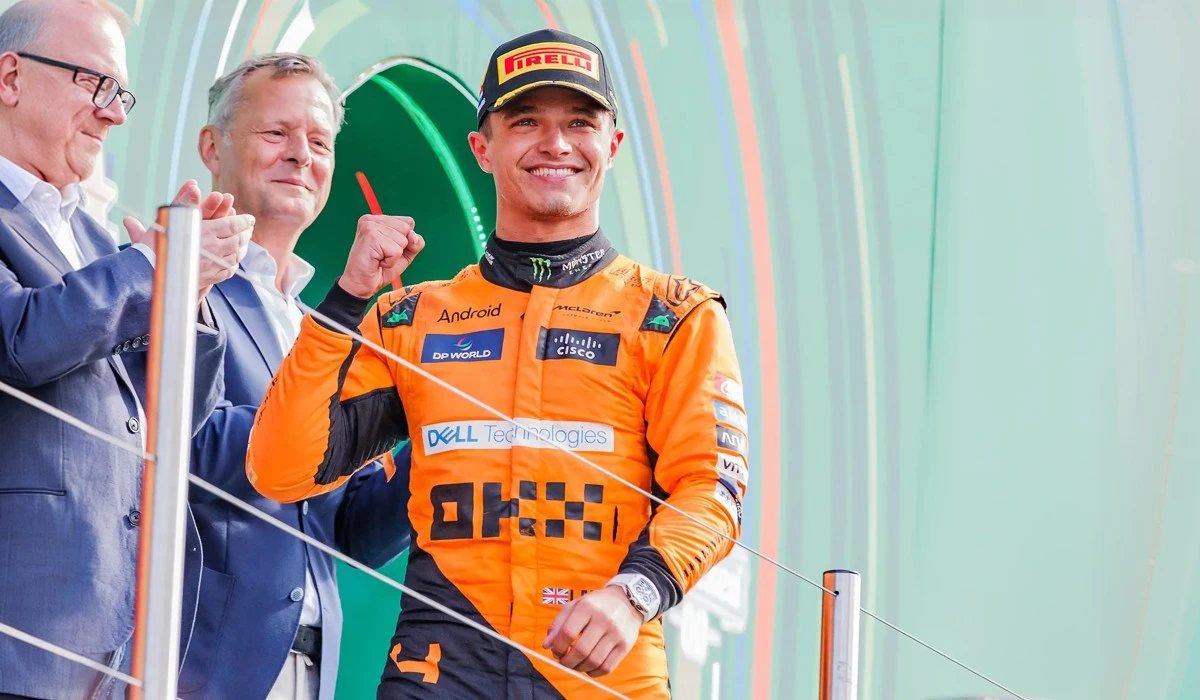
Image by Steffen Prößdorf, CC BY-SA 4.0, via Wikimedia Commons
Lando Norris 34-Point Deficit Fuelled 2025 Title
Championships are rarely won on the podium; they are secured in the dark corners of a garage where telemetry data meets human insecurity. The 2025 Formula 1 season proved that raw speed is often the least important variable in the equation of victory. Lando Norris did not claim the World Drivers’ Championship through brute force or by mimicking the aggression of his rivals. He won by decoding a complex system of psychological calibration and mechanical geometry. The narrative of his season defies the standard arc of dominance. It reveals a pattern of failure, technical disconnect, and a counterintuitive refusal to change his personality. This title fight required a driver to look at a 34-point deficit and find leverage in the silence of his own mind.
Lando Norris entered the 2025 campaign carrying the heavy burden of "favorite." The strong momentum from the end of 2024 suggested an easy transition to the top step. Reality offered a different script. The car arrived with a fundamental disconnect between the steering wheel and the asphalt. Expectations clashed violent with the mechanical limitations of the machinery. The paddock anticipated a coronation, but they witnessed a struggle. Norris found himself fighting the vehicle’s behavior at every corner entry. This friction between expectation and reality set the stage for one of the most unpredictable title fights in modern history.
The Illusion of Momentum
Momentum creates a dangerous blind spot when it masks the underlying fragility of a high-performance system. The 2024 season ended with McLaren looking like an unstoppable force, yet the 2025 opener exposed the cracks in that assumption. Lando Norris discovered immediately that the new car did not behave like its predecessor. The front axle lacked the bite he needed to commit to corners with his usual precision.
This technical instability opened the door for his teammate. Oscar Piastri adapted faster to the unpredictable handling. While Norris fought to understand the feedback from the tires, Piastri built an early lead in the standings. The situation spiraled quickly. By the time the circus reached Saudi Arabia in March, the struggle morphed into a disaster. Norris crashed out of the race. The "Did Not Finish" (DNF) result marked the absolute floor of his early campaign.
The crash in Jeddah was a symptom of a deeper issue. According to a report by F1i.com, Norris described his mental state during this period as "clueless," admitting he struggled to find rhythm despite the car's potential. He could not feel the limit of the car. When a driver cannot trust the front end of an F1 car at 200 miles per hour, confidence evaporates. The gap to the front grew wider with every lap. This early phase proved that carrying the "favorite" tag changes the atmospheric pressure in the cockpit. Every error weighs heavier when the world expects perfection.
The Mechanics of a Mid-Season Collapse
Statistical gaps on a leaderboard often hide the structural damage happening inside a driver's helmet. By late August, the championship picture looked bleak for the British driver. Data from Formula1.com indicates that following a retirement at the Dutch GP, Lando Norris trailed his victorious teammate Piastri by exactly 34 points. In the ruthless math of F1, a 34-point deficit to a driver in the exact same machinery usually signals the end of a title bid.
This specific margin forced a confrontation with reality. Lando Norris admitted that trailing a guy with the same car "didn't fill me with confidence." The deficit stripped away all excuses. He could not blame the engine or the aerodynamics. The problem lay within the cockpit. This period tested his mental fortitude more than his physical endurance.
The internal dynamic at McLaren shifted. Piastri held the upper hand, and the team’s focus naturally drifted toward the lead driver. Norris had to navigate this collapse without fracturing his relationship with the garage. He internalized the struggle. Instead of lashing out at the team, he analyzed the void between his performance and his potential. This low point served as the necessary friction to spark a transformation. He needed to hit the bottom to understand how to climb back up.
A Single Suspension Tweak Changed Everything
Small mechanical adjustments sometimes trigger massive psychological breakthroughs that rewrite the trajectory of a season. The turning point for Lando Norris did not come from a new engine or a radical aerodynamic package. It came from a subtle tweak to the front suspension. The team engineers adjusted the geometry of the front end, altering how the car communicated with the track surface.
This minor technical change repaired the disconnect. Suddenly, the front axle responded predictably. The vague feeling that plagued Norris from March to August vanished. He could now place the car on a dime. This technical fix acted as the catalyst for his form recovery. From September through December, he went on a tear, clawing back points at every round.
The suspension adjustment made him unlock his natural speed. He later described this phase as "struggles turned into strength." The data supports this claim. He secured 7 wins and 18 podiums over the course of the full season. The car finally felt like an extension of his body. This section of the season highlights the symbiotic relationship between man and machine. A few millimeters of suspension travel restored the confidence of a World Champion.
Norris and the Internal Rivalry
Teammates act as the ultimate mirror, reflecting weaknesses that rival teams cannot see. The battle for the 2025 title forced Lando Norris to manage a fierce rivalry within his own walls. While the media focused on the external threat of other teams, Oscar Piastri remained the most dangerous variable. Piastri led the championship during the mid-season and pushed Norris to his absolute limit.
Tension boiled over in Singapore. The two McLaren drivers collided on track. As reported by ESPN, Piastri voiced frustration over the radio following the near-collision, hinting that Norris almost put him into the wall and declaring the move "not fair." Such incidents threaten to destroy the trust required to share data and improve the car. A fractured garage usually leads to defeat. However, McLaren managed to keep the ecosystem intact.
The dynamic shifted again in Qatar. In a moment of strategic calculation and repayment, Norris slowed down during the Sprint race. He surrendered the win to Piastri. This gesture acted as a "return of favor" for help Piastri provided in Brazil. Who was Lando Norris's teammate in 2025? Oscar Piastri raced alongside him, creating a high-stakes internal battle that defined the season. This give-and-take proved that Lando Norris understood the long game. He prioritized the health of the team dynamic over a single sprint victory, knowing he would need Piastri's support in the finale.
Surviving the Las Vegas Disqualification
Rules enforcement introduces a chaotic variable that raw talent cannot control. The championship chase hit a concrete wall late in the year on the streets of Las Vegas. Lando Norris drove a brilliant race to finish second, a result that would have solidified his points lead. The celebrations ended abruptly in the technical bay.
Scrutineers discovered excessive wear on the wooden plank underneath the car. A statement from Formula1.com confirms that the FIA disqualified both McLaren drivers from the results after checks revealed the skid blocks fell below minimum thickness. The penalty was absolute. He lost every point from that weekend. This single ruling halved his championship lead in an instant. The buffer he worked so hard to build post-September evaporated.
The Vegas disqualification served as a brutal reminder of the sport's precision. A discrepancy of millimeters erased hours of perfect driving. The pressure spiked immediately. Lando Norris had to process this devastating blow with only a few races remaining. He could not afford to dwell on the unfairness of the technicality. The title fight was now wide open again. This incident underscores the fragility of success in F1. You can beat every other driver on the track and still lose to a caliper in the inspection garage.
The Anti-Aggression Formula
Mimicking past champions creates a counterfeit identity that cracks under pressure. Throughout the season, critics questioned whether Lando Norris possessed the "killer instinct" required to win. They compared him to Verstappen and Hamilton, drivers known for their ruthless aggression. Norris faced pressure to adopt a harder, colder persona.
He rejected this premise entirely. He chose to win without compromising his nature. "I just won it my way," he stated after the finale. "I'm happy I could go out and be myself." He refused to be as aggressive or forceful as the champions of the past. He believed that authenticity provided a more stable foundation for performance than artificial toughness.
This approach extended to his motivation. He focused on collective joy rather than individual glory. He spoke openly about wanting to make his parents and the McLaren team happy. His mother, Cisca Norris, noted the personal toll of his career, describing their time together as "ships in the night." Lando Norris used this connection to ground himself. He raced to validate the sacrifices made by his family. By removing the ego from the equation, he liberated himself from the fear of failure.
Facing the Red Bull Resurgence
Late-season charges often defy the statistical probabilities established earlier in the year. While McLaren battled internally, an old rival woke up. According to Reuters, Max Verstappen and Red Bull staged a massive revival, with the driver noting the team took a significant step back toward their dominant form. The reigning champion found late-season speed, challenging Norris for every available point.
The dynamic shifted from a civil war at McLaren to a traditional manufacturer battle. The pressure from Red Bull forced Norris to maintain perfection. Every podium mattered. The rivalry with Hamilton also lingered in the background. Hamilton, the only other active British champion, had a "frosty exchange" with Norris in 2024 regarding car advantages. That tension remained as a subtext to the 2025 season.
Hamilton observed the unfolding drama, calling the situation "nerve-wracking." Norris had to hold off the charge of a three-time champion in Verstappen while managing his own demons. Did Norris beat Verstappen? Yes, he held off the Red Bull charge to secure the title, but the gap closed significantly in the final weeks. The resurgence of Verstappen turned the final rounds into a pressure cooker. Norris proved he could withstand the heat of a direct assault from the sport's dominant force.
The Two-Point Margin at Abu Dhabi
Final scores rarely reflect the chaotic variables that defined the closing laps. The entire season distilled down to the finale in Abu Dhabi. The math was simple yet terrifying. Lando Norris held a fragile lead. He needed to bring the car home.
The race unfolded with high tension. Verstappen demonstrated his returned form, storming to victory in first place. Piastri played his role perfectly, securing second place and denying rivals crucial points. Norris crossed the line in third place. He did not need to win the race; he only needed to manage the gap.
The calculators confirmed the result. Reuters reports that Lando Norris secured the World Drivers' Championship by a margin of exactly 2 points, finishing with a tally of 423 compared to Verstappen’s 421. The final stat sheet showed 7 wins, 18 podiums, and 7 pole positions. The margin was razor-thin. The crash in Saudi, the disqualification in Vegas, and the surrender in Qatar all influenced this final number. A single position change in any race would have altered history.

Image by Steffen Prößdorf, CC BY-SA 4.0, via Wikimedia Commons
Redefining Champion Psychology
Personal evolution drives professional success more effectively than stubborn persistence. The primary weapon Lando Norris used in 2025 was his mind. He transformed his approach to mental health and performance. He stopped fighting the reality of the "rough patch" and started accepting it.
He realized that frustration only slowed him down. By accepting the car's limitations early in the year, he gathered the data needed to fix them. He credited his turnaround to this psychological shift. "The struggles turned into strength," he explained. This ability to metabolize failure distinguished him from his rivals.
Most drivers try to hide their lack of confidence. Lando Norris admitted his doubts openly. He acknowledged the pain of the 34-point gap. This vulnerability disarmed the pressure. It allowed him to focus on the process of driving rather than the fear of losing. He elevated his status in the paddock. In an interview with Racer.com, Andrea Stella observed that Norris established himself during the fight, finally believing, "I can compete with Max." That belief system became self-fulfilling.
The Architecture of a New Champion
History remembers the victor, but the mechanism of the win defines the legacy. The 2025 season will be studied as a masterclass in resilience. Lando Norris proved that a driver can survive a catastrophic start and still finish first. He overcame a car that refused to turn, a teammate who refused to yield, and a rival who refused to slow down.
His contract is now secure through 2027. The 110-race wait for his maiden win in Miami seems like ancient history. He stands as the World Champion. The victory validated his "nice guy" reputation. He showed that you do not need to be a tyrant to rule Formula 1. You only need to be fast, precise, and authentic.
Lando Norris won the 2025 title because he understood the hidden patterns of the season. He recognized that the suspension tweak was more valuable than aggressive blocking. He understood that gifting a win to Piastri in Qatar would pay dividends in Abu Dhabi. He saw the championship as a long, complex system rather than a series of isolated fights. In the end, the boy from Bristol navigated the chaos, kept his cool, and emerged with the trophy by the slimmest of margins.
Recently Added
Categories
- Arts And Humanities
- Blog
- Business And Management
- Criminology
- Education
- Environment And Conservation
- Farming And Animal Care
- Geopolitics
- Lifestyle And Beauty
- Medicine And Science
- Mental Health
- Nutrition And Diet
- Religion And Spirituality
- Social Care And Health
- Sport And Fitness
- Technology
- Uncategorized
- Videos

