
Supersonic Flight Returns
Silent Thunder: The Renaissance of High-Speed Civilian Aviation-A Historic Ascent in California
Engineers and aviation staff at Lockheed Martin witnessed a significant milestone last month. The experimental jet, known as the X-59, finally ascended into the clouds on October 28, 2025. This unique machine began its journey from the famous Skunk Works laboratory located in Palmdale, California. A test pilot controlled the aircraft for approximately sixty-seven minutes before bringing it down. The landing occurred at the military airfield at Edwards, situated roughly 85 miles from the takeoff point. NASA administrators stated that the vehicle functioned exactly as predicted during this initial subsonic test. This successful mission marks a crucial step for the agency’s project to lower aviation noise. Enthusiasts across the globe monitored the event as the needle-nosed craft started its flight. This occasion suggests the potential conclusion of a long pause in supersonic development.
Addressing the Acoustic Challenge
NASA created the X-59 specifically to solve the noise issues that plague high-speed travel. The design intends to alter the way air pressure waves interact with the airframe. Most observers recognize the loud "crack" of a shockwave that happens when jets exceed the speed of sound. This disturbing sound forced the American government to prohibit civilian supersonic journeys over terrain five decades ago. That specific rule destroyed the business case for fast travel across the North American continent. Now, however, the sector sees a viable future. Trump, the former US leader, signed a directive earlier this year asking the Federal Aviation Administration to review these old restrictions. Information gathered from the X-59 missions will guide this regulatory update.
Navigating Modern Regulations
Current statutes in the United States strictly ban civil jets from creating shockwaves above populated zones. The recent executive instruction seeks to swap this total prohibition for a standard based on noise levels. The United Kingdom enforces a comparable rule through its own regulator. The British aviation monitor, the CAA, requires specific permission for any fast jet operating above the UK. Officials in both countries demand scientific evidence that new models can fly without causing a disturbance. The X-59 must prove it can transform a window-shaking bang into a soft "thump." Achieving this goal could open fresh air routes across Europe and North America.
Reviving the Dream of Speed
Designers believe this experimental plane will establish the foundation for future passenger liners. The travel market has not offered a ticket for supersonic transport since 2003. That year saw the permanent retirement of the famous Concorde fleet. Manufacturers and airlines now think the moment is right for a resurgence. Restoring supersonic velocity would reduce travel duration by fifty per cent for international passengers. Corporate executives could depart from New York to reach London and return within one day. The X-59 acts as the technological pioneer for this bold aspiration.
The Cold War Velocity Race
History shows a fierce contest for aerial dominance that began during the decade of the fifties. France and Great Britain combined their resources to create the Concorde. The Soviet Union responded with their own machine, the Tupolev TU-144. America joined the battle with the massive Boeing 2707 project. These three gigantic initiatives symbolized the height of national engineering pride during the Cold War era. Governments invested billions into these schemes to demonstrate their technical superiority. This competition forced aerodynamic science to reach its absolute boundaries.
The American Project That Failed
Boeing intended to construct the largest and quickest contender in this international competition. The planned 2707 model by Boeing promised to transport between 250 and 300 travellers. This volume tripled the passenger capacity of the Anglo-French jet. Engineers at Boeing also aimed for a higher cruising velocity for their vessel. However, the program encountered impossible hurdles. Engineering difficulties with the swing-wing mechanism increased both weight and complexity. Escalating production costs worried the US Congress. At the same time, a rising environmental lobby voiced fears regarding ozone damage and noise. The government in Washington finally cancelled the funding in 1971.
Soviet Success and Early Failure
Russian technicians managed to get their bird into the air before the West. The Tupolev model, the TU-144, finished its maiden voyage on the final day of 1968. This event happened two months before Concorde left the runway. The Soviet group claimed victory in this initial phase. However, the TU-144 initiative suffered from a hurried development schedule. The jet earned a reputation for mechanical unreliability and extreme loudness. Its career in commerce proved incredibly short compared to its western competitor. The plane carried travellers for only a brief period between 1977 and 1978.
Tragedy at the Paris Air Show
A disastrous accident in 1973 severely ruined the image of the Soviet speed program. A TU-144 disintegrated violently during a display flight at the Paris Air Show. The crash annihilated the machine and killed all six crew members inside. Eight citizens standing below in the village of Goussainville also died. This catastrophe horrified the aviation community. While experts still debate the exact cause, the accident emphasized the dangers inherent in this experimental sector. Trust in the safety of the Soviet configuration vanished immediately.
A Short Operational Life
Aeroflot, the national carrier of the USSR, delayed putting customers on the TU-144 after the Paris wreck. The airline initially utilized the craft only to move mail and freight. Passenger routes finally started in November 1977. However, another accident during a trial run in 1978 determined the jet's future. Aeroflot stopped the passenger service after completing just 55 scheduled trips. The machine continued to fly cargo missions as the TU-144D version until 1983. Ultimately, the Soviet effort to master supersonic transport failed to reach financial stability.
Concorde Remains the Sole Survivor
The permanent grounding of the TU-144 left Concorde as the only remaining supersonic option. Air France alongside British Airways flew the elegant white birds on elite routes. Travellers could journey from Paris or London to locations such as Washington, Rio de Janeiro, and New York. The aircraft turned into an icon of exclusivity and wealth. Business tycoons and celebrities preferred the service for its status and speed. However, noise rules restricted Concorde to paths over the ocean. The jet could not fly at maximum velocity across the continental United States.
The Catastrophic Flight 4590
Concorde held an excellent safety history for decades until the millennium turned. Disaster hit on July 25, 2000. The Air France jet, numbered 4590, struck debris on the tarmac at Charles de Gaulle Airport. A tyre exploded and ruptured a fuel container, triggering a massive blaze. The vessel slammed into a hotel shortly after lifting off, killing 113 individuals. Officials ordered the whole fleet to stay down while engineers created safety updates. The jets resumed service in November 2001, but the world had shifted.
The Silence of Retirement
The crash in Paris signaled the start of the decline for Concorde. Airlines confronted increasing maintenance bills for the aging planes. The financial recession following the attacks on September 11 further reduced the demand for luxury trips. Air France and British Airways chose to retire the machines in 2003. Crowds assembled at airports to witness the final arrivals. The departure of Concorde left the globe without any civilian supersonic transport. Commercial aviation has remained stuck at subsonic velocities for over twenty years.
NASA Ignites Fresh Ambition
The vision of fast travel did not vanish with Concorde. NASA started the Quiet Supersonic Technology program in 2016 to answer the noise question. The agency gave a contract to Lockheed Martin to build a specialized demonstrator. This partnership resulted in the X-59, officially named "QueSST." The main objective involves proving computer models that forecast a quieter sound signature. Researchers want to supply regulators with concrete data to remove the overland bans.

Redefining the Sonic Boom
Conventional supersonic jets produce a double bang as they fly overhead. Shockwaves build up at the tail and nose, compressing air molecules with force. These waves combine as they move toward the earth, causing a loud explosion-like noise. The X-59 seeks to stop this merging action. The design group shaped the fuselage to separate the shockwaves. Listeners on the surface should detect a soft "thump" instead of a sharp crack. NASA likens this noise to a car door shutting down the block.
Geometry for Silence
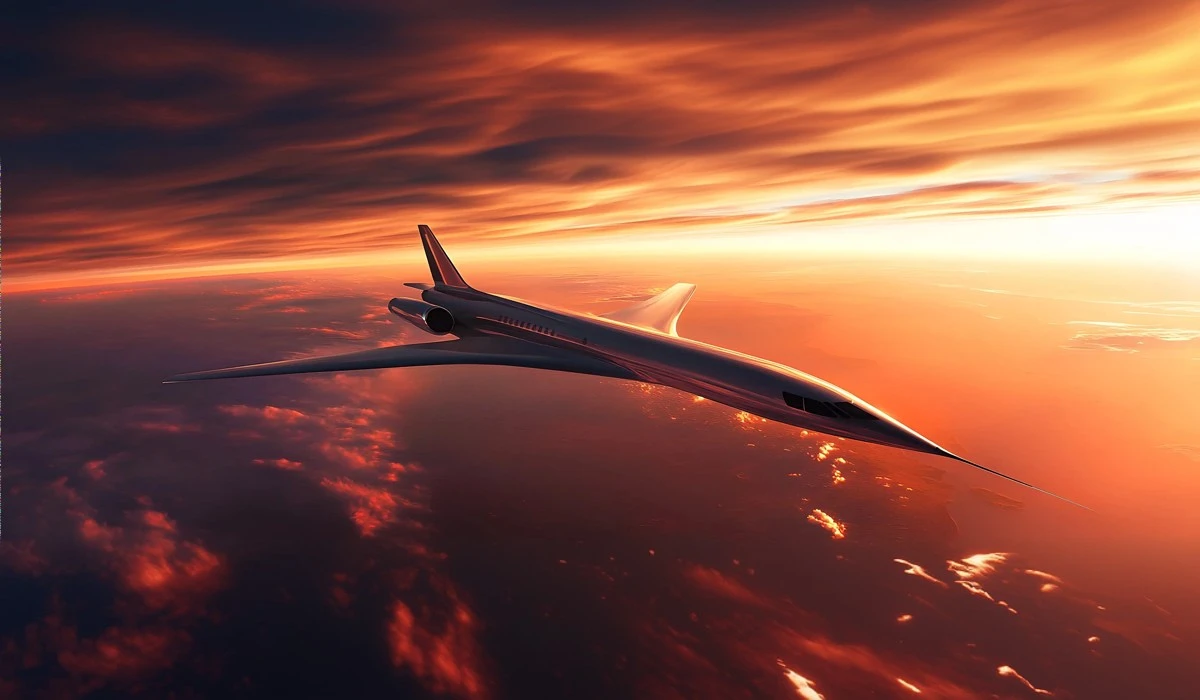
The X-59 appears different from any other plane in history. An incredibly thin and long nose dominates the front of the craft. This component measures about 30 feet in length. The stretched structure cuts through the air and isolates the initial shockwaves from the rest of the body. The wings reside far back on the fuselage to manage airflow further. Engineers positioned the engine intake on top of the plane. This layout channels engine roar upward, away from ears on the earth's surface.
Flying Without a Windshield
The extreme layout of the X-59 presents a distinct problem for the aviator. The massive nose completely blocks the forward view. A standard window would serve no function in this arrangement. Designers fixed this issue with the eXternal Vision System (XVS). A 4K camera fixed on the nose sends high-definition video to a screen in the cockpit. The pilot depends entirely on this digital monitor to see the path ahead. This mechanism represents a major jump in avionics capability.
The Upcoming Test Schedule
NASA has organized a strict testing plan for the X-59 throughout 2025 and 2026. The first flights will confirm the airworthiness of the machine. Pilots will slowly accelerate the craft to supersonic velocities. The group will then perform acoustic validation runs. The jet will fly above a network of microphones in the Mojave Desert to gauge the sound reaching the sand. Eventually, NASA intends to operate the X-59 over chosen towns in the United States. Residents will offer feedback on the noise intensity they perceive.
Private Sector Innovators
Commercial firms are also sprinting to restore supersonic options to the market. The Denver-based Boom Supersonic has generated significant headlines in 2025. The corporation successfully flew its XB-1 demonstrator craft earlier this year. This smaller jet proves the aerodynamics for their proposed airliner, the Overture. Boom aims for a service launch date of 2029 for the Overture. Major carriers like American and United have already secured pre-orders for the vessel.
The Overture Commercial Jet
Boom plans for the Overture to transport between 64 and 80 customers. The vehicle will cruise at Mach 1.7 over the ocean. The firm asserts the plane will operate on 100% sustainable aviation fuel (SAF). Boom is creating its own engine, titled Symphony, to propel the craft. The design group prioritizes making the jet financially feasible for airlines. They intend to keep ticket costs similar to existing business class rates. This pricing strategy remains essential to avoid the niche trap that restricted Concorde.
Spike Aerospace's Business Focus
Another competitor in the industry, Spike Aerospace, targets the private aviation segment. The firm from Boston is creating the S-512 Diplomat. This supersonic corporate jet intends to fly executives from New York to London in merely three hours. Spike released an update on their status in August 2025. The team is currently perfecting the cabin layout and aerodynamics. The S-512 utilizes a windowless cabin concept. Passengers will observe the outside environment through large panoramic digital displays that cover the walls.
Calculating Environmental Impact
Opponents of supersonic flights highlight the ecological costs. Moving faster than sound demands considerably more energy than subsonic travel. A fast jet consumes five to seven times more kerosene per passenger than a normal airliner. Green groups fear the expanded carbon footprint. The sector answers this claim by pledging to use sustainable aviation fuel. However, SAF inventories remain scarce globally. Increasing production to satisfy the needs of a supersonic fleet poses a giant logistical hurdle.
Concerns for the Ozone
High-altitude exhaust presents another severe environmental risk. Supersonic jets cruise at 60,000 feet, much higher than standard planes. Nitrogen oxides released at this height can harm the ozone layer. This protective shield guards the Earth from dangerous ultraviolet rays. Scientists researched this problem thoroughly during the first SST race in the 1970s. Modern propulsion engineers must discover ways to reduce these emissions. Both NASA and Boom state that their new engine designs will manage this vital concern.
Solving the Economic Puzzle
Financial reality destroyed the first generation of speed transport. Concorde used massive quantities of fuel, making fares impossibly high. Only the rich could pay for the ride. Airlines found it hard to fill the seats every day. The new group of manufacturers must fix this financial formula. They need to provide velocity without huge operating expenses. Improvements in engine efficiency and composite materials provide hope. Lighter planes use less fuel, which directly helps the profit margin.
Analyzing Market Appetite
Financial analysts doubt the size of the market for high-speed trips. Video calls have lowered the need for business travel since the pandemic. Corporate leaders may not feel the pressure to cross the Atlantic in three hours. However, the luxury travel segment continues to expand. Wealthy people value their time above everything else. A product that saves four hours on a transoceanic journey provides huge value to this group. The popularity of private jet rentals indicates a strong desire for exclusive, fast transport.
The Barrier of Regulation
Reversing the overland flight prohibition remains the largest obstacle. Without access to paths over soil, the market contracts significantly. Jets restricted to water crossings lose out on profitable city pairs like Los Angeles to New York or London to Tokyo. The data NASA collects from the X-59 missions will act as the deciding element. The International Civil Aviation Organization (ICAO) will also assess the findings. A worldwide agreement on noise limits must appear for the industry to flourish.
Benefits Beyond Speed
The investigation into supersonic travel produces advantages beyond velocity. The camera technology created for the X-59 could transform cockpit layouts for all planes. Eliminating windows reduces weight and reinforces the fuselage. Digital vision tools permit pilots to see through darkness and fog. Additionally, the materials science breakthroughs extend the limits of heat resistance. Fast flight creates intense friction heat on the aircraft skin. Mastering these thermal issues helps engineers construct more robust structures for space travel.
Defining the Noise Standard
The Federal Aviation Administration confronts a difficult job in drafting new laws. They must establish an allowable level of noise for a sonic thump. This measure differs greatly from the decibel caps used for airport sound. The noise of a thump is low-frequency and sudden. Regulators need to comprehend how this distinct sound impacts people outdoors and indoors. The community response trials scheduled by NASA will supply the required human statistics. Public approval will ultimately determine the future of the technology.
International Competition Grows
The United States is not the only country seeking a revival of civilian speed. Chinese aerospace firms have revealed concepts for high-speed liners. The space agency of Japan, JAXA, has also performed research into low-boom shapes. Europe stays cautious but continues to finance studies through various groups. A new space race is essentially happening. The victor will lead the premium section of the global travel industry for decades. Western builders like Lockheed Martin and Boom currently possess the advantage.
The Future Passenger Experience
Travellers on future fast jets will encounter a different type of journey. The cabin will likely be more intimate and smaller than a wide-body plane. The climb to 60,000 feet exposes the curve of the Earth and the blackness of space above. The ride will be incredibly smooth, as the vessel cruises above most weather patterns. The shorter time means less jet lag for the customer. Arriving in Europe for a dinner appointment after departing New York at lunch alters the tempo of global commerce.
Updates for Infrastructure
Airports will need to change to handle these new vehicles. Supersonic planes often have distinct landing and takeoff behaviors. They may need specific approach paths or longer runways to control noise near the terminal. Refuelling stations for sustainable aviation fuel must exist at all destination hubs. Maintenance teams will need specialized education to manage the high-temperature engines and advanced composite materials. The whole aviation ecosystem must advance to sustain the return of velocity.
The Road Ahead
The triumphant flight of the X-59 signals the start of a fresh chapter. The statistics collected over the next two years will mould the rules of the future. If NASA succeeds in demonstrating that quiet supersonic flight is achievable, the doors could open. Manufacturers stand ready to construct the planes. Airlines stand ready to purchase them. Passengers stand ready to fly them. The only remaining barrier is the invisible wall of sound that has kept aviation slow for fifty years.
A New Era of Discovery
Humanity has always fought against the restrictions of physical distance. The halt in supersonic travel constitutes a rare irregularity in the history of transport. We usually move faster as technology progresses, not slower. The restoration of high-speed flight fixes this deviation. It repairs the path of progress in aviation. The image of the X-59 climbing above the California desert acts as a potent symbol. It reminds us that the search for speed, when matched with environmental care, powers innovation. The world is about to become smaller once more.
Recently Added
Categories
- Arts And Humanities
- Blog
- Business And Management
- Criminology
- Education
- Environment And Conservation
- Farming And Animal Care
- Geopolitics
- Lifestyle And Beauty
- Medicine And Science
- Mental Health
- Nutrition And Diet
- Religion And Spirituality
- Social Care And Health
- Sport And Fitness
- Technology
- Uncategorized
- Videos

