


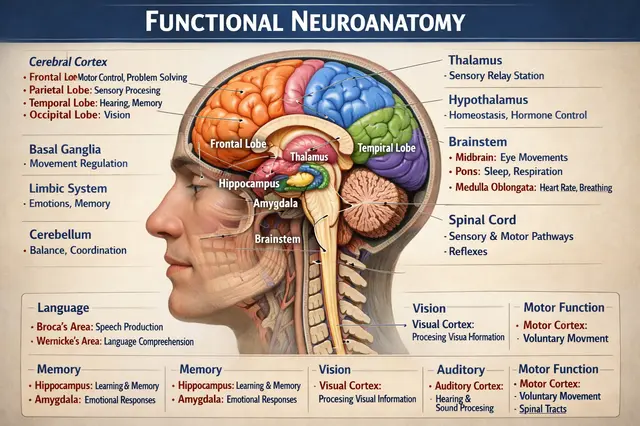
Functional Neuroanatomy
£199.00
Description
Functional Neuroanatomy Diploma Course
The Functional Neuroanatomy course offers a clear and structured path into one of the most fascinating areas of human science. It connects structure with function and shows how the brain and nervous system shape behaviour, movement, and cognition. You will not just memorise anatomy. Instead, you will understand how each region contributes to real-life neurological outcomes. As a result, learning feels purposeful and practical from the very start.
This Functional Neuroanatomy online course suits anyone who wants to build a strong foundation in neuroscience without stepping into a physical classroom. You can study at your own pace, revisit complex topics, and reinforce learning through guided explanations. Moreover, the course design keeps everything accessible, so you can focus on understanding rather than struggling with delivery.
At the beginning, you explore how neurons generate electrical signals and communicate across networks. This knowledge sets the stage for everything that follows. You then move into chemical signalling and protective systems of the nervous system. These mechanisms explain how the brain maintains balance and responds to internal and external changes. Consequently, you begin to see how disruption in these systems leads to neurological disorders.
As you progress, the Functional Neuroanatomy course introduces cerebral blood flow and its role in maintaining brain health. You will connect circulation with function, which helps you understand conditions such as stroke and hypoxia. In addition, the course explains peripheral sensorimotor systems, allowing you to link sensation and movement in a meaningful way.
The journey continues through spinal pathways and the lower brain. These sections clarify how reflexes, posture, and basic survival functions operate. Then, you examine motor coordination and central relay systems. These topics show how different brain regions communicate to produce smooth and controlled movement. Therefore, you begin to recognise how even small disruptions can affect coordination and balance.
Next, the Functional Neuroanatomy Diploma course takes you deeper into subcortical structures involved in movement and emotion. These areas influence behaviour, decision-making, and emotional regulation. At this stage, you gain insight into how neurological and psychiatric conditions often overlap. Furthermore, you will understand how structural changes can lead to functional impairments.
The course then shifts focus to the cerebral cortex and visual networks. You will learn how the brain processes visual information and transforms it into perception. Following this, you explore sensory integration and temporal regions. These areas handle memory, language, and complex sensory input. As a result, you develop a more complete picture of how the brain integrates information from different sources.
Later, the Functional Neuroanatomy online course covers executive functions and cerebrovascular events. You will connect higher-order thinking with specific brain regions. You will also understand how vascular incidents disrupt these processes. This knowledge proves essential for anyone interested in clinical or healthcare fields.
In addition, the course addresses seizure disorders and head trauma. These topics highlight how acute events affect brain function and recovery. You will examine the mechanisms behind seizures and the impact of injury on neural pathways. Therefore, you gain practical insight into real-world neurological challenges.
The Functional Neuroanatomy course also explores chronic neurological diseases and motor deficits. You will study how conditions such as degenerative disorders alter movement and coordination. Alongside this, the course explains complex cognitive deficits and clinical evaluation methods. This section strengthens your ability to interpret symptoms and link them to underlying neuroanatomy.
Throughout the Functional Neuroanatomy Diploma course, the learning experience remains flexible and fully online. You can access materials at any time, which allows you to balance study with other commitments. In addition, the platform supports repeated viewing and revision, so you can reinforce key concepts whenever needed.
Each unit concludes with a multiple-choice examination. This exercise will help you recall the major aspects covered in the unit and help you ensure that you have not missed anything important in the unit. The results are readily available, which will help you see your mistakes and look at the topic once again. If the result is satisfactory, it is a green light for you to proceed to the next chapter.
Moreover, the Functional Neuroanatomy online course encourages active learning. You engage with material through structured explanations and applied examples. As a result, you retain information more effectively and build confidence as you progress.
The Functional Neuroanatomy course also suits a wide range of learners. Students in healthcare fields can strengthen their academic understanding. Professionals can refresh their knowledge or expand into neuroscience. Meanwhile, curious learners can explore the brain with clarity and depth.
Importantly, the Functional Neuroanatomy Diploma course focuses on real-world application. It links theory with clinical relevance, so you can understand not just what happens in the brain, but why it matters. Therefore, you develop both knowledge and insight.
In conclusion, this Functional Neuroanatomy online course offers a comprehensive and practical learning experience. It builds knowledge step by step, connects structure with function, and prepares you to understand complex neurological processes with confidence.
What you will learn
1:Cellular Foundations and Electrical Signaling
2:Chemical Messengers and Nervous System Protections
3:Cerebral Hemodynamics and Peripheral Sensorimotor Networks
4:Spinal Pathways and the Lower Brain
5:Motor Coordination and Central Relays
6:Deep Brain Structures for Movement and Emotion
7:The Outer Brain Layer and Visual Networks
8:Sensory Integration and the Temporal Regions
9:Executive Control and Cerebrovascular Incidents
10:Seizure Disorders and Head Trauma
11:Neurological Diseases and Motor Deficits
12:Complex Cognitive Deficits and Clinical Evaluations

Tutor Support
Course Outcomes
After completing the course, you will receive a diploma certificate and an academic transcript from Elearn college.
Assessment
Each unit concludes with a multiple-choice examination. This exercise will help you recall the major aspects covered in the unit and help you ensure that you have not missed anything important in the unit. The results are readily available, which will help you see your mistakes and look at the topic once again. If the result is satisfactory, it is a green light for you to proceed to the next chapter.
Accreditation
Elearn College is a registered Ed-tech company under the UK Register of Learning( Ref No:10062668). After completing a course, you will be able to download the certificate and the transcript of the course from the website. For the learners who require a hard copy of the certificate and transcript, we will post it for them for an additional charge.
Related Products


Copd Management
£199.00

Biochemistry
£199.00


