

Subtotal:
£199.00


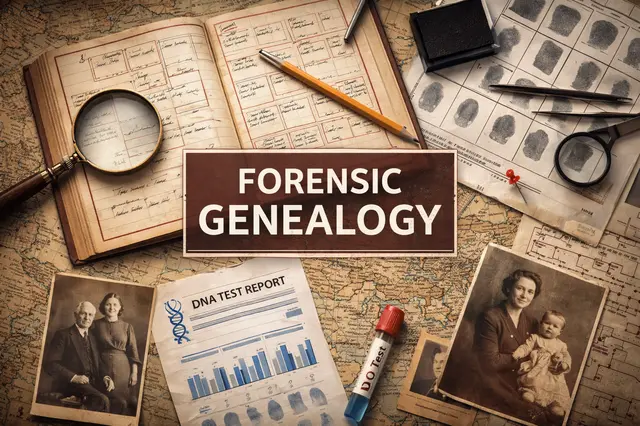
The Forensic Genealogy course offers a modern path into one of the most fascinating intersections of family history research and investigative science. Genealogical research once centred mainly on personal ancestry and historical curiosity. However, modern investigative practice now relies on genealogical methods to uncover identities, reconstruct historical connections, and solve complex investigative questions. This Forensic Genealogy course therefore equips learners with the tools needed to analyse historical evidence, interpret records, and build investigative family histories using both traditional archives and modern scientific approaches.
Today, investigators, historians, journalists, and researchers increasingly rely on forensic genealogy techniques. These methods help reconstruct family connections, uncover unknown individuals, and clarify historical mysteries. Consequently, interest in the discipline continues to grow worldwide. The Forensic Genealogy online course responds to this demand by offering a structured and accessible learning environment designed specifically for remote study.
First, the course introduces the foundations of investigative family history. Learners develop an understanding of how genealogical reasoning supports investigative work. Rather than focusing only on family trees, the Forensic Genealogy course teaches learners how to evaluate evidence critically, interpret historical context, and trace connections across multiple records. This approach builds analytical thinking while strengthening research accuracy.
Next, learners explore contextual and scientific tools that support genealogical investigation. Historical research rarely relies on a single source. Instead, investigators often assemble evidence from photographs, archives, census data, directories, and genetic records. Therefore, the Forensic Genealogy online course explains how these tools interact and how researchers combine them to build reliable investigative conclusions.
Photographic analysis also plays a crucial role in genealogical investigation. Historical photographs often contain hidden clues about time, place, and identity. Accordingly, the Forensic Genealogy course teaches learners how to extract data from photographic artefacts. Small details such as clothing style, environmental features, and photographic techniques often reveal valuable chronological information. Through careful analysis, researchers reconstruct timelines and identify possible historical contexts.
Furthermore, learners study chronological markers within historical photography. Photographic technology changed rapidly across different decades. As a result, investigators often estimate dates by examining photographic materials, printing techniques, and visual characteristics. The Forensic Genealogy online course explains how these markers guide historical dating and support broader genealogical reconstruction.
After establishing foundational observation skills, learners progress toward structured visual analysis. Photographs rarely stand alone as evidence. Instead, investigators compare images with written records, local history, and demographic patterns. Consequently, the Forensic Genealogy course shows how to conduct initial visual analysis while connecting observations with archival documentation.
Environmental context also offers powerful investigative clues. Buildings, landscapes, signage, and social settings reveal information about location and historical era. Therefore, the course explains how investigators construct timelines from environmental context. This process often narrows potential locations and identifies communities associated with the individuals under investigation.
Research then moves beyond visual evidence toward structured archival exploration. Periodicals, directories, and historical databases provide essential information for genealogical investigation. These records document occupations, addresses, community relationships, and public activities. The Forensic Genealogy course therefore teaches learners how to navigate periodical databases and historical directories effectively. This skill allows investigators to confirm identities and track individuals across changing locations.
In addition, event records play an essential role in forensic genealogy. Birth registrations, marriage records, migration data, and cultural events often reveal valuable demographic information. The Forensic Genealogy online course demonstrates how these records contribute to cultural profiling and historical identity reconstruction. When researchers combine event records with community data, they often uncover patterns that clarify unknown identities.
Community reconstruction forms another key investigative strategy. Historical communities left behind extensive documentation in newspapers, municipal archives, and local publications. Consequently, the Forensic Genealogy course shows how researchers construct community timelines using these records. This method helps investigators understand social networks, family structures, and demographic changes within a specific region.
However, investigators frequently encounter demographic anomalies. Records may contradict one another, disappear entirely, or contain inaccurate information. Therefore, the Forensic Genealogy Diploma course emphasises cross-disciplinary research strategies. Researchers often combine genealogy with historical analysis, demographic research, and social science investigation. This broader approach helps resolve inconsistencies while strengthening investigative conclusions.
Alongside historical research, genetic investigation now plays a transformative role in forensic genealogy. Modern genetic technology allows investigators to trace biological relationships and identify individuals through DNA evidence. Accordingly, the Forensic Genealogy online course introduces learners to the principles of genetic tracking. Participants learn how genetic information supports genealogical reconstruction while maintaining ethical and analytical responsibility.
Genetic analysis requires careful interpretation. DNA results rarely offer direct answers without supporting genealogical evidence. Therefore, the Forensic Genealogy course explains how investigators integrate genetic data with archival research and family history reconstruction. This balanced approach prevents misinterpretation and strengthens investigative accuracy.
As learners progress further, they encounter advanced genetic calculations and visualisation techniques. Genetic relationships often require mathematical interpretation and probability analysis. Consequently, the course explains how investigators calculate relationship likelihoods and visualise genetic connections through genealogical mapping. These skills allow researchers to evaluate possible family structures and identify the most plausible investigative conclusions.
Importantly, the Forensic Genealogy Diploma course focuses entirely on digital learning. The learning platform allows students to study from any location while maintaining structured progress through the curriculum. Interactive materials, reading resources, and case-based examples support independent learning. Furthermore, the flexible structure allows learners to manage their study schedule alongside professional or academic commitments.
The course suits a wide range of learners. Genealogists seeking advanced investigative skills will benefit greatly. Additionally, historians, researchers, journalists, archivists, and forensic science enthusiasts often find forensic genealogy highly valuable. The Forensic Genealogy course also appeals to individuals interested in historical problem solving, investigative storytelling, and genetic genealogy.
Moreover, digital archives now expand rapidly across the world. Governments, universities, and cultural institutions continue to digitise historical records. As a result, researchers gain access to an unprecedented volume of historical information. The Forensic Genealogy online course prepares learners to navigate this digital research landscape efficiently. Participants develop systematic search strategies that uncover relevant records while avoiding research confusion.
Equally important, ethical responsibility remains central to forensic genealogical work. Investigators handle sensitive information about individuals and families. Therefore, the Forensic Genealogy Diploma course encourages responsible research practices, careful documentation, and thoughtful interpretation of genetic and historical data. Ethical awareness strengthens both professional credibility and investigative reliability.
Each unit concludes with a multiple-choice examination. This exercise will help you recall the major aspects covered in the unit and help you ensure that you have not missed anything important in the unit. The results are readily available, which will help you see your mistakes and look at the topic once again. If the result is satisfactory, it is a green light for you to proceed to the next chapter.
Overall, the Forensic Genealogy course combines historical research, photographic interpretation, archival investigation, and genetic analysis within a structured learning framework. The programme therefore builds investigative thinking while strengthening practical research skills. Through the Forensic Genealogy online course, learners gain the knowledge required to reconstruct identities, interpret historical evidence, and explore the powerful connection between genealogy and investigative science.
1:Fundamentals of Investigative Family History
2:Contextual and Scientific Tools Overview
3:Extracting Hidden Data from Photographic Artifacts
4:Chronological Markers in Historical Photography
5:Initial Analysis of a Visual Artifact
6:Establishing Timelines from Environmental Context
7:Navigating Periodical Databases and Directories
8:Event Records and Cultural Profiling
9:Constructing Community Timelines from Historical Records
10:Solving Demographic Anomalies Through Cross-Disciplinary Research
11:Principles of Genetic Tracking
12:Advanced Genetic Calculations and Visualizations

After completing the course, you will receive a diploma certificate and an academic transcript from Elearn college.
Each unit concludes with a multiple-choice examination. This exercise will help you recall the major aspects covered in the unit and help you ensure that you have not missed anything important in the unit. The results are readily available, which will help you see your mistakes and look at the topic once again. If the result is satisfactory, it is a green light for you to proceed to the next chapter.
Elearn College is a registered Ed-tech company under the UK Register of Learning( Ref No:10062668). After completing a course, you will be able to download the certificate and the transcript of the course from the website. For the learners who require a hard copy of the certificate and transcript, we will post it for them for an additional charge.


£199.00


