
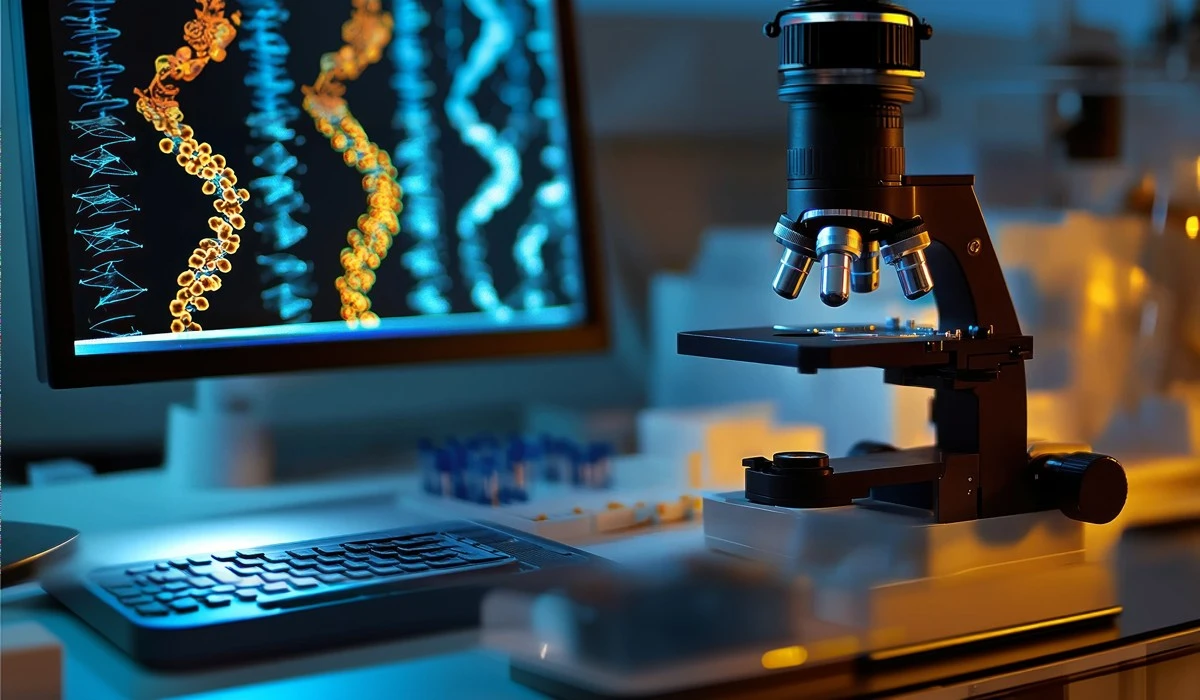
Forensic Biology: Catching Killers With DNA Clues
A killer touches a doorknob, breathes heavily in a closed room, and leaves a microscopic trail of guilt. They scrub the wooden floors with bleach and burn their bloody clothes. They think they got away with a brutal murder. The real truth remains safely locked inside tiny cells scattered across the living room rug.
According to the Center for Forensic Science Research & Education (CFSRE), Forensic Biology steps in as the vital bridge between those microscopic droplets and a fully solved criminal case, as the field analyzes tissues and bodily fluids from physical evidence to identify and individualize suspects. Detectives no longer rely purely on eyewitness testimony or shaky confessions. They integrate forensic DNA profiling and exact biological evidence tracing to pin suspects to the exact coordinates of a crime scene or exonerate innocent people entirely. Every single drop of sweat tells a factual story. We will map the entire path from the crime scene to the courtroom, showing exactly how modern investigators extract truth from a single cell.
The Core Foundations of Forensic Biology
Investigators target specific bodily fluids because they yield high amounts of cellular data. Semen and blood act as primary targets for crime scene technicians. A single drop of semen contains up to 150 million sperm cells, offering massive data yields for lab analysts. Hair shafts provide limited mitochondrial data, while the actual follicle root holds the full nuclear code required for accurate forensic DNA profiling. When newcomers learn these foundational elements, a common question arises: what is the main purpose of forensic biology? Simply put, it exists to locate, identify, and analyze biological materials found at crime scenes to establish undeniable links between suspects, victims, and the location. Analysts categorize these fragile items quickly because organic matter degrades the moment it leaves the human body, forcing specialized extraction teams to race against the relentless ticking clock.
Securing the Chain of Custody
A flawless lab test means absolutely nothing if detectives fail to protect the original sample from contamination or tampering. According to guidelines from the National Institute of Standards and Technology (NIST), law enforcement officers document every single person who touches the material with an electronic or paper-based tracking system. The agency also specifies that they package this fragile evidence in breathable paper bags, or other porous materials that allow vapors to pass through, rather than plastic containers.
Plastic traps condensation. Condensation activates nucleases, which act as aggressive enzymes that rapidly cleave and destroy delicate genetic molecules post-mortem. A secure chain of custody guarantees that the sample analyzed in the lab remains the exact same sample collected from the victim's living room. Defense attorneys will attack any gap in this documentation during a trial. Proper Forensic Biology protocols ensure that laboratory technicians maintain strict control over every swab. This exact tracking process transforms a simple cotton swab into a legally binding piece of undeniable proof ready for the criminal courtroom.
The Art of Biological Evidence Tracing
Detectives perfect biological evidence tracing when they use specialized equipment to locate fluids that easily blend into carpets or clothing. They frequently deploy Alternate Light Sources to scan completely dark rooms. Semen fluoresces bright blue under violet light between 300 and 450 nanometers. Technicians view this peak fluorescence at 415 nanometers through an orange or yellow barrier filter.
Blood absorbs light at 415 nanometers, appearing completely black to enhance visual contrast against dark fabrics. Once they spot a stain, investigators verify it using the Kastle-Meyer test, which Joseph Kastle and Erich Meyer invented in 1903. Research published in ScienceDirect explains that this reliable chemical test relies on the peroxidase activity of haemoglobin to turn a swab bright pink upon contact. The publication notes that the test displays extreme sensitivity using phenolphthalein, allowing technicians to detect blood diluted up to 1:10,000, revealing violent crimes even after severe chemical cleanup attempts.
Preserving Degradable Samples
Finding the stain marks only the first hurdle in a difficult race against natural decay. Autolysis, or cellular self-destruction, begins the exact second a person dies or sheds a cell. Moisture, heat, and oxygen serve as the primary drivers for the rapid microbial degradation of organic samples. Crime scene teams must rapidly cool samples to halt this destructive bacterial growth. They transport swabs in temperature-controlled coolers to preserve the delicate cellular walls. If detectives leave a blood-soaked shirt in a hot car trunk, bacteria will devour the remaining cells within hours. Technicians freeze these items upon arrival at the laboratory to suspend the decay process indefinitely. This extremely rapid response guarantees that analysts have enough intact material to perform exact biological evidence tracing and build a reliable profile for the impending criminal trial.
From Blood Typing to Modern Genomics
Sir Alec Jeffreys altered modern justice when he found genetic fingerprinting at the University of Leicester in 1984. Before this breakthrough, scientists relied on simple ABO blood typing, which could only narrow suspects down to large portions of the population. This finding introduced absolute mathematical certainty.
In 1986, Forensic Biology played a pivotal role in the Narborough murders of Lynda Mann and Dawn Ashworth. For the very first time, forensic DNA profiling exonerated an innocent seventeen-year-old boy and ultimately convicted the true killer, Colin Pitchfork. This monumental case shifted law enforcement strategy globally. Police departments realized they possessed a tool capable of definitive identification. Laboratories upgraded their equipment, moving rapidly from basic chemical blood tests to advanced genomic sequencing, entirely changing how society investigates, prosecutes, and ultimately punishes highly violent criminal offenses worldwide.
Decoding Short Tandem Repeats (STR)
Modern scientists focus their microscopes on Short Tandem Repeats, or STRs, to accurately identify suspects. These microsatellites consist of short sequences of two to six base pairs found specifically in the non-coding regions of the human genome. The FBI formalized this process in 1998 when they introduced the thirteen core CODIS loci. They used these specific markers to build a unified national database.
As detailed in ScienceDirect, on January 1, 2017, the FBI expanded this requirement to twenty core loci, adding highly specific markers like D1S1656 and D12S391, which the study identifies as the foundational basis of the combined DNA index system (CODIS). This necessary expansion significantly reduced fictitious matches and drastically improved international database compatibility. Analysts calculate probabilities that exceed the total human population when they count how many times a specific sequence repeats at these twenty locations. This precise biological evidence tracing creates an individualized barcode that belongs uniquely to one specific human being.
How Forensic Biology Solves Impossible Cold Cases
Detectives use historical archives to solve brutal murders that went completely cold decades ago. Studies on fossils and bone taphonomy prove that under ideal, dry preservation conditions, the mathematical half-life of genetic material reaches exactly 521 years. Because cold cases involve decades-old evidence, people naturally wonder, how long does DNA last on a piece of evidence? If stored properly in a cool, dry, and dark environment, DNA can remain viable for analysis for decades or even centuries. Modern lab technicians extract usable strands from dried bloodstains preserved on forgotten t-shirts or archived cigarette butts. They carefully rehydrate these crusty samples in sterile environments to salvage whatever microscopic fragments remain. This recovery process demands intense patience and highly specialized chemicals, allowing investigators to extract the truth from forgotten evidence and bring closure to grieving families.
The Rise of Genetic Genealogy
As reported by Reuters, in April 2018, cold case investigators merged traditional laboratory techniques with open-source ancestry databases like GEDmatch to finally catch the notorious Golden State Killer, Joseph James DeAngelo. The news outlet explains that California detectives uploaded a discarded profile to consumer genealogy websites to compare the crime scene data, allowing them to identify a possible third cousin via shared autosomal single nucleotide polymorphisms. They built massive family trees branching out from these distant relatives to find their primary suspect. They utilized advanced health risk analyzers like Promethease to predict his exact physical phenotype.
The software specifically targeted a male suspect with blue eyes and premature baldness. This groundbreaking tactic completely bypassed the need for a direct database hit. Law enforcement agencies worldwide now use this exact forensic DNA profiling method to sidestep investigative dead ends. They connect the unseen dots through distant family members, quickly closing difficult cases that baffled traditional investigators for more than forty years.
Advanced Laboratory Techniques for Difficult Samples
American biochemist Kary Mullis invented the Polymerase Chain Reaction at Cetus Corporation in 1983, a massive breakthrough that later earned him the 1993 Nobel Prize. PCR acts as a powerful molecular photocopier inside the modern laboratory. Technicians use thermal cycling, specialized primers, and Taq polymerase to exponentially amplify microscopic strands into billions of testable copies.
Before PCR existed, analysts needed extremely large blood pools to generate a reliable test result. Today, they only need a few skin cells scraped from a dirty steering wheel. The machine heats the sample to separate the strands, then cools it to allow primers to attach and rebuild the entire sequence. This repetitive heating and cooling cycle turns inadequate, microscopic samples into massive quantities of data. This specific biological evidence tracing technique completely changed how modern investigators process heavily degraded crime scenes.
Next-Generation Sequencing (NGS)
Traditional Capillary Electrophoresis systems only measure the physical size of fragments to create a match. Next-Generation Sequencing systems, like the MiSeq FGx, actually read the genetic code base-by-base for ultimate accuracy. NGS machines interrogate up to ninety-six combined SNP and STR libraries in a single automated run. They easily pull nuclear, mitochondrial, and epigenetic markers simultaneously from severely degraded biological mixtures. When multiple people bleed on the exact same piece of fabric, older machines struggle to separate the overlapping data points.
Next-Generation Sequencing easily untangles these highly complicated mixtures. The laboratory relies on strict Forensic Biology protocols to process this deep sequencing data without generating any false peaks. This powerful technology provides investigators with unprecedented insights into a suspect's ancestry, physical traits, and exact identity, drastically shrinking the suspect pool in extremely difficult criminal investigations.
Overcoming Environmental Contamination Challenges
Mother Nature actively fights against crime scene investigators by immediately destroying fragile cellular structures. Prolonged exposure to direct ultraviolet light causes severe damage at the molecular level. Research published in Nucleic Acids Research states that UV rays create thymine dimers, identifying these structures as a primary mutagenic photoproduct caused by UV radiation that acts as covalent bonds between adjacent thymine bases that physically kink and destroy the genetic chain.
Rainwater heavily dilutes bloodstains while washing away loose skin cells from outdoor murder weapons. Bleach and household cleaners violently break down lipid membranes, completely dissolving the biological material before technicians even arrive. Investigators constantly battle these natural elements when they work swiftly to locate and secure samples under protective tents. They photograph the exposed evidence immediately, knowing that sunlight degrades the molecules with every passing minute. Technicians counteract environmental damage when they use advanced extraction chemicals to salvage the remaining intact fragments for highly accurate forensic DNA profiling.
Eliminating Cross-Contamination Risks
A report by the International Organization for Standardization (ISO) highlights that the infamous Phantom of Heilbronn case exposed massive contamination risks when police chased a supposed female serial killer for years. The organization notes this case showed that the presence of foreign human DNA is far more common than previously thought, as the killer turned out to be a factory worker whose stray cells contaminated the sterile cotton collection swabs during manufacturing. Because the collection process is so delicate, skeptics often ask, can a DNA test be wrong in a criminal case?
While the biological science is mathematically sound, human error, severe sample degradation, or cross-contamination can lead to flawed interpretations. Crime scene technicians now wear full-body Tyvek suits, double layers of nitrile gloves, and surgical masks to prevent their own breath from ruining the crime scene. Laboratories utilize isolated positive pressure rooms and bleach-washed ventilation hoods. These extreme sterilization measures guarantee that the final results represent the true suspect and absolutely nothing else.
The Technological Future of Forensic Investigations
The justice system constantly upgrades its technical arsenal to outsmart sophisticated criminals. Forensic Biology now utilizes artificial intelligence to drastically speed up difficult evidence processing. Probabilistic genotyping software, such as STRmix and TrueAllele, uses advanced mathematical algorithms to separate highly complicated mixtures involving three or more human contributors. In the past, analysts struggled to interpret swabs pulled from public doorknobs or shared weapons because too many profiles overlapped on the graph.
Today, machine learning algorithms quickly untangle these extremely messy peaks. The computer assigns statistical weights to every possible combination, successfully isolating the prime suspect from the background noise. This software eliminates human bias because it relies purely on mathematical probability. Detectives trust these advanced algorithms to process difficult samples, ensuring that advanced forensic DNA profiling holds up under intense cross-examination during high-stakes criminal trials.
Rapid Mobile Testing Devices
Engineers have successfully miniaturized massive laboratory equipment into highly portable machines that perfectly fit inside a standard police cruiser. According to the National Institute of Justice (NIJ), rapid testing technology, like the ANDE machine, allows field investigators to extract, amplify, and read profiles completely outside of a traditional laboratory setting. Detectives plug a collected swab directly into the device right at the chaotic crime scene.
The NIJ reports that these rapid mobile testing devices can generate viable profiles incredibly fast; the machine fully performs STR analysis and processes the advanced biological evidence tracing data in less than ninety minutes. Officers can positively match a suspect in police custody before the suspect even finishes their initial interrogation. This speed completely eliminates the notorious months-long laboratory backlog that historically stalled critical investigations. Bringing the laboratory directly to the dangerous streets allows law enforcement agencies to rapidly clear innocent bystanders and lock down violent offenders before they get an opportunity to flee the local jurisdiction.
The Unyielding Power of Proof
Microscopic cells act as the ultimate witnesses to every single violent crime. They never lie, they never forget, and they never succumb to the intense pressure of an aggressive courtroom interrogation. The rigorous discipline of Forensic Biology transforms these tiny, scattered cells into undeniable legal proof. From the moment technicians secure a bloodstain under an Alternate Light Source to the final computer algorithm isolating an exact match, the science relentlessly pursues the factual truth. Criminals constantly invent new ways to hide their tracks, but modern technology adapts faster to ensure they ultimately fail. Rapid processing machines and advanced genetic genealogy databases leave violent perpetrators absolutely nowhere to hide. This rigorous science stands as a significant pillar of modern justice, giving a powerful voice to the scattered evidence and ensuring truth prevails in the end.
Recently Added
Categories
- Arts And Humanities
- Blog
- Business And Management
- Criminology
- Education
- Environment And Conservation
- Farming And Animal Care
- Geopolitics
- Lifestyle And Beauty
- Medicine And Science
- Mental Health
- Nutrition And Diet
- Religion And Spirituality
- Social Care And Health
- Sport And Fitness
- Technology
- Uncategorized
- Videos

