
Planetary Science Spots Habitable Alien Skies
A telescope sits on a high, dry mountain peak. It points toward a star forty light-years away. This star appears only as a tiny point of light. Suddenly, the light dims by a fraction of a percent. A planet just crossed in front of the star. This small dip in brightness holds the secrets of an entire world. Planetary Science converts these tiny shadows into maps of alien oceans and forests. We once spent centuries wondering about our neighbors. Today, we measure their air from our own backyards. This shift turns a vast, empty space into a neighborhood of potential homes. We use data to find the next Earth.
Finding "Earth 2.0" remains the ultimate puzzle for modern researchers. Astronomers must look past the simple presence of a planet. They must understand the ground, the air, and the gravity of these distant rocks. Planetary Science provides the toolkit to solve this cosmic mystery. Researchers now combine orbital mechanics modeling with the study of exoplanet atmospheric composition. This combination turns science fiction into measurable data. We no longer just guess about life in the stars. We calculate its probability with every new observation.
The Evolving Field of Modern Planetary Science
The field of Planetary Science changed forever when we found the first planet around a sun-like star in 1995. Before that finding, we only knew our own solar system. We studied the red dust of Mars and the thick clouds of Venus to learn how planets work. Now, we characterize thousands of worlds across the Milky Way. We moved from simple detection to detailed characterization. We treat every star as a laboratory for life.
How do scientists find life on other planets? Researchers utilize high-resolution spectroscopy to detect chemical imbalances in a planet's air that shouldn't exist naturally. This branch of Planetary Science looks for 'technosignatures' or biological waste gases as primary evidence. Scientists look for gases like oxygen and methane together. On Earth, these gases react and disappear quickly. Only the constant presence of life keeps them in our atmosphere. Finding them elsewhere suggests a living world.
We now use comparative planetology to understand these distant worlds. We use Earth as a control group for every test. This allows us to understand the greenhouse effect on Venus or the crustal cooling on Mars. We apply these lessons to planets trillions of miles away. According to a report from the NASA Technical Reports Server, this knowledge helps us predict which planets might have liquid water and identify those that suffered a "moist greenhouse" fate, a process where water vapor rises high into the atmosphere, breaks apart under light, and escapes into space, leaving the planet dry.
Decoding Exoplanet Atmospheric Composition via Spectroscopy
Light tells the story of a planet's history. When starlight passes through a planet's air, the gas molecules absorb specific colors. We call this process transmission spectroscopy. It allows us to determine the exoplanet atmospheric composition from across the galaxy. Every molecule leaves a unique fingerprint on the light.
The Chemical Fingerprints of Light
Water vapor, methane, and carbon dioxide each leave a distinct mark. If a planet has a lot of water vapor, the light curves dip in a predictable way. Planetary Science experts read these dips like a barcode. High-resolution spectrographs divide light into thousands of colors. This precision allows us to see even trace amounts of gas. We can detect clouds of sulfur or even the glint of alien oceans.
Distinguishing Between Toxic and Breathable Skies
Venus and Earth look similar from a distance. However, their air tells different stories. Venus trapped its heat in a thick blanket of carbon dioxide. Earth maintains a balance. Analyzing exoplanet atmospheric composition is the only way to verify the presence of a protective ozone layer. Without ozone, harsh solar rays would sterilize the surface. As explained by NASA Science, we look for the "Rayleigh scattering" effect to measure air density, noting how it scatters blue wavelengths and makes transits observed in blue light appear deeper than those in red light, ultimately telling us if the sky looks blue or a different, alien color.
Precision Through Orbital Mechanics Modeling
Gravity keeps the universe in order. To understand if a planet stays warm enough for life, we must map its path. We use orbital mechanics modeling to simulate these movements over billions of years. A planet's position relative to its star determines its energy intake.
Defining Gravitational Stability
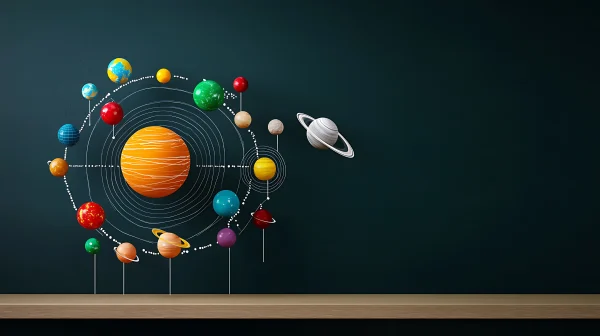
A planet needs a circular path to keep a steady climate. If the path stretches into an oval, the planet freezes and boils in turns. According to Britannica, while we attempt to use the "N-body problem" to calculate how multiple planets pull on one another, there is no universal solution, and the resulting motion rapidly turns chaotic. These models show us if a world remains in the habitable zone. Stability provides the time needed for life to evolve. Chaos leads to extinction or ejection from the solar system.
The Influence of Multi-Planet Systems
Planets never travel alone. They pull on each other with relentless force. A giant planet like Jupiter can ruin the orbit of a smaller, Earth-like world. Orbital mechanics modeling allows researchers to predict if a planet has stable seasons or chaotic temperature swings. As detailed by The Planetary Society, we also use Transit Timing Variations (TTVs) to find unseen planets; because unseen worlds exert gravitational pulls that alter the schedules of predictable transits, a planet crossing its star earlier or later than expected indicates an unseen neighbor is tugging on it. This gravity-based detective work reveals the full structure of alien systems.
How Planetary Science Defines the Habitable Zone
The "Goldilocks Zone" is the area where water stays liquid. Planetary Science defines this region based on the star's heat and the planet's distance. Every star has a different zone. A hot blue star has a distant zone. As noted by planetary researchers, a small red star has a very close zone.
What makes a planet habitable? A planet is generally considered habitable if it can maintain liquid water on its surface for billions of years. Within the field of Planetary Science, this requires the perfect trifecta of distance from a star, a stable atmosphere, and a circular orbit. Mass also matters. A tiny planet like Mars cannot hold onto its air long enough for advanced life. A massive planet might turn into a gas giant with no solid surface.
We also consider the "Hill Sphere" radius. This defines the region where a planet’s gravity beats the star's gravity. This helps us find habitable moons. An Earth-sized moon orbiting a Jupiter-sized planet might be the best place for life. We model these interactions to see if these moons stay stable for eons.
Environmental Simulations and Climate Stability
Supercomputers now build virtual worlds. These simulations help us see what our eyes cannot. We use General Circulation Models (GCMs) to predict weather patterns on distant rocks. These models take the physics we learned on Earth and apply it to alien conditions.
Cloud Formation and Albedo Effects
Clouds change the fate of a world. High clouds trap heat and warm the surface. Low, thick clouds reflect starlight back into space. This reflectivity, or albedo, dictates the final temperature. A planet covered in ice reflects almost all its light. This creates a "Snowball Earth" scenario where the planet stays frozen even if it moves closer to the star. Planetary Science models these feedback loops to find the true temperature of the surface.
Tidal Locking and Global Winds
Many planets orbit small, red stars. These planets often stop spinning relative to their star. One side bakes in eternal day. The other side freezes in permanent night. Can we see an exoplanet's atmosphere? While we cannot see them as clear images yet, we can 'see' their makeup by measuring how the planet filters its host star's light. Modern Planetary Science uses these light curves to build 3D weather maps of worlds trillions of miles away. These maps show us if global winds move heat from the day side to the night side, keeping the planet habitable.
Identifying Biosignatures in Distant Worlds
Oxygen is a great sign, but it can lie. According to research published by Georgia Tech, some chemical processes make oxygen without any life present, creating abiotic false positives in the habitable zone that mimic true biosignatures. The study also suggests that high-energy light can cause water in a planet's upper atmosphere to break down, losing hydrogen to space and building up oxygen purely through chemical reactions rather than biological processes. Planetary Science looks for combinations that shouldn't happen naturally to avoid these "false positives."
The most convincing evidence is chemical disequilibrium. We look for methane and oxygen together. These two gases react and destroy each other quickly. If we see both in an exoplanet's atmospheric composition, something must be constantly making them. On Earth, that "something" is life. The same Georgia Tech research notes that we also search for the "Vegetation Red Edge" when examining secondary biosignatures. Plants reflect a lot of infrared light to stay cool. If we see this specific glow in the light spectrum, we might be looking at alien forests covering a distant continent.
Technological Breakthroughs Shaping the Field
According to NASA Science, the James Webb Space Telescope (JWST) altered the field significantly by studying infrared wavelengths, a type of light that cuts right through cosmic dust and reveals the heat of distant planets. It provides the best data we have ever seen.
Next-Gen Space Telescopes
Hubble showed us that planets existed in the thousands. While it was initially hoped that JWST would easily tell us what those planets are made of and see the exoplanet atmospheric composition of worlds as small as Earth in the TRAPPIST-1 system, NASA Science cautions that the telescope has not yet found any definitive signs of an atmosphere around these specific planets. Future telescopes like the Extremely Large Telescope (ELT) will sit on the ground. These giant mirrors will capture even more light. They will allow us to see the actual color of alien skies.
AI and Machine Learning in Data Analysis
The data from these telescopes is massive. AI algorithms now sift through light curves to find tiny signals. These tools spot patterns in orbital mechanics modeling that humans miss. They identify the subtle tugs of moons and unseen planets. Machine learning also helps us understand the Rossiter-McLaughlin effect. This effect shows us if a planet orbits in the same direction as the star rotates. This tells us if the solar system formed peacefully or through violent collisions.
The Enduring Legacy of Planetary Science
We live in the first period where humans can identify life on other worlds. Planetary Science provides the tools to bridge the gap between our home and the stars. Combining orbital mechanics modeling with the study of exoplanet atmospheric composition turns dots of light into real places. We no longer just guess. We calculate. We measure the silicate-carbonate cycle of distant worlds to see if they have active volcanoes. We track the Kozai-Lidov process to see if a distant star will pull a planet into its orbit.
These findings change how we see our own place in the universe. We learn that Earth is one of many possible homes. Every time we find a planet with water and oxygen, we find a new reason to look up. Planetary Science turns the mystery of the night sky into a map for the future. The next sunset we see through a telescope might belong to another living world.
Recently Added
Categories
- Arts And Humanities
- Blog
- Business And Management
- Criminology
- Education
- Environment And Conservation
- Farming And Animal Care
- Geopolitics
- Lifestyle And Beauty
- Medicine And Science
- Mental Health
- Nutrition And Diet
- Religion And Spirituality
- Social Care And Health
- Sport And Fitness
- Technology
- Uncategorized
- Videos

