
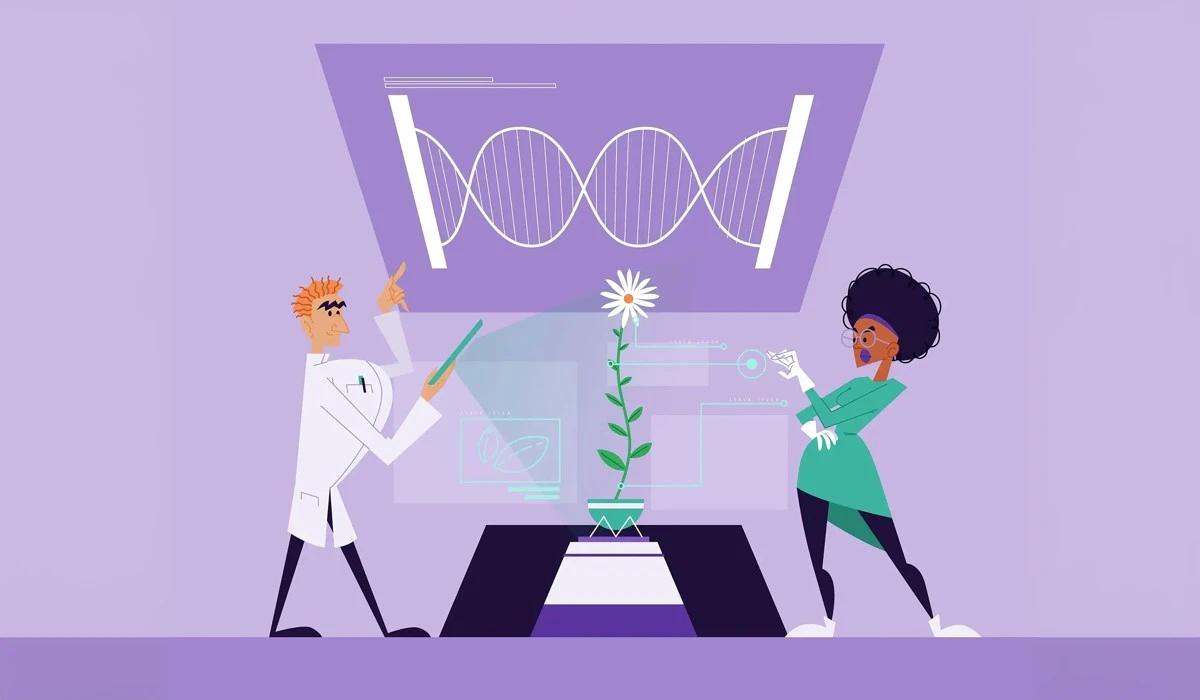
History Of Tomorrow: DNA Becomes A Human Tool
When a species evolves, it usually pays a heavy price in blood and time. A mutation happens by accident. If the animal survives, it passes that trait down. If it doesn’t, the trait vanishes. This slow process shaped every living thing on Earth for billions of years. But humans just broke the speed limit. We now cut, paste, and delete genetic code as easily as we fix a typo in a text message.
This shift moves us from being passengers to being the pilots of our own DNA. The History of Tomorrow shows how our past choices with technology dictate our future bodies. We are not simply guessing what might occur. We use predictive historical trends to see what is already in motion. Most people view futurism predictions as wild guesses. In reality, they are just the next logical steps on a path we started walking decades ago. We are moving toward a world where biological "mistakes" simply don't exist anymore.
The History of Tomorrow reveals how we control tools
We often think of technology as something outside ourselves. We built hammers to strike harder and wheels to move faster. Eventually, we always turn these tools inward. The History of Tomorrow shows that once we control the physical world, we attempt to control the biological one. We see this pattern clearly in how we manage our food supply.
Lessons from the Green Revolution
In the 1970s, scientists like Norman Borlaug led the Green Revolution. They used selective breeding to create high-yield crops. Research published in ScienceDirect indicates that this "Green Revolution" has saved more than a billion people from starvation. Today, we use CRISPR to achieve similar goals but with much higher speed. Is gene editing the same as GMOs? While both involve genetic changes, a study in the National Library of Medicine notes that gene editing is more precise because it typically modifies an organism's own DNA rather than introducing foreign genetic elements. The study also suggests this precision allows us to make crops drought-resistant in weeks rather than decades.
Our current efforts to edit plant DNA mirror the early days of agricultural industrialization. We are applying engineering logic to the field of biology. These predictive historical trends suggest that we will soon treat our own health with the same industrial productivity. We are moving away from treating symptoms and toward editing the source code of life.
Analyzing predictive historical trends in biotechnology
History shows us that medical breakthroughs always follow a specific cycle. People start with fear, move to debate, and end with total reliance. We saw this with vaccines and organ transplants. As noted in the National Library of Medicine, even IVF (In Vitro Fertilization) faced massive public backlash upon its arrival in 1978, though it is now considered a standard medical procedure.
The Path from Taboo to Standard Care
The Carlson Curves provide a clear metric for this progress. Much like Moore’s Law for computer chips, these curves show that biotech productivity doubles every 12 to 24 months. In 2001, the Human Genome Project cost $95 million to map one genome. Today, we can do it for about $100. This 99.99% decrease in cost changes how we view genetic data.
When information becomes this cheap, it becomes a utility. We no longer treat genetic mapping as a rare event. We treat it as a routine checkup. The History of Tomorrow suggests that genetic traits we currently consider "lucky" will become standard expectations. We will likely see a future where parents view genetic screening as a basic responsibility of childcare.
How futurism predictions shape modern CRISPR research
Early science fiction often painted a dark picture of genetic control. Movies like Gattaca imagined a world where your DNA determined your entire social status. These futurism predictions focused on class wars and biological elites. However, the reality on the ground looks much more practical and life-saving.
Moving Beyond "Gattaca" Archetypes
Modern researchers focus on fixing broken systems within the body. According to an announcement by the FDA, in late 2023, the agency approved Casgevy, which is the first CRISPR-Cas9 therapy for Sickle Cell Disease. Findings published in PubMed explain that this treatment disables a specific enhancer called BCL11A. Through this process, the body starts producing fetal hemoglobin again, which offsets the defective adult hemoglobin that causes the disease.
Can gene editing cure all diseases? It holds the potential to fix hereditary conditions caused by single-gene mutations, though complicated diseases involving multiple genes and environmental factors remain a challenge. We are currently tackling the "low-hanging fruit" of the genetic world. These early successes prove that we can rewrite human health without creating a dystopian nightmare.
Economic Accessibility and the History of Tomorrow
New technology always starts as a luxury for the rich. The first cell phones were bulky, expensive, and limited to elites. Over time, mass production and competition drive prices down until everyone has one. The History of Tomorrow tells us that gene editing will follow this exact same path from the lab to the living room.
From Luxury Goods to Public Health Requirements

The competition between sequencing giants like Illumina and startups like Ultima Genomics is already crashing the price of DNA data. As costs drop, the focus shifts from sequencing to editing. The global gene editing market is expected to hit $36 billion by 2027. This growth comes from moving away from custom lab work toward standardized clinical kits.
We are watching genetic therapy move from a "luxury" to a "right." Just as clean water and vaccines became public health requirements, genetic corrections will follow. When it costs less to edit a gene than it does to treat a lifelong chronic illness, governments will choose to edit every time. This economic reality drives the predictive historical trends of universal genetic healthcare.
Ethical Guardrails and Global Regulatory Shifts
Nations compete for biological dominance just as they once competed for nuclear power. This creates a patchwork of laws across the globe. Some countries move slowly to ensure safety, while others race ahead to gain an economic edge. This divergence determines where the next century of innovation will happen.
The Divergence of East and West in Bio-Innovation
The European Union often follows the "Precautionary Principle." They regulate the process of gene editing very strictly to avoid any possible risks. In contrast, the United States focuses on the final product. As noted by the National Academies Press, if the edited plant or medicine is "substantially equivalent" to the natural version, it faces fewer hurdles during the safety presumption process.
Meanwhile, China recently updated its laws after the 2018 case of He Jiankui, who illegally edited human embryos. Their 2020 Criminal Law revision now strictly controls unauthorized human editing. These shifts show that while the world wants the benefits of the History of Tomorrow, everyone is still terrified of the social consequences. The nations that find the balance between safety and speed will lead the global economy.
Longevity and the History of Tomorrow
The most ambitious goal of gene editing involves the clock in our cells. We used to think aging was an inevitable part of being alive. Now, we see it as a series of genetic and cellular breakdowns. If we can fix the breakdown, we can likely extend the timeframe of human life.
Targeting the Cellular Clock
Scientists use Horvath’s Epigenetic Clock to measure "biological age," which research in ScienceDirect describes as a common tool to quantify the aging process. Chemical & Engineering News reports that companies like Altos Labs, backed by $3 billion in funding, now work on "cellular rejuvenation" to program cells to return to a younger state.
Can gene editing stop aging entirely? While we cannot achieve immortality, scientists are successfully identifying genes that slow cellular decay to extend the healthspan of humans. We are looking at a future where being 90 years old feels like being 50. These futurism predictions are grounded in the fact that we have already doubled human lifespans through sanitation and antibiotics. Genetic repair is simply the next phase of that trend.
Environmental Restoration through Synthetic Biology
Our influence on the planet has been largely destructive for the last two centuries. We wiped out species and altered the climate. Now, we are using the History of Tomorrow framework to reverse that damage. We are moving from a period of extinction to a period of "de-extinction."
Rewilding the Future Environment
Colossal Biosciences plans to bring back the Woolly Mammoth by 2028. They use multiplex editing to insert mammoth genes into elephant cells. The goal isn't just to put a mammoth in a zoo. They want to restore the Arctic tundra. These mammoths act as "ecosystem engineers" that help sequester carbon in the frozen ground.
We also see this with "gene drives" in mosquitoes. A study in Science Magazine suggests that by ensuring a specific trait passes to 99% of offspring, we can eliminate diseases like malaria. This level of environmental control is unprecedented. It shows that our predictive historical trends are moving toward a total management of the Earth’s biosphere. We are no longer just living in nature; we are maintaining it.
Navigating the History of Tomorrow
We stand at the edge of a biological revolution that dwarfs the industrial one. For the first time, we have the tools to decide who we become. An analysis of the History of Tomorrow reveals that these changes are not random. They follow the same patterns of adoption and scaling that brought us the internet and modern medicine.
We are moving away from being victims of random genetic mutations. Instead, we are becoming the conscious authors of our own physical reality. While futurism predictions offer us a glimpse of what is possible, our predictive historical trends show us that these changes are inevitable. We are finally taking the pen to write the next chapter of human evolution. The only question left is what kind of story we want to tell.
Recently Added
Categories
- Arts And Humanities
- Blog
- Business And Management
- Criminology
- Education
- Environment And Conservation
- Farming And Animal Care
- Geopolitics
- Lifestyle And Beauty
- Medicine And Science
- Mental Health
- Nutrition And Diet
- Religion And Spirituality
- Social Care And Health
- Sport And Fitness
- Technology
- Uncategorized
- Videos

