
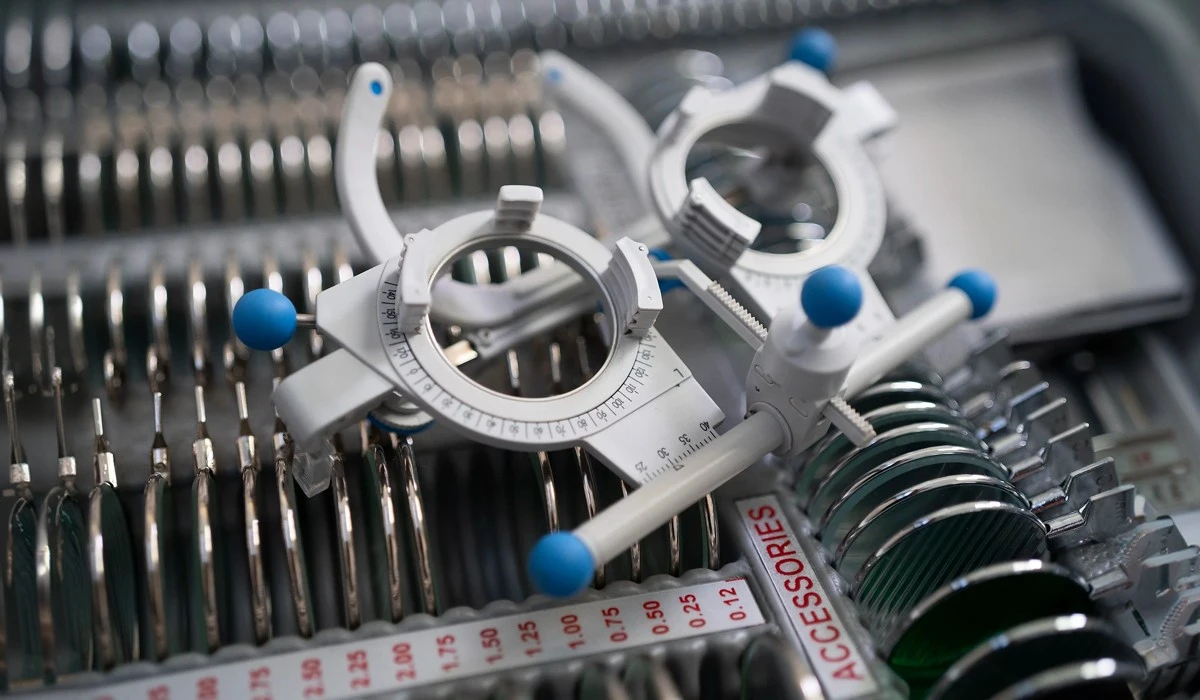
Perfect View: Spectacle Lens Fitting Standards
A doctor spends twenty minutes testing your eyes to find the perfect numbers. You leave the exam room feeling confident that your vision issues are solved. Then, you pick out a pair of frames that look great in the mirror. You wait a week, put them on, and everything feels wrong. The floor seems to tilt when you walk, or you get a dull headache within minutes.
A prescription serves as a set of instructions rather than a finished product. The person who bridges the gap between those numbers and your comfort is the one performing Ophthalmic Dispensing. If they miss a single millimeter in the alignment, the most expensive lenses in the world become useless.
Real vision occurs at the dispensing table rather than in the exam chair, where spectacle lens fitting standards turn a piece of plastic into a medical device. Developing expertise in this craft distinguishes a simple retail clerk from a true optical professional. Getting this right allows you to change how a person experiences the world instead of just selling glasses.
The Basic Principles of Modern Ophthalmic Dispensing
At its heart, this profession is about translation. A doctor measures what the eye needs, but the dispenser determines how the eye will actually use the lens. Historically, this started simply. In the 11th century, Ibn al-Haytham, known as the "Father of Modern Optics," proved that smoothed glass could assist vision. Since then, the field has grown into an advanced mixture of science and physical engineering.
Bridging the Gap Between Refraction and Wearability
The dispenser translates "doctor's orders" into a tangible, comfortable product. This requires a deep knowledge of lens geometry. As noted in an article by Mo Jalie for the Association of British Dispensing Opticians (ABDO), it is necessary for the optical axis of a lens to pass through the eye’s center of rotation. If the lens sits too high or too low, the light hits the eye at an angle. This creates a distortion that the brain struggles to ignore.
The Psychology of Frame Selection
Assessing patient lifestyle needs ensures the dispensed product meets daily functional requirements. A librarian needs a different setup than a professional tennis player. If a patient spends ten hours a day on a computer, the frame must support a lens with a wide intermediate zone. Ophthalmic Dispensing involves asking the right questions before ever picking up a ruler. You must match the frame's physical shape to the weight of the lenses required.
Why Spectacle Lens Fitting Standards Define Clinical Success

Precision is the only thing that matters when you are dealing with light. There is a very small margin for error, especially with high-index and aspheric lenses. International rules like ISO 21987:2017 exist to make sure every pair of glasses meets a specific quality level. These rules ensure the lenses are secure and the prescription is accurate across the entire surface.
How do spectacle lens fitting standards affect vision? According to the OptiCampus guide on ophthalmic optics, adhering to these standards ensures that the optical center of the lens aligns perfectly with the patient's visual axis to avoid inducing unwanted prism. When these standards are ignored, the patient might see "halos" or feel like they are looking through a fishbowl.
The Vision Council states that American standards, like ANSI Z80.1-2015, are even more specific, noting that for a lens between -6.50 D and + 6.50 D, the power must be within ± 0.13 D of the prescription. If you are off by more than that, the eye has to strain to clear the image. This strain leads to physical fatigue. Strict adherence to spectacle lens fitting standards removes the physical stress from the patient's visual system.
Expertise in Essential Measurements in Ophthalmic Dispensing
The most basic tool in the shop is the ruler, but it is also the most dangerous if used incorrectly. A fit that is "close enough" is usually a failure in disguise. To reach a high level of Ophthalmic Dispensing, move beyond the basics of measuring the distance between pupils.
Beyond the PD: The Importance of Monocular Centration
Binocular interpupillary distance (PD) is no longer enough for modern lenses. Most human faces are not perfectly symmetrical. One eye might sit two millimeters further from the nose than the other. If you use a single binocular measurement, you might split the error, but both eyes will still be looking through the wrong part of the lens. Monocular PD is mandatory to ensure the narrow corridor of a progressive lens aligns with the visual axis.
Vertex Distance and Its Effect on Effective Power
Vertex distance is the space between the back of the lens and the front of the eye. It changes how strong a lens feels. If you move a lens further away from the eye, a plus lens becomes stronger and a minus lens becomes weaker. Why is vertex distance important in lens fitting? Formula notes on Ophed.net mention that the formula Fe=F/(1-dF) is utilized to calculate the new power based on vertex distance, particularly when it deviates from the refracted position.
As explained in documentation from the Association of British Dispensing Opticians (ABDO), for prescriptions over ±7.00D, the "rule of thumb" is that a movement of 5mm will result in a change of 0.25DS in the effective power of the lens. If the doctor tested the patient at 12mm, but the frame sits at 15mm, the glasses will not work as intended.
The Geometry of Comfort: Pantoscopic Tilt and Wrap
Glasses are three-dimensional objects sitting on a moving, three-dimensional face. You cannot treat them like flat stickers. To follow spectacle lens fitting standards, you have to account for the angle of the frame.
Compensating for Pantoscopic Angle
Pantoscopic tilt is the way the bottom of the frame leans toward the cheeks. This tilt is necessary for a natural field of view, but it changes how the light passes through the lens. In the Association of British Dispensing Opticians (ABDO) "OA Corner" series, it is stated that for every two degrees of pantoscopic tilt, the vertical position of the optical center should be lowered by 1mm. If the frame tilts 10 degrees, the center must move down 5mm. Ignoring this creates an "induced cylinder," which makes the patient feel dizzy.
Managing Frame Wrap in Sports and Fashion Eyewear
Modern sports frames often wrap around the face. This curve is great for protection but terrible for optics. Research from IOT Lenses indicates that high-wrap frames induce unwanted prism and oblique astigmatism. The same study suggests that to address this, practitioners use "Position of Wear" (POW) digital compensation, where modern lens design technologies adjust the prescription based on how the frame actually sits. Without this, a person wearing wrap-around sunglasses might misjudge distances, which presents a danger during high-speed activities like cycling.
Troubleshooting Common Patient Non-Tolerance Issues
When a patient comes back saying they can't see, the dispenser becomes a detective. You have to find out if the problem is the doctor's prescription or the way the glasses were made. Research shows that while nearly half of the problems come from refraction errors, about 13.5% come directly from dispensing failures.
What causes peripheral distortion in new glasses? Peripheral distortion is often caused by incorrect base curves or improper alignment of the lens's optical center relative to the eye's rotation point. If the base curve of the new lens is much flatter than the old one, the patient will feel like the world is "warped."
You must also look for vertical imbalance. If one eye has a much higher power than the other, the patient will see double when they look down to read. According to a guide from Optical Training, bicentric grinding, commonly called slab-off, is needed to correct the vertical imbalance. It’s a detailed fix that requires complete expertise in spectacle lens fitting standards.
Digital vs. Manual Tools in Ophthalmic Dispensing
Technology has changed the dispensing table, but it hasn't replaced the need for human skill. We now have tablets and towers that take measurements to the tenth of a millimeter. These tools are incredible, but they are only as good as the person operating them.
The Precision of Digital Centration Systems
Digital systems take a "photo" of the patient wearing the frame. They calculate the tilt, the wrap, and the vertex distance all at once. This reduces human error in marking the lenses. These systems are especially helpful for sophisticated progressive lenses where the "reading zone" is very small. They ensure the patient doesn't have to tilt their head at an awkward angle just to read a text message.
Why Manual Verification Remains a Critical Skill
Research published in PMC notes that a skilled professional in Ophthalmic Dispensing must be able to verify digital results with a ruler and lensmeter, which is an instrument used to verify the prescription of spectacles. You cannot trust a machine blindly. Hand-checking every lens for internal strain using a device called a polariscope prevents vision issues. Adhering to spectacle lens fitting standards requires checking the work by hand before the patient tries them on.
Elevating the Patient Experience through Technical Proficiency
Gaining proficiency in the technical side ensures the business side follows. High technical proficiency leads to fewer "re-dos." Every time a patient has to come back because their glasses are wrong, you lose money and trust. Conversely, when a patient puts on a pair of glasses and sees perfectly for the first time, you gain a loyal customer for life.
Trust is built at the dispensing table. When you explain why you are measuring the tilt of their frame or why a certain lens material is better for their high prescription, you show authority. Instead of simply selling a product, you provide a clinical service. This commitment to the highest level of Ophthalmic Dispensing turns a routine purchase into a life-changing improvement in quality of life.
The Path to Optical Excellence
Expertise in this field is a path from basic measurements to total technical expertise. It requires a deep respect for the math and physics behind every lens. Every adjustment you make to a frame, and every measurement you take, serves a single purpose: visual clarity.
Ophthalmic Dispensing is the final, key step in eye care development. Without it, the best eye exam in the world remains merely numbers on a page. Consistent adherence to spectacle lens fitting standards serves as the ultimate service to the patient rather than being merely a technical requirement. When you get it right, you ensure they see the world exactly as it was meant to be seen.
Recently Added
Categories
- Arts And Humanities
- Blog
- Business And Management
- Criminology
- Education
- Environment And Conservation
- Farming And Animal Care
- Geopolitics
- Lifestyle And Beauty
- Medicine And Science
- Mental Health
- Nutrition And Diet
- Religion And Spirituality
- Social Care And Health
- Sport And Fitness
- Technology
- Uncategorized
- Videos

