
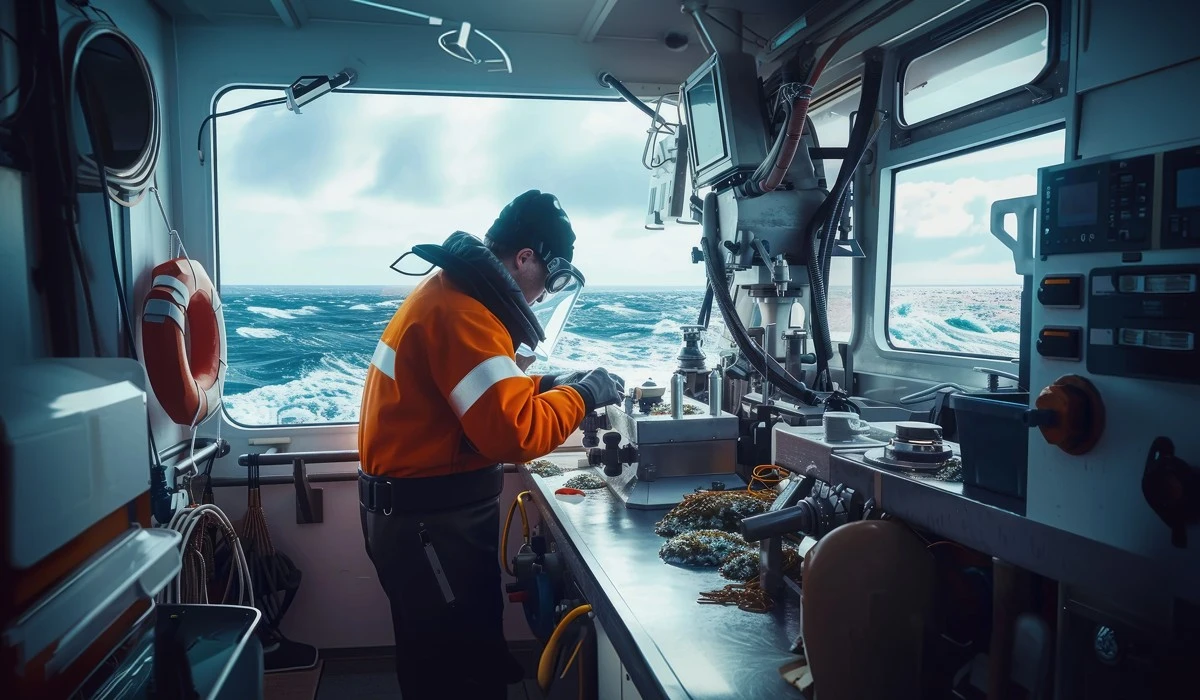
Ace Your Next Watch via New Nautical Science
Imagine standing on the bridge of a 100,000-ton container ship. It is 02:00, and you are slicing through the dark waters of the Singapore Strait. The hum of the massive engine vibrates through your boots. Hundreds of flickering lights crowd the horizon, each one representing a potential disaster if you make a single wrong move.
If you treat this job like a simple driving shift, you already face a dangerous disadvantage. Success in this high-stakes environment relies on Nautical Science. It provides the hard facts you need to manage a massive physical object against the raw power of the tide. You aren't just steering; you are balancing weight, water flow, and math.
To stay safe, you must perfect specific bridge watchkeeping procedures. These rules turn involved physics into repeatable actions. People often wonder: What is bridge watchkeeping in the merchant navy? It is the period of duty where a deck officer maintains an uninterrupted lookout and ensures the safe navigation of the vessel according to international regulations.
Understanding the Core Principles of Nautical Science
Every move a ship makes follows strict physical laws. Nautical Science combines ship stability, weather patterns, and navigation into one plan. If you don't understand how the water supports your hull, you cannot predict how the ship will react in a tight turn or a heavy sea.
The Intersection of Physics and Navigation
Ship stability depends on the relationship between the Center of Buoyancy and the Center of Gravity. Professionals look at the Metacentric Height (GM). If this value stays positive, the ship naturally returns to an upright position after a wave hits it. If you ignore these numbers, a heavy cargo load can turn a stable ship into a death trap.
Fluid dynamics also plays a massive role. Water moving around the hull creates pressure changes that pull or push the ship toward shallow banks. Skilled officers use this knowledge to anticipate "bank suction" before it drags the vessel off course.
Terrestrial and Celestial Navigation
Before satellites, sailors relied on the stars. According to the U.S. Naval Institute, the 1714 Longitude Act changed everything for the maritime industry. Research published by the Royal Museums Greenwich notes that this shift occurred when John Harrison developed the H4 marine chronometer to solve the problem of determining longitude at sea. Today, we still use the Marcq St. Hilaire method to check our position. This involves measuring the angle of a star and comparing it to a calculated point on a chart.
Even with modern GPS, these old skills save lives. Electronics fail during power surges or solar flares. Knowing how to use a sextant to find a Line of Position ensures you never wander blind across the ocean.
Precision in Executing Bridge Watchkeeping Procedures
A guide from the Oil Companies International Marine Forum (OCIMF) states that Standard Operating Procedures (SOPs) prevent accidents by ensuring compliance with the Safety Management System. They remove the guesswork from high-pressure situations. When every officer follows the same bridge watchkeeping procedures, the entire team knows exactly what to expect, even during a crisis.
The Handover Protocol
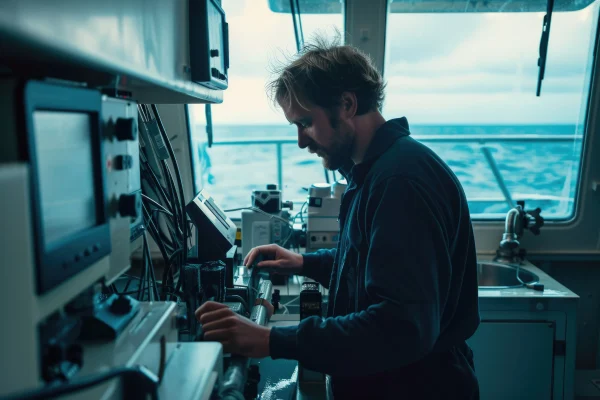
The "Before Taking Over the Watch" checklist is your first line of defense. You must arrive on the bridge early to adjust your eyes to the dark. STCW rules suggest waiting 20 to 30 minutes for full night vision. This allows you to spot the faint glow of a small fishing boat that radar might miss.
During the handover, you must verify the ship’s position, current speed, and any nearby hazards. Never sign the logbook until you feel 100% confident in the current situation. This simple moment of verification stops errors from passing from one shift to the next.
Maintaining a Proper Lookout
As mandated by the International Maritime Organization (IMO), COLREG Rule 5 requires a proper lookout by sight and hearing at all times. This means you cannot just stare at a screen. You must use your eyes, ears, and radar together. In thick fog, you should station a lookout at the very front of the ship to hear fog signals away from engine noise.
Effective bridge watchkeeping procedures help you manage your focus. Instead of "tunnel visioning" on one target, scan the entire horizon every few minutes. This habit ensures a stray jet ski or a floating container doesn't surprise you.
The Physics of Maneuvering: Nautical Science in Action
A ship does not move like a car. It slides, drifts, and sinks deeper into the water as it gains speed. Gaining knowledge of the Nautical Science behind these movements allows you to predict where the ship will be in ten minutes, not just where it is now.
Pivot Points and Turning Circles
As explained by Pilot Mag, when a ship moves forward at a steady speed, the "pivot point" sits about one-third of the way back from the bow. This creates a massive lever for the rudder to push against. If the ship starts moving backward, that pivot point shifts toward the stern, completely changing how the vessel turns.
What are the 4 main duties of an officer of the watch? The primary responsibilities include maintaining a safe lookout, navigating the vessel, avoiding collisions, and ensuring the safety of the crew and cargo. Keeping these duties in mind helps you apply physics correctly during every maneuver.
Environmental Influence on Heading
Wind and current constantly push the ship off its intended track. This is called set and drift. You must adjust your heading to compensate for these forces so the ship stays on the planned line. If a strong tide hits your side, the ship might point north while actually traveling northeast.
Proper bridge watchkeeping procedures require the calculation of the "squat effect." Research by John D. Fenton suggests that in shallow water, a ship actually sinks lower due to factors like ship speed and water depth. This is calculated using the square of your speed and the hull's block coefficient. Ignoring this math leads to grounding even in channels that look deep enough.
Advanced Technology Integration for Modern Watchkeepers
Modern bridges look like space centers. While these tools make life easier, they also create new risks. Technology should be used to support your eyes, not replace them. Over-reliance on screens leads to "sensor obsession," where an officer misses a real-world danger because the computer didn't beep.
Maximizing ECDIS and ARPA Effectiveness
The Electronic Chart Display and Information System (ECDIS) is a powerful tool. A report by North Standard states that you must set your safety contours based on the ship's draft and the required under-keel clearance. If you set the alarm too shallow, you won't get a warning before hitting a rock.
The Automatic Radar Plotting Aid (ARPA) tracks dozens of targets at once. It tells you the Closest Point of Approach (CPA) and the time you have left before a collision. If you set these alarms to two miles and fifteen minutes, you will have enough time to make a bold, safe move.
AIS and VHF Communication Limits
The Automatic Identification System (AIS) shares your name and speed with other ships. However, as noted by Comar Systems, AIS relies on VHF radio waves, which move in straight lines, meaning buildings or big mountains can block these signals and reduce the range.
Never rely solely on VHF radio to avoid a collision. Talking to another ship takes time and can lead to confusion. Instead, use the physical laws of Nautical Science and the COLREG rules to take clear, early action that the other ship will see on their radar.
Navigating Regulatory Standards and Nautical Science Compliance
The law on the ocean is not a suggestion. International treaties like STCW and SOLAS provide the legal backbone for every decision you make. These laws ensure that every sailor on the water follows the same safety standards, regardless of their home country.
The Role of the Master’s Standing Orders
The Captain, or Master, provides specific instructions called Standing Orders. A circular from ClassNK emphasizes that it is the duty of the Master of every vessel to ensure that watchkeeping arrangements are adequate for maintaining a safe navigational watch at all times. These orders refine general bridge watchkeeping procedures for that specific ship and voyage. They tell you exactly when to call the Captain, such as when visibility drops below two miles or if traffic gets too heavy.
Which STCW chapter deals with watchkeeping? As detailed by the Australian Maritime Safety Authority (AMSA), Chapter VIII of the STCW Convention provides the mandatory standards regarding watchkeeping zones and principles to be observed. Adherence to these standards keeps you legally protected and ensures the ship stays within international safety requirements.
Logbook Entries and Legal Accountability
Your logbook is a legal document. In the event of an accident, lawyers will scrutinize every word. You must record the ship’s position, the weather, and any changes in speed or course with total accuracy. Precise documentation proves that you followed all necessary bridge watchkeeping procedures and acted as a professional officer.
Skilled Communication and Bridge Team Management
Even the smartest officer can fail if the team doesn't talk. Bridge Team Management (BTM) focuses on the "human element." It ensures that everyone from the helmsman to the Captain shares the same mental map of the situation.
Closed-Loop Communication Techniques
According to guidelines from the OCIMF, always use closed-loop communication to prevent mistakes, which involves the officer giving an order and the helmsman repeating it back. For example, when the officer says, "Port ten," the helmsman repeats, "Port ten." The officer then confirms with "Correct."
The Nautical Institute also suggests that this method is one of the most vital bridge watchkeeping procedures because it removes doubt by ensuring orders are well understood. In a loud, windy environment, clear and repeated orders ensure the ship moves exactly how the officer intends.
Challenge and Response Culture
A good bridge team encourages everyone to speak up. If a junior officer sees a shallow spot on the chart that the Captain missed, they must feel safe saying something. We call this the PACE model: Probe, Alert, Challenge, and Emergency.
Instead of staying silent, the junior officer might say, "I notice our heading is drifting toward that buoy." This keeps the team sharp. It creates a safety net where every person on the bridge actively guards the ship against error.
The Evolution and Future of Nautical Science
The maritime world is changing fast. We are moving toward ships that can almost sail themselves. However, the core of Nautical Science remains the same because the physics of the ocean does not change.
AI-Assisted Decision Support Systems
New computers can now suggest the best way to turn to avoid five different ships at once. These systems use data-driven logic to support the officer of the watch. They don't replace the human; they just provide better information to help the human make a choice.
The next generation of Nautical Science will focus on "Degree 1" autonomy. Here, the ship provides options, but the officer still makes the final call. This combines the speed of a computer with the intuition and experience of a trained mariner.
Lifelong Learning for the Modern Mariner
To stay relevant, you must practice in simulators. These high-tech rooms let you experience typhoons and engine failures without any real danger. Constant training keeps your bridge watchkeeping procedures fresh.
Technology will continue to evolve, but a ship still has a pivot point and still reacts to the tide. If you stay curious and study new tools, you ensure that you remain the commander of your vessel, no matter how many gadgets the ship carries.
Commanding the Horizon
The ocean does not care about your intentions; it only responds to your actions. Aced watches involve showing up on time as well as showing a deep respect for Nautical Science and a disciplined approach to every task. When you apply these principles, you transform from a passenger into a true navigator.
Every successful voyage is a win for precision over chaos. Through the use of strict bridge watchkeeping procedures, you protect your crew, your cargo, and the environment. You become the final barrier against disaster in an environment that is always moving.
Stay vigilant and continue to learn. The sea is a powerful teacher, but with the right science and the right habits, you can command any horizon. Keep your eyes on the water and your mind on the math.
Recently Added
Categories
- Arts And Humanities
- Blog
- Business And Management
- Criminology
- Education
- Environment And Conservation
- Farming And Animal Care
- Geopolitics
- Lifestyle And Beauty
- Medicine And Science
- Mental Health
- Nutrition And Diet
- Religion And Spirituality
- Social Care And Health
- Sport And Fitness
- Technology
- Uncategorized
- Videos

