
Geothermal Power As The UK’s Infinite Battery Era
Most renewable energy relies on a lucky weather forecast, but the ground beneath our feet burns with constant heat regardless of the season. While solar panels sit useless at night and wind turbines freeze on calm days, the Earth’s core operates like a permanent engine that never shuts down. This week, the UK finally tapped into this relentless power source.
After fifteen years of drilling through solid rock, the country’s first deep geothermal power plant has officially introduced in Cornwall. This project changes the rules of clean energy. We can look three miles down rather than looking up at the sky for a solution to the energy crisis. Beyond generating electricity, the plant has stumbled upon a massive source of lithium, a dangerous mineral for modern batteries. This dual discovery suggests that the answer to energy independence was buried under British soil the entire time.
The Granite Battery Beneath Cornwall
Rocks naturally hold onto heat like a thermos, turning the ground into a massive storage unit that stays hot for millions of years. This heat arises from the rock itself rather than the sun. In Cornwall, the granite is special. It contains tiny amounts of uranium, potassium, and thorium. As these elements decay over time, they release energy.
This process acts like an "inverse nuclear power station." The heat remains trapped inside the granite because the rock is an excellent insulator. Over centuries, the temperature rises to extreme levels. This specific site sits on the Porthtowan Fault Zone, a geological area perfectly suited for heat extraction.
Drilling Into the Heat
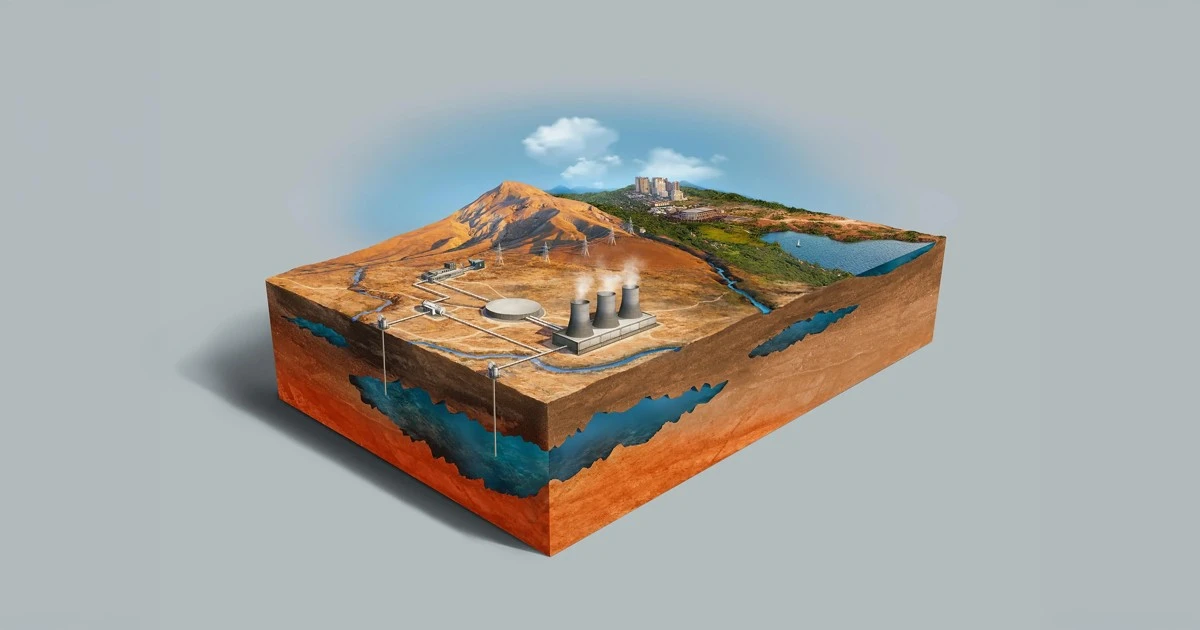
To access this energy, engineers drilled deeper than any previous project in the UK. A report by the London School of Economics notes that the £50 million site features the deepest drilling project in the country, to a depth of more than 3 miles underground. Data published by Stanford University shows the facility operates a geothermal doublet system, with a 5,275-metre production well and a 2,393-metre injection well. At these depths, temperatures exceed 190°C — the highest ever documented in the UK.
These two wells work together to circulate water through the hot rock. The result is a system that accesses a vast, untapped resource. While other countries like Indonesia and the US have used this technology for years, the UK is only now catching up.
Solving the Weather Problem
Reliance on the weather creates a dangerous gap in the power grid that vanishes when the fuel source lives underground. The biggest criticism of green energy is usually reliability. Solar needs sun. Wind needs a breeze. When those things disappear, the grid has to burn gas or coal to keep the lights on.
Deep geothermal power eliminates this variability. It provides "baseload" power. This means it runs 24 hours a day, 7 days a week. It is "always-on." Ryan Law, the CEO of Geothermal Engineering Ltd (GEL), emphasizes this stability. He points out that unlike renewables dependent on the weather, this plant offers constant output. It creates a safety net for the national grid.
Stability in a Volatile Market
This stability applies to money as well as electricity. Gas prices fluctuate wildly based on global politics and supply chains. Geothermal energy creates immunity to these price spikes. Once the plant is built, the fuel is free and local.
Is geothermal energy renewable?
Yes, the heat from the Earth's core is effectively limitless and naturally replenished over time through radioactive decay.
This makes it a secure domestic energy source. The Octopus Energy spokesperson confirmed this major change. For the first time, the UK has access to perpetual green power that does not require importing fuel from other nations.
The Accidental Lithium Goldmine
Sometimes digging for one resource reveals a second treasure that completely changes the economics of the project. The primary goal of the Cornwall plant was always electricity. However, as noted by LSE, when the team tested the water brought up from the deep wells, tests revealed that the fluid contained elevated lithium levels, suitable for producing zero-carbon lithium carbonate.
Lithium is a critical component in electric vehicle (EV) batteries. The Cornish wells show concentrations exceeding 340 parts per million (ppm) — among the highest levels recorded globally.
A Dual-Purpose Facility
Ryan Law admitted that finding this much lithium was "luck rather than design." But this luck has massive implications. Reporting by ITV News confirms that the facility will produce lithium for car batteries and is anticipated to generate zero-carbon lithium carbonate. This is sufficient to build 1,400 EV batteries every year from the initial output alone.
Demand for lithium in the UK is forecast to increase by 12 to 45 times by the 2020s. Usually, getting lithium involves environmentally damaging mining or huge evaporation ponds. Here, the lithium is dissolved in the same water used to produce electricity. The facility separates the mineral before reinjecting the water back underground. It creates a clean, domestic supply chain for the car industry.

How Deep Geothermal Power Actually Works?
You don’t need to burn fuel to make steam when the Earth is already boiling water for you. The engineering behind the plant is difficult, but the concept is simple. It uses the natural fractures in the granite to act as a heat exchanger.
The process starts by pumping cold water down the injection well. This water travels through the cracks in the hot granite. As it moves through the rock, it absorbs the intense heat stored there. The pressurized, superheated water then shoots back up the manufacture well to the surface.
From Water to Wire
Once the hot water reaches the surface, it runs through a heat exchanger. The heat is transferred to a secondary fluid that boils at a lower temperature. The steam from this secondary fluid spins a turbine, creating electricity.
How does geothermal energy work?
It works by sending water deep underground, where it absorbs heat from hot rocks, and then bringing it back to the surface to drive turbines that generate electricity.
Once the heat has been extracted, the water cool off to around 55°C — a temperature that is well suited to lithium extraction. After the lithium is separated, the water is reinjected underground to be reheated. The entire system operates as a closed loop, meaning no water is lost in the procedure.
The High Cost of Digging Deep
Free fuel usually requires an incredibly expensive entry ticket that scares away most investors. The biggest barrier to geothermal adoption is the upfront cost. Drilling miles into the Earth is technically demanding and financially risky.
The total price of the project so far is £50 million. A massive chunk of this money goes strictly to drilling. In fact, Drilling represents over half of the project’s total capital expenditure (CAPEX). Gas plants are cheap to build but expensive to fuel, whereas geothermal plants are expensive to build but cheap to run.
The Struggle for Funding
Ryan Law described the development phase as “1.5 decades of struggle.” For years, investors were wary. The resource had not been proven in the UK, and banks tend to favour safer investments — drilling deep wells in Cornwall was widely seen as a risk.
The project ultimately stayed afloat with £15 million from the European Development Fund and backing from private investors. The UK government later contributed a £1.8 million grant, covering half the cost of the lithium extraction facility. Even so, industry leaders maintain that greater government support will be essential to reduce risk and unlock future projects.
What are the disadvantages of geothermal energy?
The upfront cost of drilling is extremely high, and there is a small risk of triggering minor earthquakes. While minor seismicity is a known risk, the Cornwall site has managed it effectively. A previous project in Basel, Switzerland, was halted due to earthquakes, but the geology here is different, and monitoring is strict.
A Small Footprint for Massive Output
Massive energy production usually eats up huge amounts of land, but digging vertically bypasses the need for sprawling fields. Solar farms require thousands of acres. Wind farms dominate horizons. Deep geothermal power keeps a low profile.
Covering just 0.6 hectares (around 1.5 acres), the Cornwall site occupies a remarkably small area. Despite its compact footprint, Enlit World reports that the facility has secured a power purchase agreement with Octopus Energy to supply electricity to roughly 10,000 homes. In terms of land use, it is exceptionally efficient.
Efficiency by the Numbers
When you compare land use per gigawatt-hour (GWh) of energy, the difference is stark.
- Geothermal: 404 square meters per GWh.
- Wind: 1,335 square meters per GWh.
- Coal: 3,632 square meters per GWh.
The environmental advantages extend to carbon emissions as well. The plant emits approximately 45g of CO2 per kWh. This amounts to under 5% of the emissions generated by coal-fired power.
Water usage is also minimal at 20 liters per MWh, compared to over 1,000 liters for nuclear or coal. It creates huge amounts of energy with very little physical effect on the countryside.
Reviving the Cornish Economy
A region defined by what it pulled from the ground in the past now finds its future by returning to the same soil. Cornwall has a long history of mining. For centuries, it was the tin and copper capital of the world. When the mines closed, the region suffered economically.
This new project brings high-skilled jobs back to the area. The plant has created around 100 roles for engineers, geologists, and chemists. It signals a shift toward "securonomics"—the idea that a country should control its own essential resources.
A New Identity
Perran Moon, the local MP, stated that mining is integral to the Cornish identity. This project honors that history while modernizing it. The region is now leading the way in green technology rather than sending men underground to hack at coal.
Lord Whitehead, the UK’s newly appointed Geothermal Minister, called this a historic milestone. It verifies that Cornwall is not just a place for tourism; it is a hub for national innovation. The success here could encourage more drilling across the granite-rich southwest.
The Ground Beneath Us
We often look for difficult solutions to energy problems while standing directly on top of the answer. The unveiling of this plant proves that the heat underneath the UK is a viable, powerful resource. It offers a way to keep the lights on without polluting the air or waiting for the wind to blow.
The mixture of deep geothermal power and lithium extraction turns a single facility into a dual engine for the future. It powers homes today and builds the batteries for tomorrow's cars. After fifteen years of hard graft, the results show that the most reliable energy source lies in the rock rather than the clouds.
Recently Added
Categories
- Arts And Humanities
- Blog
- Business And Management
- Criminology
- Education
- Environment And Conservation
- Farming And Animal Care
- Geopolitics
- Lifestyle And Beauty
- Medicine And Science
- Mental Health
- Nutrition And Diet
- Religion And Spirituality
- Social Care And Health
- Sport And Fitness
- Technology
- Uncategorized
- Videos

